

ADA Space Signs Deal With SenseTime for Computing Satellites
Up to 1,000 satellites could be made for one of China's leading artificial intelligence firms.

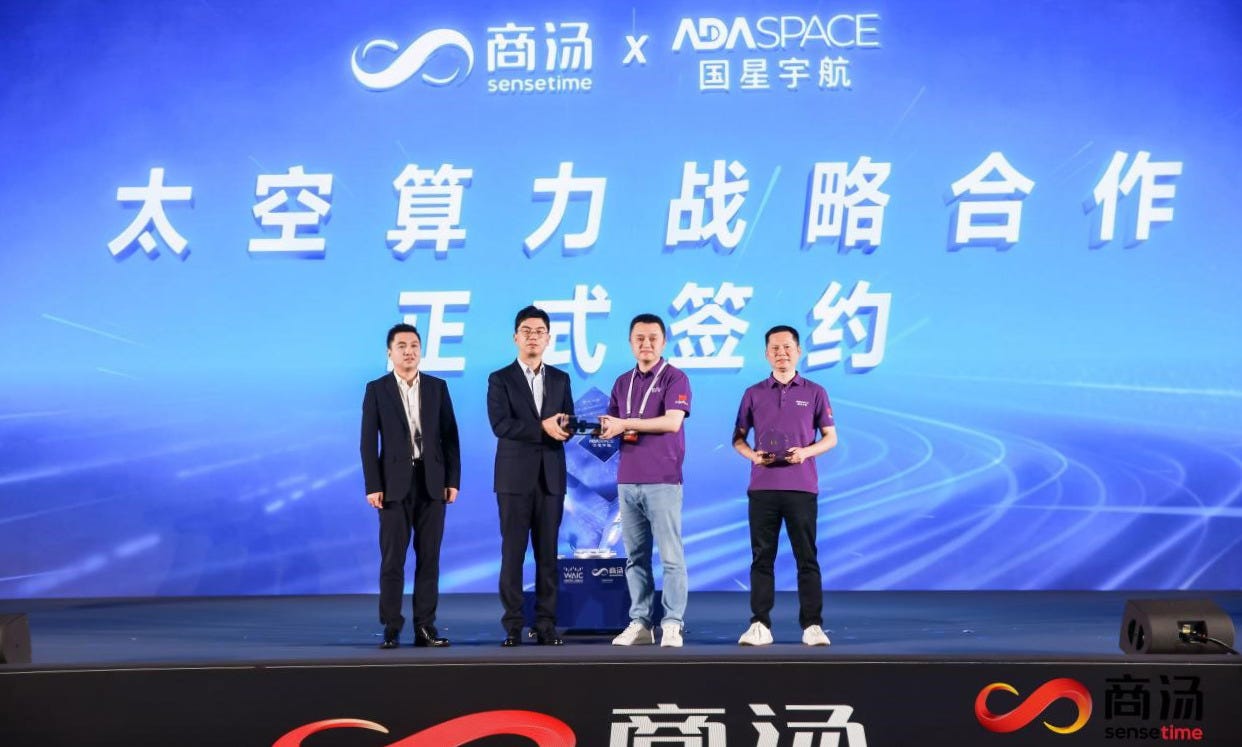
Operator of China and the world’s only space-based computing constellation, ADA Space (国星宇航), announced on July 18th that they have signed a deal with SenseTime (商汤科技)1, one of the nation’s leading artificial intelligence and computer vision firms, at the 2026 World Artificial Intelligence Conference (2026世界人工智能大会)2.
According to ADA Space, its teams will work with SenseTime to establish an ‘orbit and Earth’ computing infrastructure using their proven capabilities through satellites currently in orbit. As part of the deal, SenseTime will receive dedicated spacecraft with ‘high-performance, autonomous, and controllable’ compute that have access to significant amounts of storage to allow for several artificial intelligence solutions to run in space simultaneously.
Without providing much detail, the two companies’ plans to have an initial small ‘SenseTime Space Computing Constellation (商汤太空算力星座)’ deployed by year’s end. That will then be followed by enough satellites for the ‘orbit and Earth’ infrastructure in 2028, and then up to 1,000 satellites in orbit by 2030.
The deal for the many satellites was signed by Yang Fan (杨帆), Co-Founder of SenseTime, and Tan Xinglin (谭兴林), ADA Space’s Executive Vice President. Xu Li (徐立), Chief Executive Officer of SenseTime, oversaw the signing alongside Lu Chuan (陆川), Founder and Chairman of ADA Space.
Through having their own computing satellites, SenseTime is exploring diversifying its compute hubs, with work commenced on a new data center in Hong Kong (香港) last month and opened another in 2022 in Shanghai (上海市) under a generative artificial intelligence push. Part of the rationale, according to Yang Fan, was shared as:
“In environments with weak network coverage, such as emergency disaster relief, ocean-going vessels, and wilderness operations, space-based computing power can effectively fill in the gaps in terrestrial coverage. Its value extends beyond breaking through capability boundaries; it also serves as the infrastructure that supports the global expansion of China’s AI capabilities and is poised to significantly increase the reach of domestically developed AI services overseas.”
If there are any problems with this translation please reach out and correct me.
Having compute in space also supports corporate sustainability aims, as the only linked pollution would come from spacecraft production, launch to orbit, and end-of-life decommissioning into Earth’s atmosphere.
With SenseTime looking to have up to 1,000 satellites, ADA Space’s own Three-Body Computing Constellation may have to slow its deployment of 2,800 satellites, which is used by multiple enterprise customers, like Alibaba Cloud (阿里云) and Shanghai Jiao Tong University (上海交通大学). And as of recent weeks, a cohort of intelligent automotive vehicle entities, through a new agreement, for exploring and supporting improvements in that field.
This year, ADA Space has significantly expanded its partnerships through strategic signings with technology giant Tencent (腾讯) and the Shanghai Meteorological Bureau (上海市气象局), among others.
Efforts with the Three-Body Computing Constellation so far have seen ADA Space receive praise from the International Telecommunications Union at the AI For Good 2026 Summit. That was for empowering intelligent cities and their claimed open source solution-hosting platforms.
Specifically the Shanghai SenseTime Technology Development Co Ltd (上海商汤科技开发有限公司) entity.
Hosted in Shanghai from July 17th to 20th.