

CAS Space Tests New Engines to Upgrade Kinetica-2 Rocket
Kinecore-2 will allow the vehicle to reuse its first-stage, while Kinecore-4 is set to enable missions beyond Earth orbit.

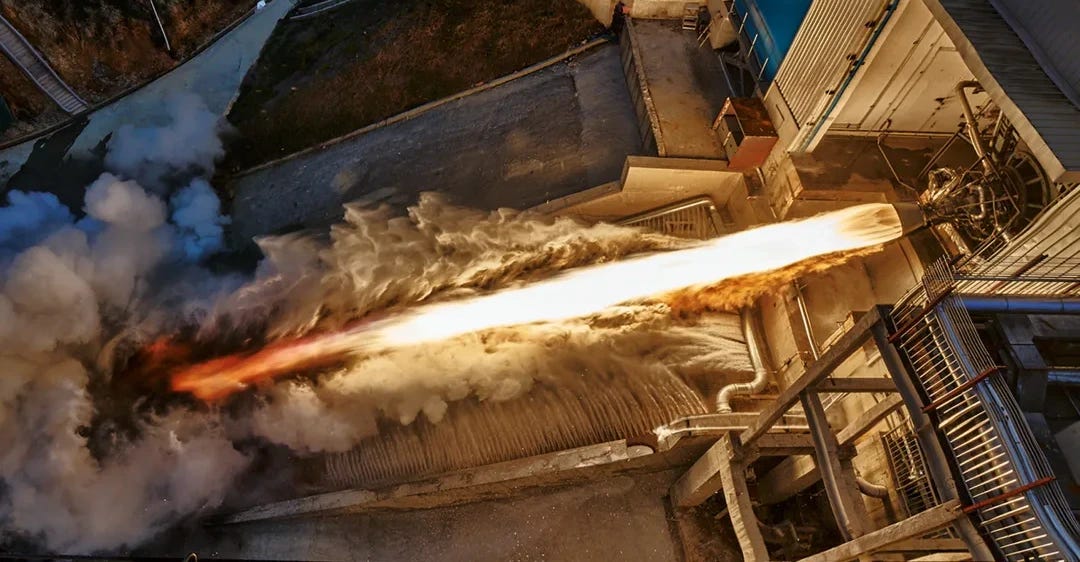
In the coming weeks, CAS Space’s tri-core Kinetica-2 launch vehicle will perform its first mission, placing the Qingzhou (轻舟) cargo spacecraft into orbit as part of a demonstration flight. The debut flight of the vehicle will utilize the off-the-shelf YF-102 engines to bring in proven reliability, however CAS Space is already looking to improve Kinetica-2’s capabilities via its own engines.
At the company’s firing center in Conghua (从化区)1, the rocket-grade kerosene and liquid oxygen burning Kinecore-2 (力擎二号) fired up for a 110-ton thrust test, detailed by CAS Space on March 13th. That saw the engine fire up a few times with a cumulative burn time of 420 seconds (7 minutes), while demonstrating its maximum burn time of 200 seconds (3 minutes and 20 seconds).
With the recent firings of Kinecore-2, the company stated that they have verified their mastery of the engine’s injector and pump systems to achieve multiple startups. The recent firings of are also said to have brought the total firing times of Kinecore-2 engines to over 3,000 seconds (50 minutes), allowing CAS Space to move towards improving and verifying its reliability2.

Several missions into Kinetica-2 operations, the Kinecore-2 engine is planned to be introduced to enable the reuse of the vehicle’s three-core first-stage, which is planned to land as a single unit. First-stage reuse is currently scheduled to be part of Kinetica-2 flights from 2028 onward.
A few days after their last test, CAS Space shared a progress update on Kinetica-2’s optional third-stage, on March 18th, thanks to recent firings of the storable propellant-burning Kinecore-4 (力擎四号) engine, generating 2 tons of thrust, and small attitude control thrusters. Once developed, the stage will boost payloads on a geostationary transfer orbit or into deep space.
Building off of September 2025 firings, recent testing saw Kinecore-4 igniting eighteen times, with a longest burn of 100 seconds (1 minute 40 seconds) and a total firing time of 480 seconds (8 minutes), to prove its high and low thrust operation with flight-like demonstration firings. Those tests also validated new mass savings of up to fifteen kilograms alongside composite ceramic and 3D printed components.
As for the attitude control thrusters for the third-stage3, CAS Space said that recent tests were to understand their limits of operation. Those limits were about 300 seconds (5 minutes) of continuous firing with regular startups. One thruster performing those tests was stated to have fired for 3,235 seconds (53 minutes and 55 seconds) cumulatively through over eight thousand five hundred ignitions.
Located administratively with Guangzhou (广州市), Guangdong (广东) province.
Early tests of the engine’s systems began in January and February 2025.
Used to change its orientation in orbit and provide ullage to settle propellants for the Kinecore-4 engine.