

China's Reusable Spaceplane Departs Jiuquan to Begin Fourth Mission [Long March 2F/T]
The anonymous Reusable Experimental Spacecraft has entered low Earth orbit again, where it will operate for many weeks.

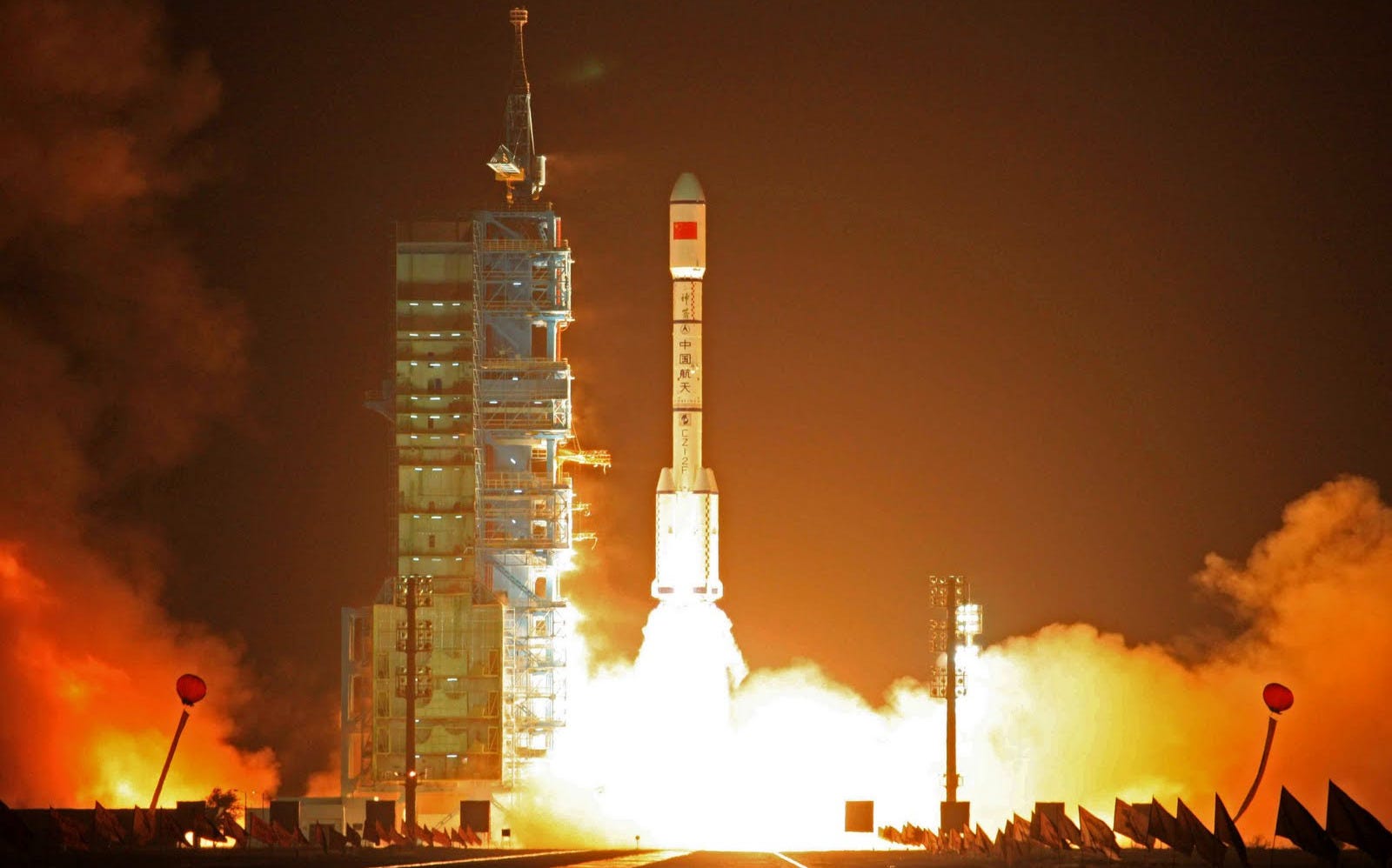
Between 11:48 am and 12:07 pm China Standard Time (03:45 and 04:07 am Universal Coordinated Time) on February 7th, a Long March 2F/T launch vehicle lifted off from Launch Site 91 at the Jiuquan Satellite Launch Center, carrying an advanced spacecraft into low Earth orbit.
Onboard the launch vehicle was China’s spaceplane-shaped Reusable Experimental Spacecraft (可重复使用试验航天器), beginning its fourth mission to date. It follows a two-day flight in September 2020, a 276-day mission between August 2022 and May 2023, as well as a 266-day orbital voyage from December 2023 to September 2024.
While in orbit, the spaceplane will perform experiments for items stored onboard along with those of its own systems. Small independent satellites may be released from it for conducting novel rendezvous and proximity operations, as well as other technology tests. Details for the mission published by Xinhua stated:
“The experimental spacecraft will conduct planned technical verification of reusable spacecraft technology, providing technical support for the peaceful use of space.”
If there are any problems with this translation please reach out and correct me.
In many, many weeks or months, the Reusable Experimental Spacecraft will return to Earth with a landing at an airfield in Lop Nur (罗布泊 / لوپنۇر), Xinjiang Uygur Autonomous Region (新疆维吾尔自治区 / شىنجاڭ ئۇيغۇر ئاپتونوم رايونى).
With this launch, the Jiuquan Satellite Launch Center’s Long March 2F series facilities can shift to solely working on upcoming crewed missions, with both of the launch vehicle assembly buildings’ bays focused on Shenzhou-23 and Shenzhou-24. That includes further preparing the recently delivered spacecraft and launch vehicle for the Shenzhou-23 mission, restoring ‘emergency response’ launch capabilities if needed.
Today’s launch was the 28th for the Long March 2F series, and the 630th launch of the Long March launch vehicle series. This was also the 9th launch from China in 2026.
Check out the previous Long March 2F launch
'Emergency Response' Shenzhou-22 Successfully Launched to Tiangong [Long March 2F/G Y22]
!['Emergency Response' Shenzhou-22 Successfully Launched to Tiangong [Long March 2F/G Y22]](https://substackcdn.com/image/fetch/$s_!gAuU!,w_1300,h_650,c_fill,f_webp,q_auto:good,fl_progressive:steep,g_auto/https%3A%2F%2Fsubstack-post-media.s3.amazonaws.com%2Fpublic%2Fimages%2Ff92c655c-5e61-497c-885e-cb3c524fd697_1700x849.jpeg)
Blasting off at 12:11 pm China Standard Time (04:11 am Universal Coordinated Time) on November 25th from Launch Area 4 at the Jiuquan Satellite Launch Center, a Long March 2F/G carried the replacement un…
What is the Long March 2F?
This section is for those less familiar with China’s Long March series of launch vehicles.
The Long March 2F is the only human-rated launch vehicle currently active in China, with it developed by the China Academy of Launch Vehicle Technology. Two versions of the launch vehicle are currently active, the 2F/G and 2F/T. The Long March 2F/G launches the Shenzhou spacecraft, while the 2F/T launches China’s reusable spaceplane and did launch the first two Tiangong space stations. All versions of the Long March 2F have had the boosters, first, and second-stage burn Dinitrogen Tetroxide and Unsymmetrical Dimethylhydrazine.
The payload capacity of the launch vehicle is currently as follows:
8,400 kilograms to low Earth orbit with Shenzhou’s abort systems
8,600 kilograms to low Earth orbit with a 4.2-meter-wide fairing
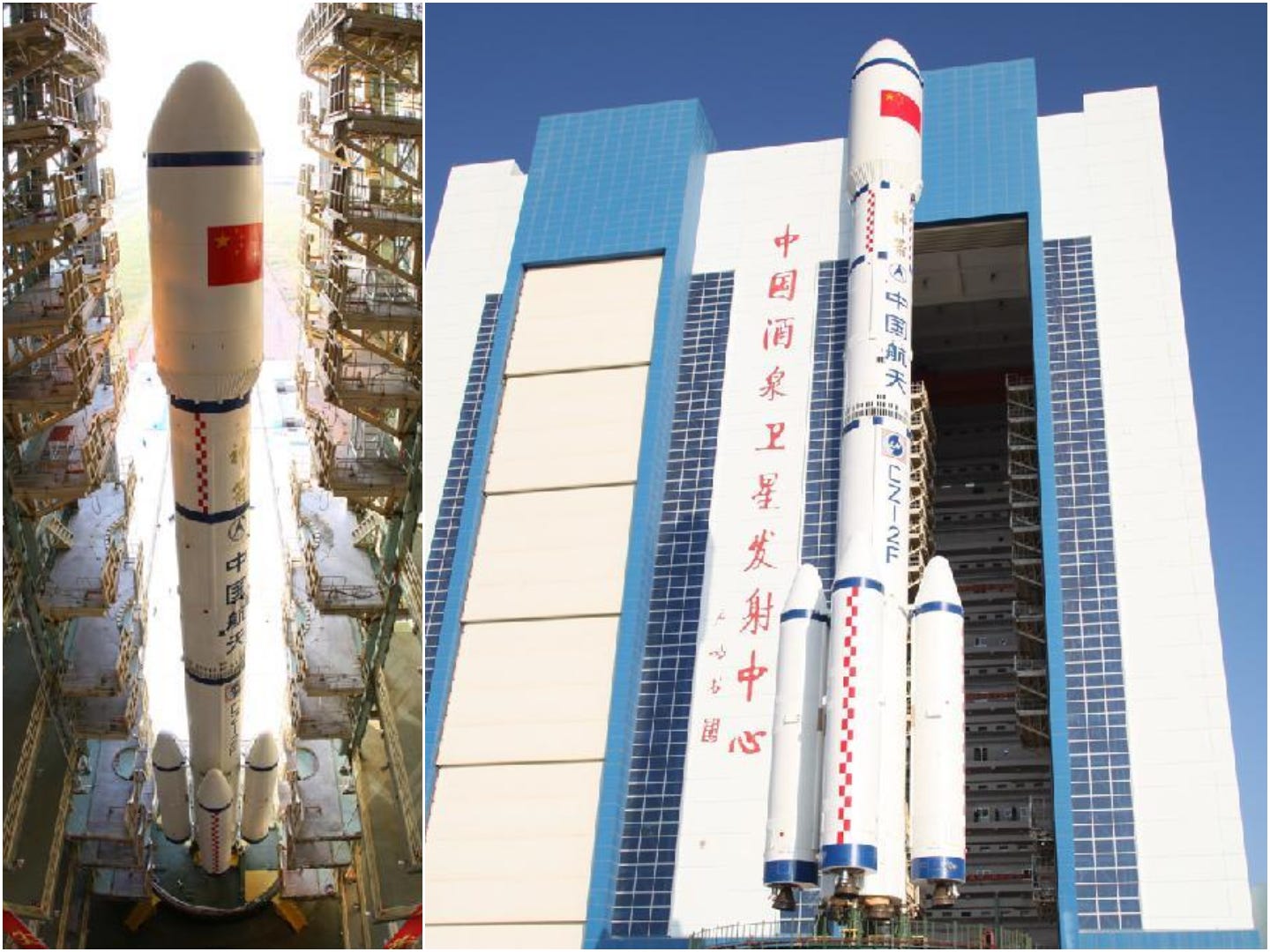
Powering the first-stage are four YF-20B engines generating a combined 332 tons of thrust, burning Dinitrogen Tetroxide and Unsymmetrical Dimethylhydrazine. Augmenting the thrust of the first-stage are four boosters, each powered by one YF-20B, each generating 83 tons of thrust each for a combined booster thrust of 332, while also burning Dinitrogen Tetroxide and Unsymmetrical Dimethylhydrazine. The combined thrust of the first-stage and four boosters is 664 tons of thrust. The second-stage of the vehicle is powered by one YF-24B generating 85 tons of thrust, once again burning Dinitrogen Tetroxide and Unsymmetrical Dimethylhydrazine.
On the launchpad, the Long March 2F is 62 meters tall, with the Shenzhou spacecraft’s launch escape system, and weighs 464,000 kilograms when fully fuelled. The first and second stages have a diameter of 3.35 meters, with the four boosters having a diameter of 2.3 meters, and the Shenzhou spacecraft’s protective fairing has a maximum diameter of 3.6 meters.
So far, the Long March 2F has only flown from the Jiuquan Satellite Launch Center, in the west of the Inner Mongolia Autonomous Region and the north of Gansu province.