

China's Reusable Spaceplane Quietly Progressing With Mission
With over four months spent in orbit for the fourth mission, research and technology verification has been ongoing, along with the release of a satellite.

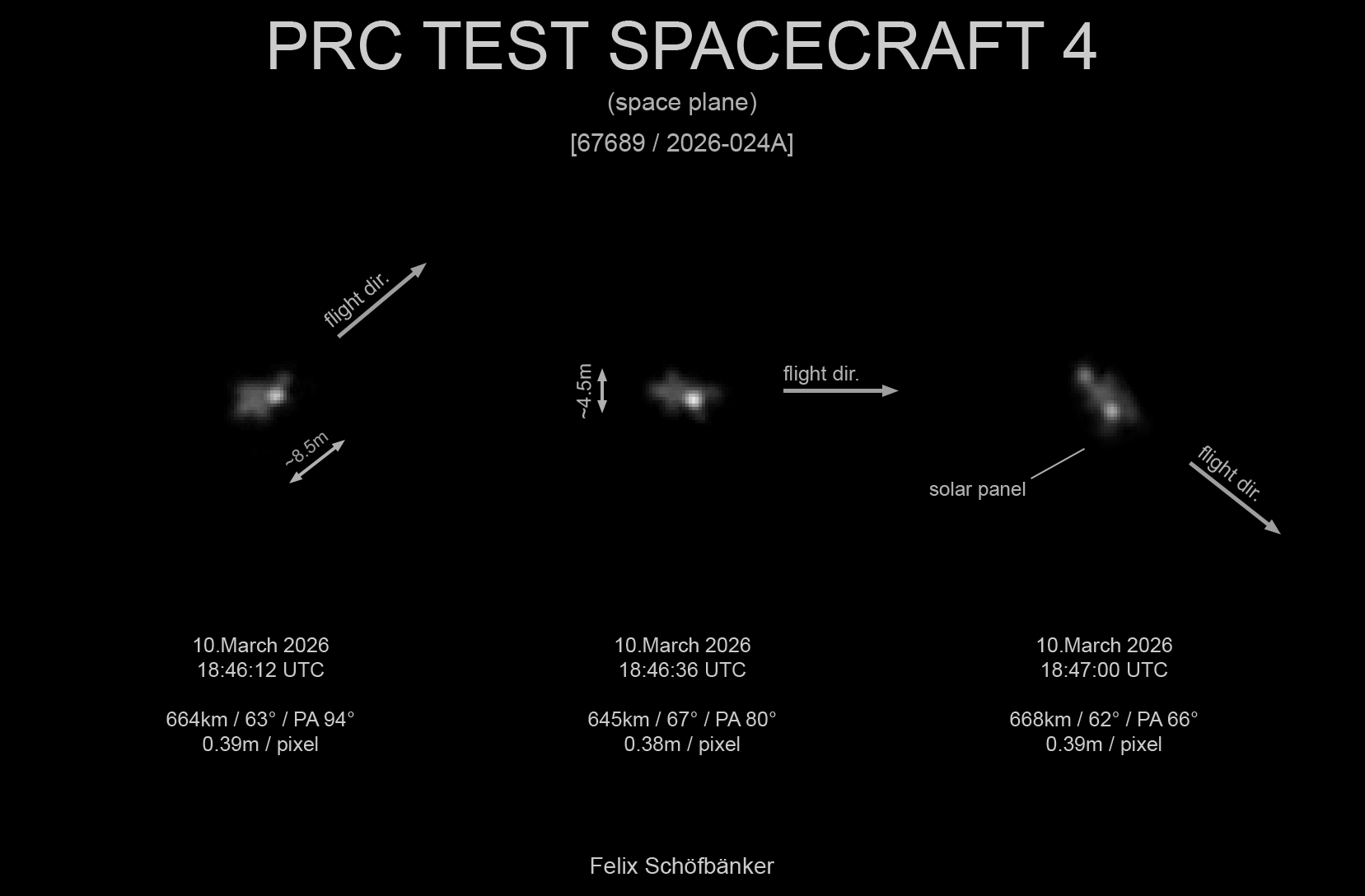
Launched back on February 7th atop of a Long March 2F from the Jiuquan Satellite Launch Center, China’s spaceplane-shaped Reusable Experimental Spacecraft (可重复使用试验航天器) has been quietly been residing in low Earth orbit for its fourth mission, being watched from below too.
According to tracking data, the mission commenced in a 344 by 590 kilometer 50-degree inclined orbit after separation from the launch vehicle’s second-stage. That orbit was used to perform systems checks of the spaceplane, verifying it did not need to return to Earth soon1, before it moved up to a 588 by 597 kilometer orbit on February 12th.
In that higher orbit, the spaceplane began its main mission of supporting research items and experimental technologies onboard to verify them in the microgravity environment. It’s unclear how many items are stored onboard or who they are from.
Around June 22nd, the spaceplane released a satellite it had been storing since its launch, according to the U.S.-based LeoLabs. The satellite, probably small in size and mass due to the spaceplanes believed design, has stayed about 1,000 meters away for the past few days.


The recently released satellite will likely perform joint technology verifications with the spaceplane. That may include the spaceplane positioning itself to be thoroughly imaged by the satellite or moving in a coordinated manner. Alternatively, the satellite could depart for a separate task in the near future.
The fourth mission follows a two-day flight in September 2020, a 276-day mission between August 2022 and May 2023, as well as a 266-day orbital voyage from December 2023 to September 2024. Satellites have been released by the first two missions as well.
In the coming weeks or months, the Reusable Experimental Spacecraft will continue to perform its tasks before returning to Earth with a landing at an airfield in Lop Nur (罗布泊 / لوپنۇر), in the Xinjiang Uygur Autonomous Region (新疆维吾尔自治区 / شىنجاڭ ئۇيغۇر ئاپتونوم رايونى). Indications of when the mission may end will be detailed via the filing of airspace restrictions, followed by an official news bulletin later on.

The need to do so would be if any systems were sending abnormal data that required fixes only available on Earth.