

Commercial Sea Launch Lofts Four Internet of Things Satellites [Ceres-1S Y7]
Galactic Energy has returned its Ceres-1 series to flight via a sea launch mission near Rizhao.

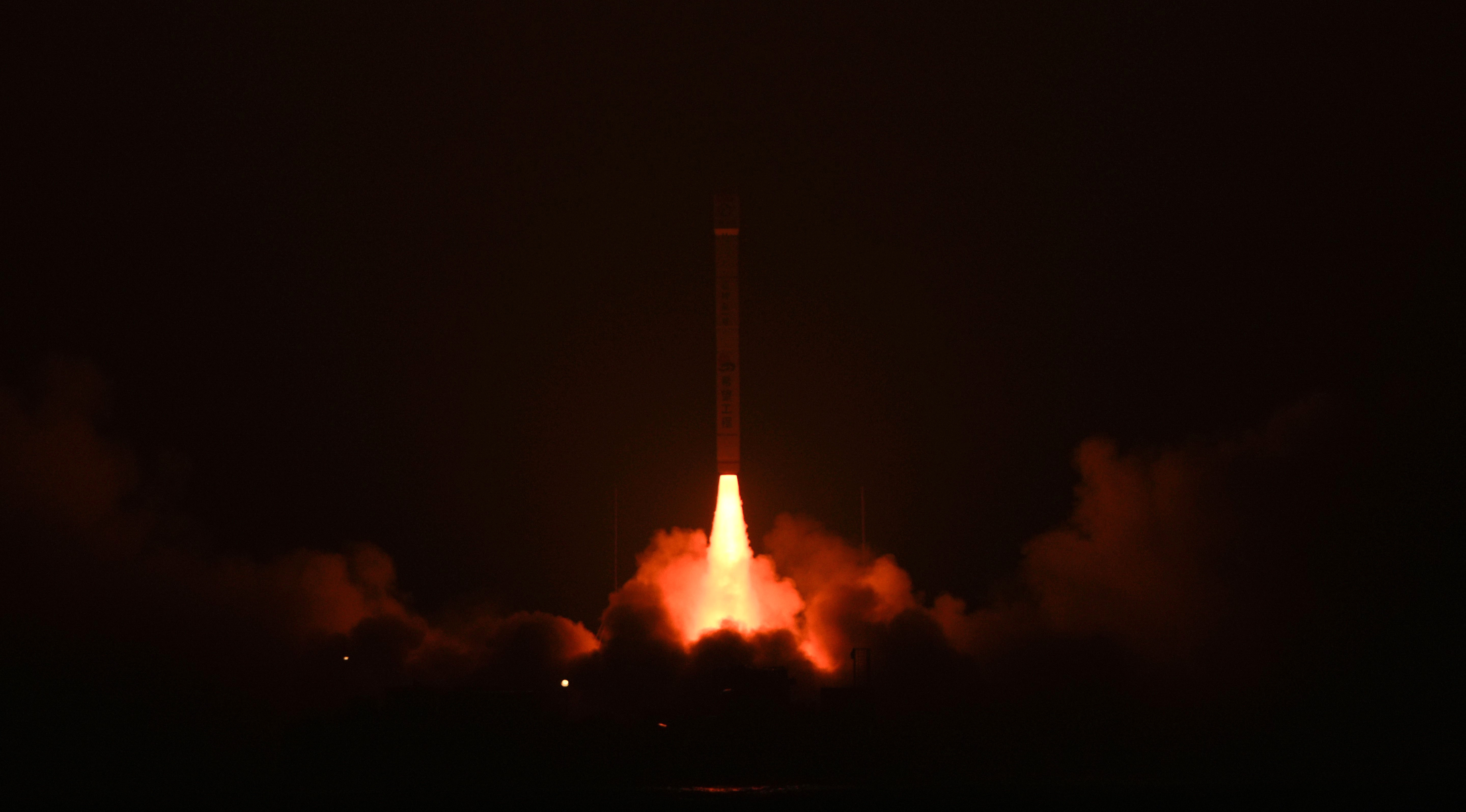
Just off the shore of Rizhao (日照市), in Shandong (山东) province, Galactic Energy’s Ceres-1S blasted off from a sea-launch platform on January 16th at 04:10 am China Standard Time (January 15th at 20:10 pm Universal Coordinated Time), heading into low Earth orbit with a handful of satellites for a routine customer.
Being delivered to an 850-kilometer 45-degree low Earth orbit were four of Guodian Gaoke’s (国电高科) Tianqi (天启) Internet-of-Things satellites (numbered 37, 38, 39, 40) to bring its constellation up to 41 total spacecraft. Through the constellation, the company provides connectivity services to various industries, including forestry, agriculture, aquaculture, petroleum, emergency response, ecological environment conservation, and smart city development.
Guodian Gaoke plans to expand the constellation to several hundred spacecraft in the near future, before increasing to a few thousand in the years afterward. With those expansions, the constellation is planned to provide low-latency connectivity for vehicle automation and communications services.
With today’s Ceres-1S mission, Guodian Gaoke has flown via Galactic Energy’s launch solutions seven times to deliver 22 satellites into orbit. Its previous spacecraft deployment was also via a Ceres-1S in May 2025.
A partner for this Ceres-1S mission was the China Youth Development Foundation (中国青少年发展基金会) and the Beijing Youth Development Foundation (北京青少年发展基金会) to encourage and support children from China’s less-developed regions to pursue space dreams. Galactic Energy says they plan to continue partnering with various regional youth development foundations.
Today’s Ceres-1S mission additionally served as the return to flight mission for the Ceres-1 launch vehicle series following a failure two months ago in November 2025. That failure was found to have been caused by overheating of the engine valve control lines, resulting in the fourth-stage liquid propellant engine shutting down several seconds short of orbit.
Today’s launch was the 6th mission for Ceres-1S, and the 23rd launch for the Ceres-1 launch vehicle series (Ceres-1 and Ceres-1S). This was also the 4th launch from China in 2026.
Liftoff footage via ‘The Boys’ for ThatSpaceDogeGuy, as well as 星河动力航天 and 大众新闻-大众日报 on Weibo.
Launch livestreams via ThatSpaceDogeGuy and International Rocket Launches on YouTube.
Check out the previous Ceres-1 launch
Three Satellites Lost as Galactic Energy Suffers Launch Failure [Ceres-1 Y19]
![Three Satellites Lost as Galactic Energy Suffers Launch Failure [Ceres-1 Y19]](https://substackcdn.com/image/fetch/$s_!xPk4!,w_1300,h_650,c_fill,f_webp,q_auto:good,fl_progressive:steep,g_auto/https%3A%2F%2Fsubstack-post-media.s3.amazonaws.com%2Fpublic%2Fimages%2F096079e6-1f3d-4731-a325-7113cb245478_4780x2867.jpeg)
At 12:02 pm China Standard Time (04:02 am Universal Coordinated Time) on November 10th, Galactic Energy attempted to fly its Ceres-1 launch vehicle into sun-synchronous orbit from the Jiuquan Satellite Launch Center. Sadly, after three stage…
What is Ceres-1/1S?
This section is for those less familiar with China’s commercial launch vehicles.
Galactic Energy’s Ceres-1, and its sea launch version Ceres-1S, is a four-stage launch vehicle that burns solid fuel in the first three stages, and a storable propellant in the fourth-stage. The fourth-stage can also be replaced with the company’s Eros orbital test platform.
The payload capacity of the launch vehicle is currently as follows:
420 kilograms to low Earth orbit
300 kilograms to a 500-kilometer sun-synchronous orbit
270 kilograms to a 700-kilometer sun-synchronous orbit
The first-stage is powered by a solid rocket motor that burns an undisclosed solid propellant to produce 60 tons of thrust. The second-stage also burns an undisclosed solid propellant to produce 28 tons of thrust. The third-stage is the final solid rocket stage, once again burning an undisclosed solid propellant, producing 8.8 tons of thrust. The fourth-stage burns a storable liquid Monomethylhydrazine and mixed oxides of nitrogen fuel in an ‘attitude control thruster’ to generate 1 ton of thrust.
On the launchpad, Ceres-1 weighs 33,000 kilograms and stands 20 meters tall. The first, second, and third stage have a diameter of 1.4 meters while the fairing has a diameter of 1.6 meters.
So far Ceres-1 vehicles have flown from the Jiuquan Satellite Launch Center and various sea-based launch platforms.