

Cosmoleap Raises 500 Million Yuan for Tower-Caught Reusable Rocket
New capital will be used to complete the first Leap-1A launch vehicle this year and to start development of new hardware for later versions.

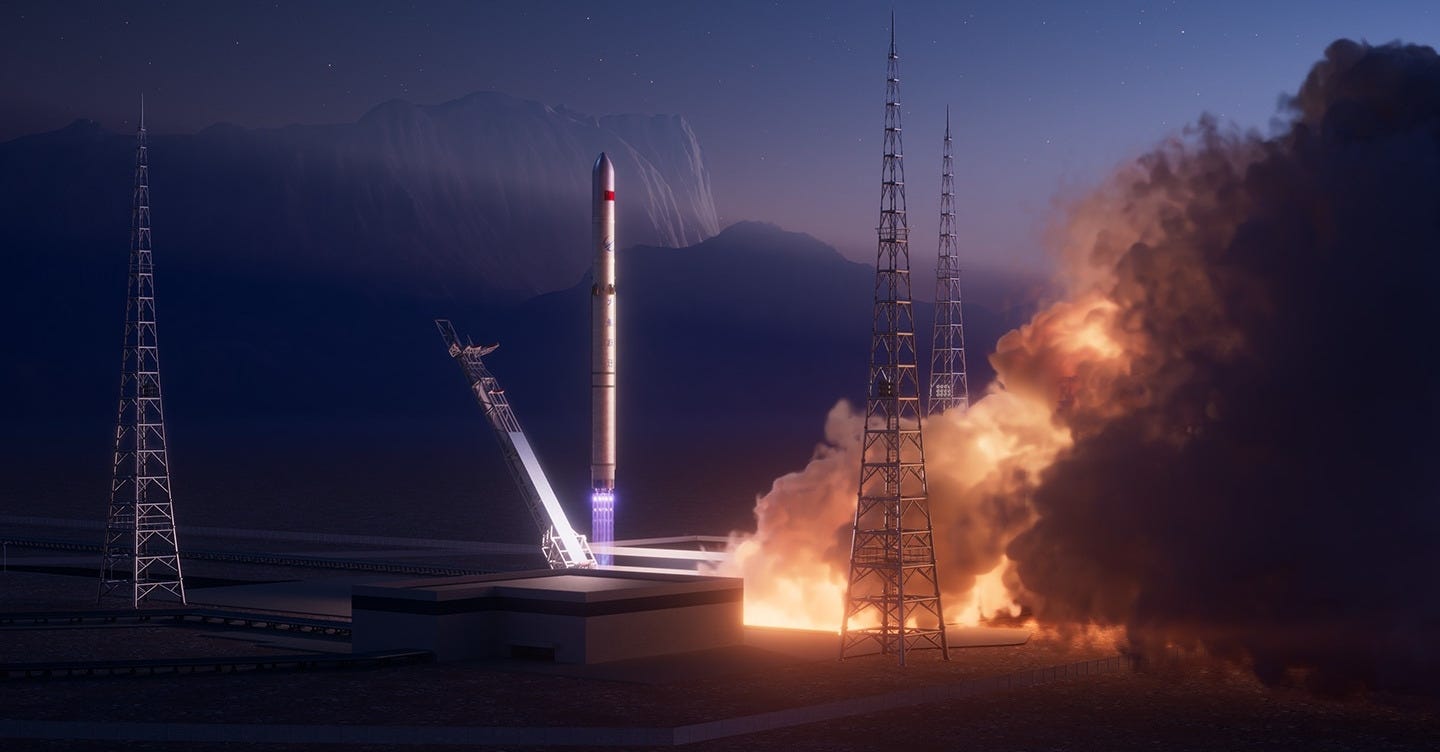
Yesterday, April 29th, Cosmoleap (大航跃迁) announced that they have raised 500 million Yuan (73.1 million United States Dollars, as of April 29th) as part of a new funding round. It follows an earlier 100 million Yuan (14.6 million United States Dollars) round from November 2024.
Capital for this round was jointly led by Qianhai Ark (前海方舟) and Puhua Capital (普华资本), with other participating investors being Lingge Capital (领格资本), Haiying Capital (海鹰资本), Huifengda (惠丰达), Junchuan Capital (君川资本), Chongqing Shadao Technology (重庆沙刀科技), Zhongke Technology (中科科技), Yuanchuang Resources (元创资源), and Hanli Capital (汉理文化). Long-term investor Huaxing Capital (华兴资本) was said to have advised the participants in this round.
The new funding is planned to be for continuing development of the Leap-1A (跃迁一号甲) partially reusable launch vehicle for a debut flight in 2027, a delay from the second half of 20261, which is now when assembly of the first flight vehicle should begin and be completed. Cosmoleap also shared that part of the funds will be used to begin development of liquid methane and liquid oxygen engines.
Cosmoleap’s intent to develop their own engines is a recent development. Known as Qingyu-11 (擎宇-11), and labelled a 100-ton class engine, the company plans to have it generate around 150 tons of thrust, with a thrust range of 30 to 105 percent, while having a specific impulse of up to 350 seconds. Each Qingyu-11 will be lit three times per flight, for liftoff, reentry, and recovery. Cosmoleap is planning to use each of them fifty times.
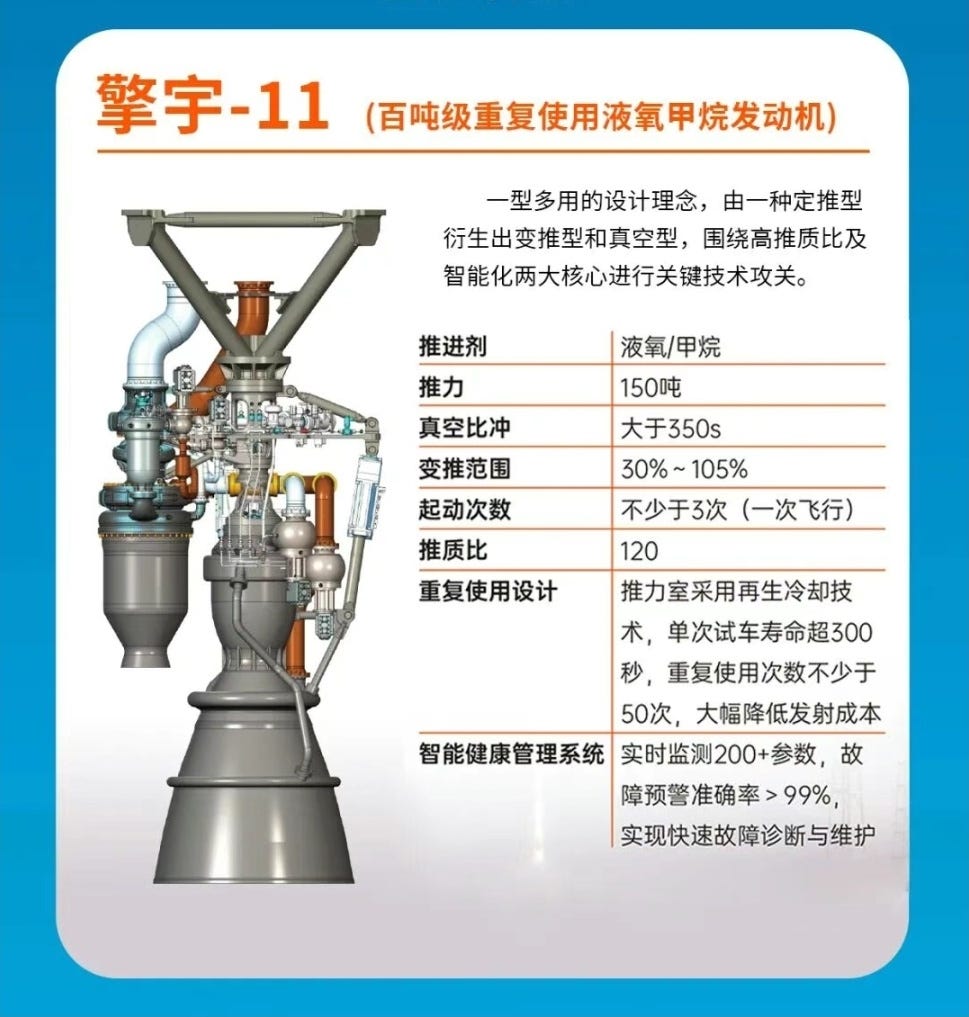
For now, that engine won’t power Leap-1A, instead being taken skyward by the Academy of Aerospace Liquid Propulsion Technology’s (航天推进技术研究院) YF-209, which generates 80 tons of thrust with the same propellant, in a similar approach to CAS Space with the YF-102. The Flint One (火石一号) flight computer to control Qingyu-11 will be gaining flight time with the YF-209. It recently passed technical acceptance.
Details on the development of Leap-1A have been relatively few since the company’s emergence into the public eye, with a final design meeting approving full development in September 2025. That is partly because Cosmoleap is externally sourcing its propellant tanks, fairings, and the previously mentioned engines. Occasional development updates have shared imagery of hardware during testing, including the launch vehicle’s attitude control system.
When Leap-1A eventually makes its way to a launch pad, the launch vehicle will stand 70 meters tall and 4.2 meters in diameter. Fully fuelled with liquid methane and liquid oxygen, it will weigh about 554,000 kilograms. Ten YF-209 engines will power the vehicle, with nine on the first-stage collectively producing 720 tons of thrust and a single vacuum-optimized variant on the second-stage. Payload capacity of Leap-1A is expected to be 18,000 kilograms to low Earth orbit when expended, or 12,000 kilograms if reused.
For recovering the first-stages of Leap-1A, expected to be flown up to twenty times, Cosmoleap plans to build a series of catch towers downrange of inland launch sites2, and on ships for missions from the Wenchang Commercial Space Launch Site. Testing of catch towers has been underway since November 2024, with hardware pathfinders included from January 2025. Rationale for using downrange towers instead of landing legs is mass savings, claimed to increase payload capacity by up to 5,000 kilograms.
Back in mid-2024, the company believed they would only fly once in 2026 before flying multiple times in 2027. First-stage catch towers are not a requirement for the first few flights (which will be expendable), easing hardware delay risks.
The Jiuquan Satellite Launch Center, the Taiyuan Satellite Launch Center, and the Xichang Satellite Launch Center.