

Engineers Achieve One Gigabit Laser Link With Geostationary Satellite
Data was beamed over 40,000 kilometers for three hours, laying the groundwork regular high-speed use at even further distances.

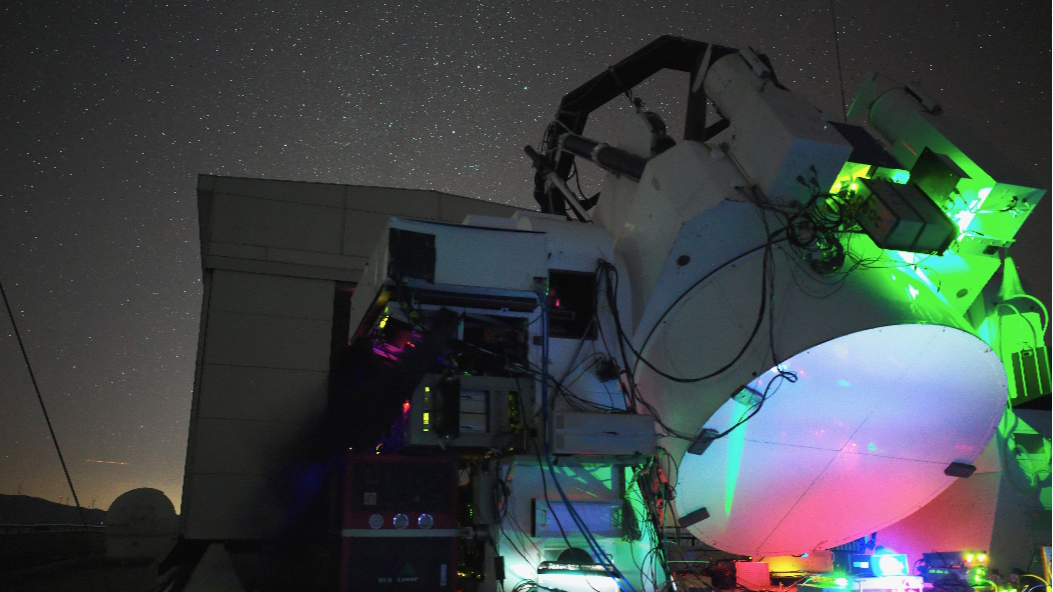
At the Yunnan Lijiang Astronomical Observatory (云南丽江天文观测站), in Lijiang (丽江市), Yunnan (云南) province, a 1.8-meter-diameter optical telescope achieved a three-hour-long laser communication link with a satellite 40,740 kilometers away in geostationary space, China Science Daily (中国科学报社) reported on March 2nd.
Finding and locking onto the target satellite for the test required the telescope to pick up a faint ‘beacon’ transmitted from geostationary orbit. Once the beacon in orbit was found, the telescope sent out its own, which the satellite found shortly after. Both the telescope and satellite reportedly linked to each other in just four seconds, then acting as each other's reference point afterwards.
Once linked, the telescope continuously made gradual movements to maintain its connection to the satellite, allowing it require no maneuvers in orbit. Of course, some natural atmospheric distortion attempted to muddy the connection, with the telescope’s adaptive optics correcting any errors in the link and smoothing out any remaining fluctuations.
During their connection, data uplink and downlink between the telescope and the geostationary satellite reached regular speeds of one gigabit per second across tens of thousands of kilometers. That reportedly proved that a high orbiting relay satellite can beam back massive amounts of data being sent to it by several other spacecraft in lower or nearby orbits.
Future uses of the laser communication links, following further testing, may allow for high-speed links with spacecraft on the Moon, around Mars, or floating through deep space1, according to engineers involved. The technology could be a key part of the proposed Queqiao (鹊桥) lunar relay constellation, planned to support extensive robotic and crewed exploration of the Moon.2
Organisations and enterprises that worked on achieving the impressive geostationary laser link, other than the observatory, were the Institute of Optics and Electronics, Chinese Academy of Sciences (中国科学院光电技术研究所), the Beijing University of Posts and Telecommunications (北京邮电大学), the Xi’an (西安市) branch of the China Academy of Space Technology, and Beijing Guangyou Xingkong Technology Co Ltd (北京光邮星空科技有限公司), who specialize in making laser link hardware for spacecraft.
As for what satellite was used in the test, that was not stated. However in 2025, nine Communication Technology Experimental Satellites (通信技术试验卫星), abbreviated as TJSW, were sent toward geostationary space for, as their name suggests, communications technology tests. Two of those spacecraft, TJSW-20 and TJSW-23, belong to the China Academy of Space Technology and may have been utilized.
This month’s test follows on from a demonstration back in December 2024 that had Changguang Satellite Technology Co Ltd (长光卫星技术股份有限公司) achieving a one hundred gigabits per second laser link with one of its Jilin-1 (吉林一号) remote sensing satellites in low earth orbit3. Beijing Guangyou Xingkong Technology was also involved in that feat.
NASA and the European Space Agency have proven that spacecraft can be communicated with at a distance of 265 million kilometers via the Psyche spacecraft, a dedicated transmitter, and a 2.3 meter diamter telescope.
No higher than an altitude of 2,000 kilometers