


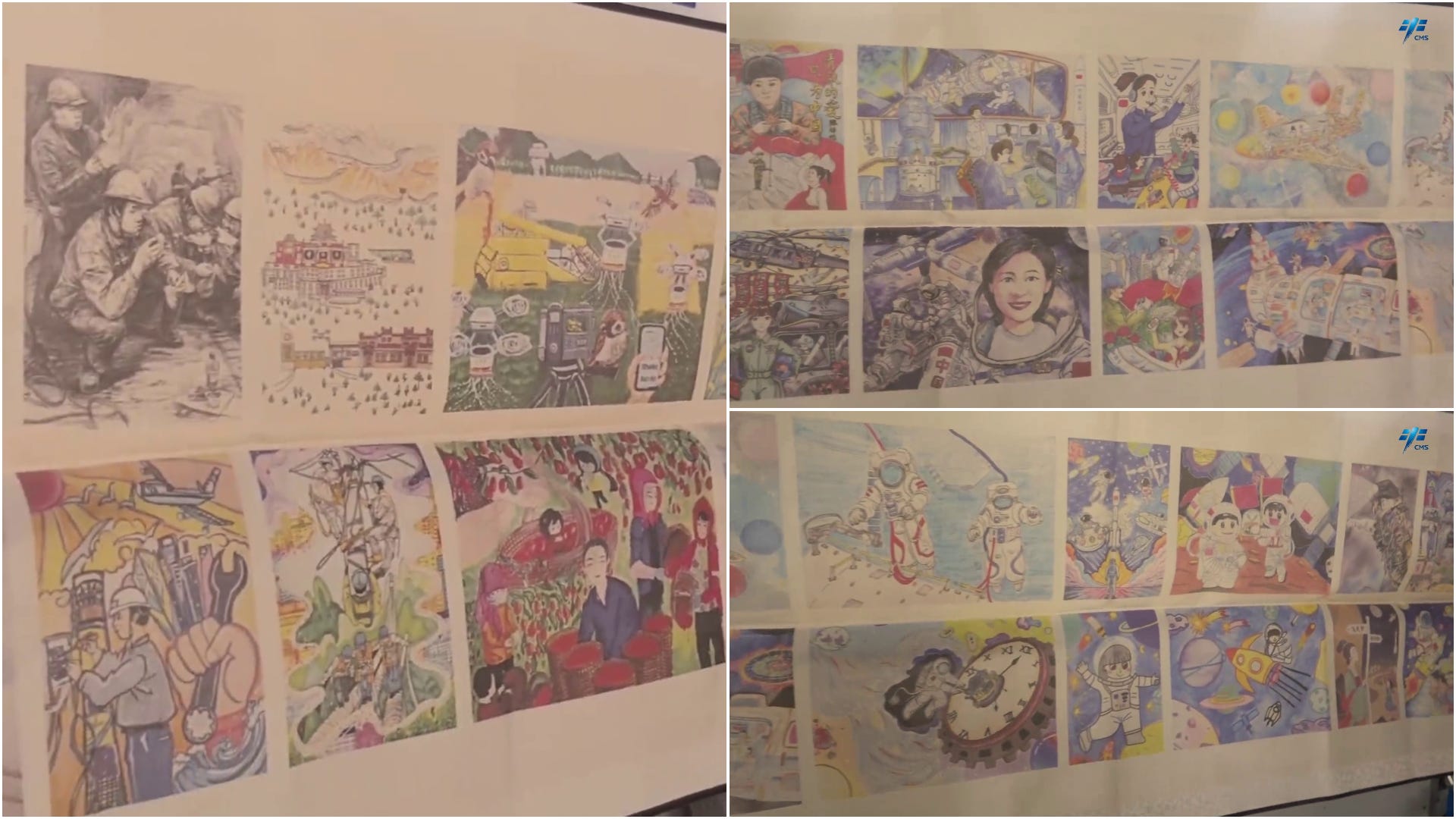
To start April every year on the Tiangong Space Station, an exhibition of eighty art pieces from young artists across China takes place1, and the Shenzhou-21 crew of Zhang Lu (张陆)2, Wu Fei (武飞)3, and Zhang Hongzhang (张洪章)4 have kept up that tradition for the fifth year in a row, having flown the artworks up with them in October 2025. Alongside the art exhibition, the three taikonauts have kept up their usual work as shown via ‘Tiangong TV’.
Attached below is a translated transcript of the start of the art exhibition and the newest episode:
Fifth Annual Art Exhibition
Hello everyone. With the Earth and sky gazing at each other and the Milky Way as our companion, I am Zhang Lu, a taikonaut on the Shenzhou-21 mission. Right now, I am stationed at the Chinese Space Station, 400 kilometers above Earth, alongside my crewmates Wu Fei and Zhang Hongzhang.
Now we have the first piece of amazing news to share: the Fifth Sky Art Exhibition is about to launch! This is a momentous occasion that young people have been eagerly anticipating.
From the hand-painted artwork ‘Questioning the Heavens’ to the five subsequent exhibitions that continue to illuminate the night sky, every piece sent into space represents a heartfelt dialogue between Earth and the heavens, and a resonance of dreams between young people and the stars.
‘Pioneers and Role Models in My Heart’ is the theme of this art exhibition. Through the paintings, we can deeply sense the emotions the children have imbued in their brushstrokes, emotions that shine brighter than the Milky Way and stretch farther than the sky.
The eighty paintings on display are representative of the outstanding works submitted by more than 15,000 young artists across the country. The young artists used their ideals as ink and colors as brushes to carefully depict the pioneering spirit in their hearts. Their artwork depicts the sincere dedication of veteran scientists who have devoted their lives to the nation, the perseverance of space professionals chasing their dreams in the heavens, and the sense of responsibility shown by those who press forward against the odds. Every stroke of color embodies the unwavering conviction that ‘a strong nation depends on me’, and every painting captures the lofty aspirations of today’s youth.
Tiangong TV April 5th 2026
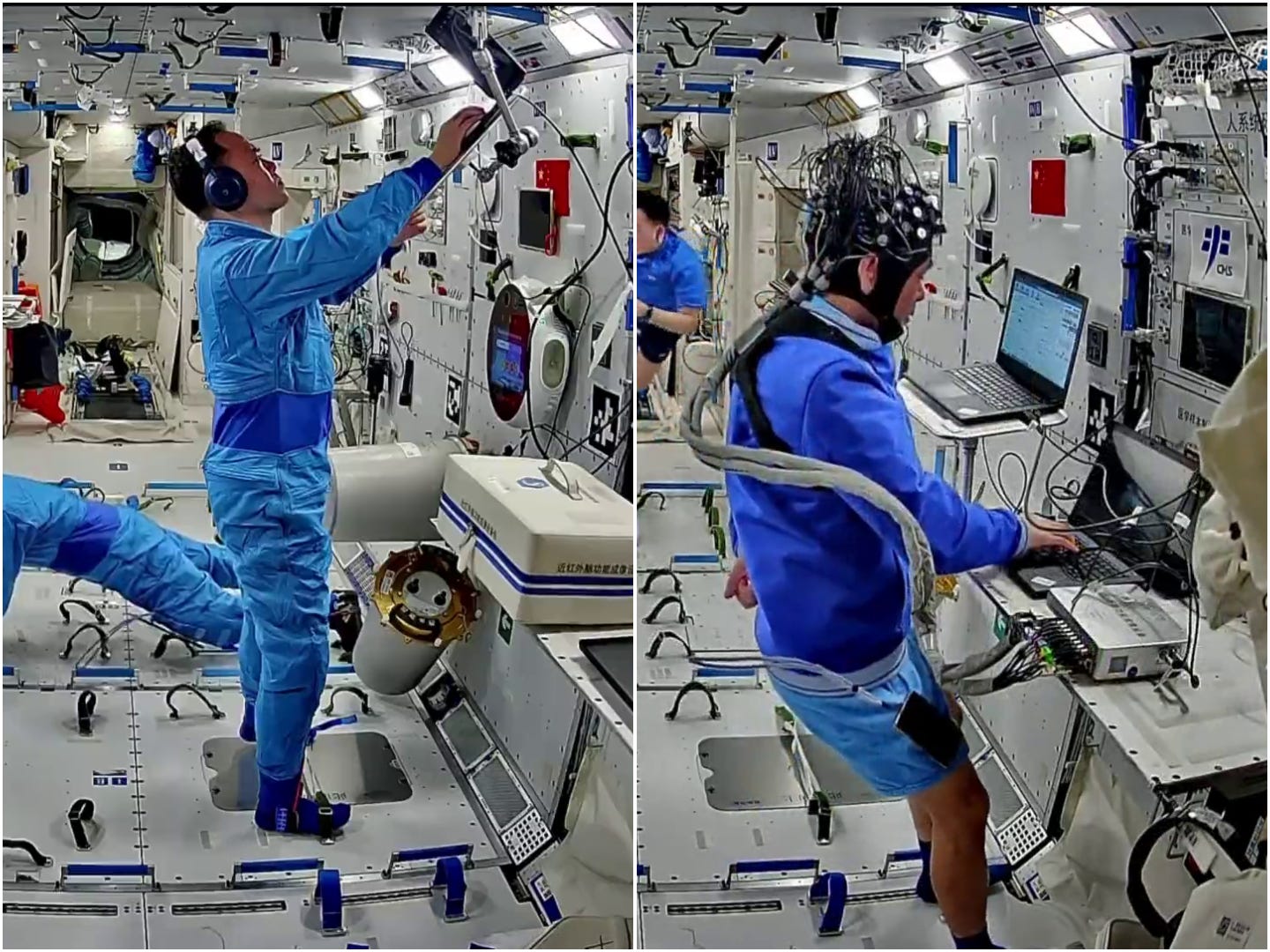
Since arriving at the Chinese Space Station, the Shenzhou-21 crew has been working in orbit for over five months, steadily advancing their various missions with a rigorous approach and efficient teamwork. Let’s take a look at the crew’s weekly log from last week.
In the field of space medicine experiments, the crew used laptops and related experimental software to conduct experiments related to trust and collaboration mechanisms, human-machine trust in space, and utilized near-infrared brain function imaging equipment to conduct experiments on the real-time characteristics of brain networks in space.
In the field of microgravity physics, the crew carried out tasks in accordance with the experiment schedule, including replacing the ignition heads and sampling covers of the experimental cabinets inside the combustion science cabinet, replacing experimental samples in the fluid physics experiment cabinet, and cleaning samples from the experimental chamber of the containerless experiment cabinet, as well as maintaining the electrodes of the handling mechanism.
Regarding cabin cargo management, the crew completed environmental monitoring tasks such as temperature measurement, wind speed measurement, and dew point testing as planned, and carried out material sorting, regular cleaning, and on-site equipment inspection and maintenance.
In terms of health maintenance and monitoring, the three taikonauts underwent a series of medical examinations, including 12-lead electrocardiograms, non-invasive cardiac function tests, and ambulatory electrocardiogram and blood pressure monitoring. They also used a traditional Chinese medicine diagnostic instrument to monitor and collect data on various health indicators. At the same time, they actively engaged in on-orbit exercise.
If there are any problems with these translations please reach out and correct me.
Fifth Annual Art Exhibition and Tiangong TV Episode April 5th 2026 originally from the China Manned Space Agency, cloned to YouTube for archival.

A copy of the artworks are also shown off in museums back in China.
Zhang Lu is the Commander and Pilot of the mission for his second spaceflight, having flown for the Shenzhou-15 mission between November 2022 and June 2023. He is from Hanshou County (汉寿县), Hunan (湖南) province, and was selected as part of China’s second taikonaut group in 2010, also being considered a ‘post-70s’ taikonaut having been born in November 1976.
Before becoming a taikonaut, Zhang served in the People’s Liberation Army Air Force and achieved the rank of Senior Colonel. He also joined the Communist Party of China in April 1999. After the Shenzhou-15 mission, Zhang was awarded the Spaceflight Merit Medal (Third Class) along with the honorary title of hero taikonaut.
Wu Fei is the Flight Engineer for this mission, which will be his first trip into space. He is from Baotou (包头市 / ᠪᠤᠭᠤᠲᠤᠬᠣᠲᠠ), in the Inner Mongolia Autonomous Region (内蒙古自治区 / ᠥᠪᠥᠷ ᠮᠣᠩᠭᠣᠯ ᠤᠨ ᠤᠨᠥᠪᠡᠷᠲᠡᠭᠨ ᠵᠠᠰᠠᠬᠤ ᠣᠷᠣᠨ), and was selected as part of the third taikonaut group in October 2020, while being considered a ‘post-90s’ taikonaut having been born in 1993.
Before his selection as a taikonaut, Wu was an engineer at the China Aerospace Science and Technology Corporation. He also joined the Communist Party of China in 2015.
Zhang Hongzhang is the Payload Expert for this mission, with it being his first trip to space. He is from Binzhou (滨州市), Shandong (山东) province, and was also selected as part of the third taikonaut group in October 2020, while being considered a ‘post-80s’ taikonaut having been born in 1986.
Prior to being selected as a taikonaut, Zhang was a researcher at the Dalian Institute of Chemical Physics, Chinese Academy of Sciences (中国科学院大连化学物理研究所), where he explored new materials and technology for batteries. He also joined the Communist Party of China in 2004.