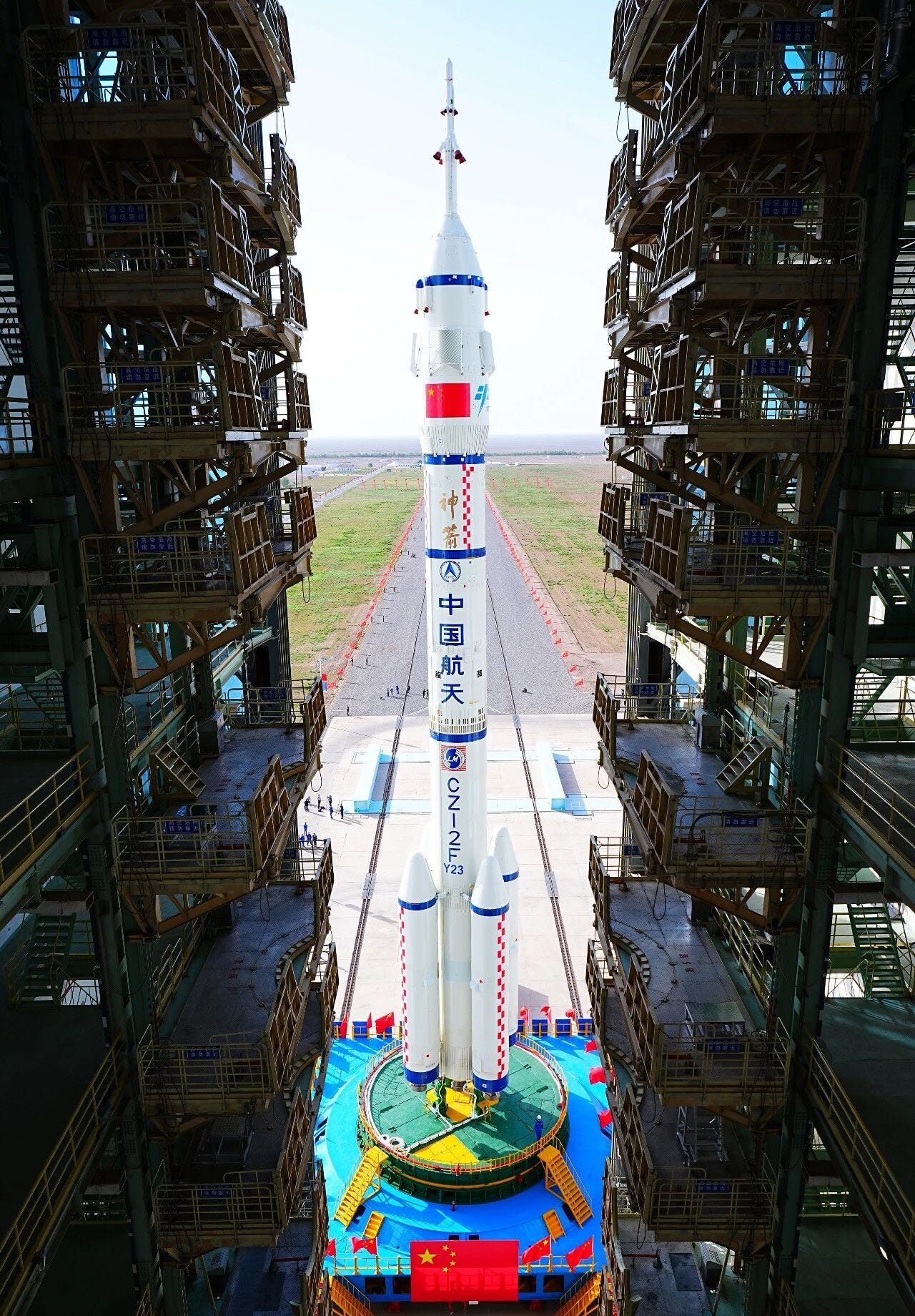

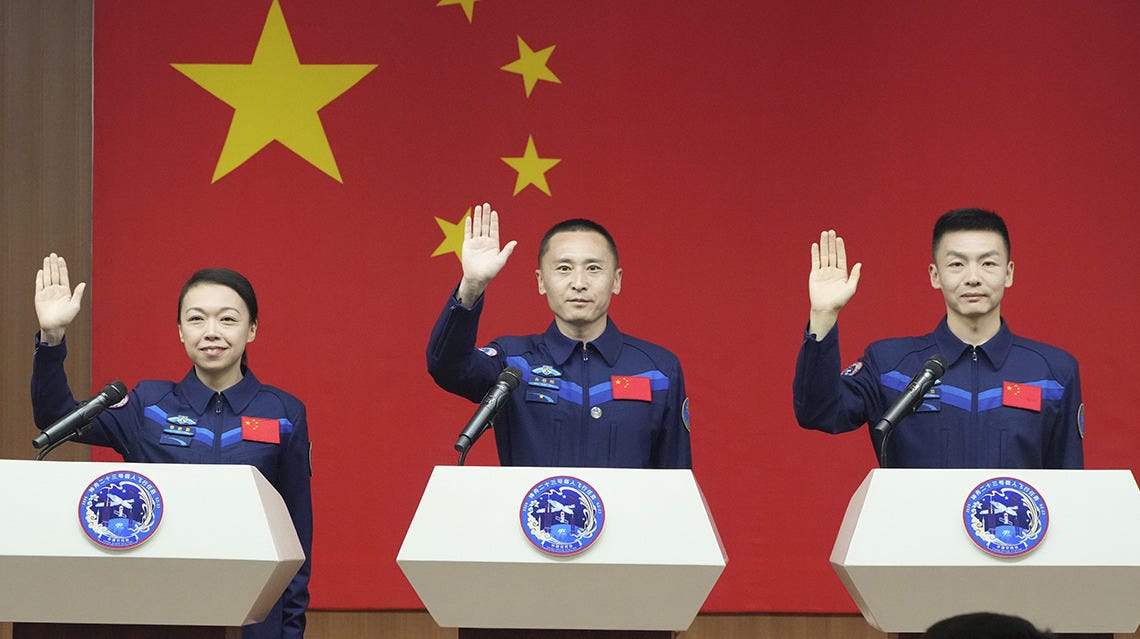
With launch set for 23:08 pm China Standard time (15:08 pm Universal Coordinated Time) tomorrow, May 24th, from the Jiuquan Satellite Launch Center, the China Manned Space Agency has hosted its two pre-launch press events for Shenzhou-23 with officials and the three taikonauts heading to space. Information shared during those press events is detailed below.
Introducing the Shenzhou-23 crew
As the first item at a press conference, the China Manned Space Agency announced the crew members for the Shenzhou-23 mission, which is expected to last a standard five months. It was also stated that one of them will be in space for about a full year, staying with two members of Shenzhou-24, with that choice to be determined by physical and psychological health status later in their mission.
Zhu Yangzhu (朱杨柱)
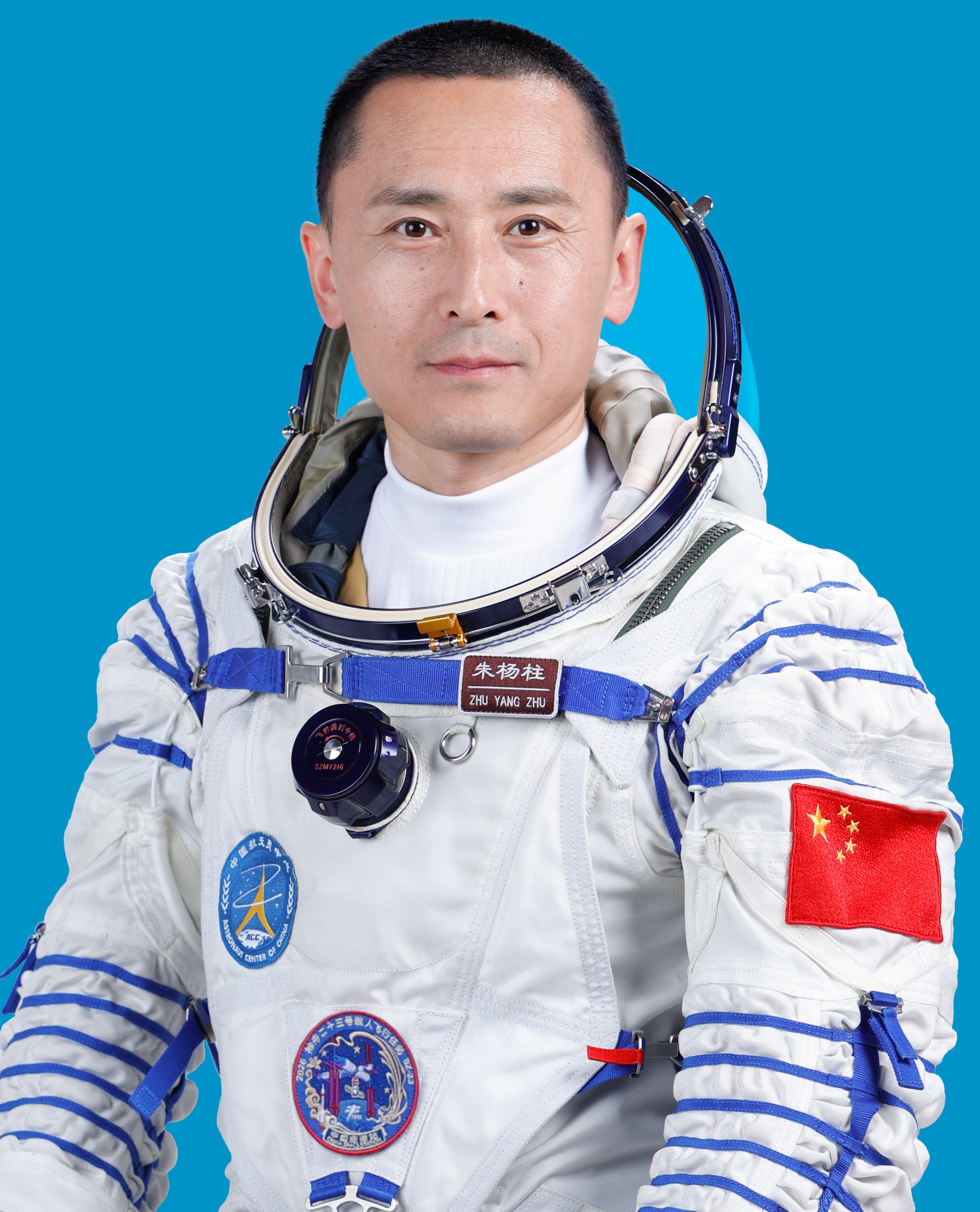
To command the Shenzhou-23 mission, China Manned Space Agency has chosen Zhu Yangzhu, born in September 1986 in Peixian (沛县), Jiangsu (江苏) province, for his second trip to space. He has previously flown as part of the Shenzhou-16 mission, for 153 days from May 30th 2023 to October 31st 2023.
Speaking on his crewmates and the mission ahead, the commander stated:
“In this mission, taikonauts from the third and fourth batch will head to space, and also our compatriot from Hong Kong who is heading to space for the first time. We share the glory of spaceflight, it is a vivid embodiment of patriotism, but also a concentric circle of China’s space dream. We will work as a team to channel our personal goals together to march forward for the country. Faced with many firsts, we deeply feel the honor of our mission and the great responsibility.”
“As a [previous] flight engineer and now serving as the commander, for me it is both full trust and the inheritance of the mission. … As you can see, we have a brand new crew to meet you, we have a spacecraft pilot and a payload specialist, our first from Hong Kong. We are like three different pieces of a puzzle, put together to form a powerful whole. We think as one and make expert efforts in a single direction. We will successfully fulfill the missions tasks together.”
Before becoming a taikonaut as part of the third group, he worked as an Associate Professor of aerospace engineering within the People’s Liberation Army, where he achieved the rank of Colonel. Since December 2006, Zhu Yangzhu has been a member of the Communist Party of China. He has been awarded the title of ‘Heroic Astronaut’ too.
Li Jiaying (黎家盈)
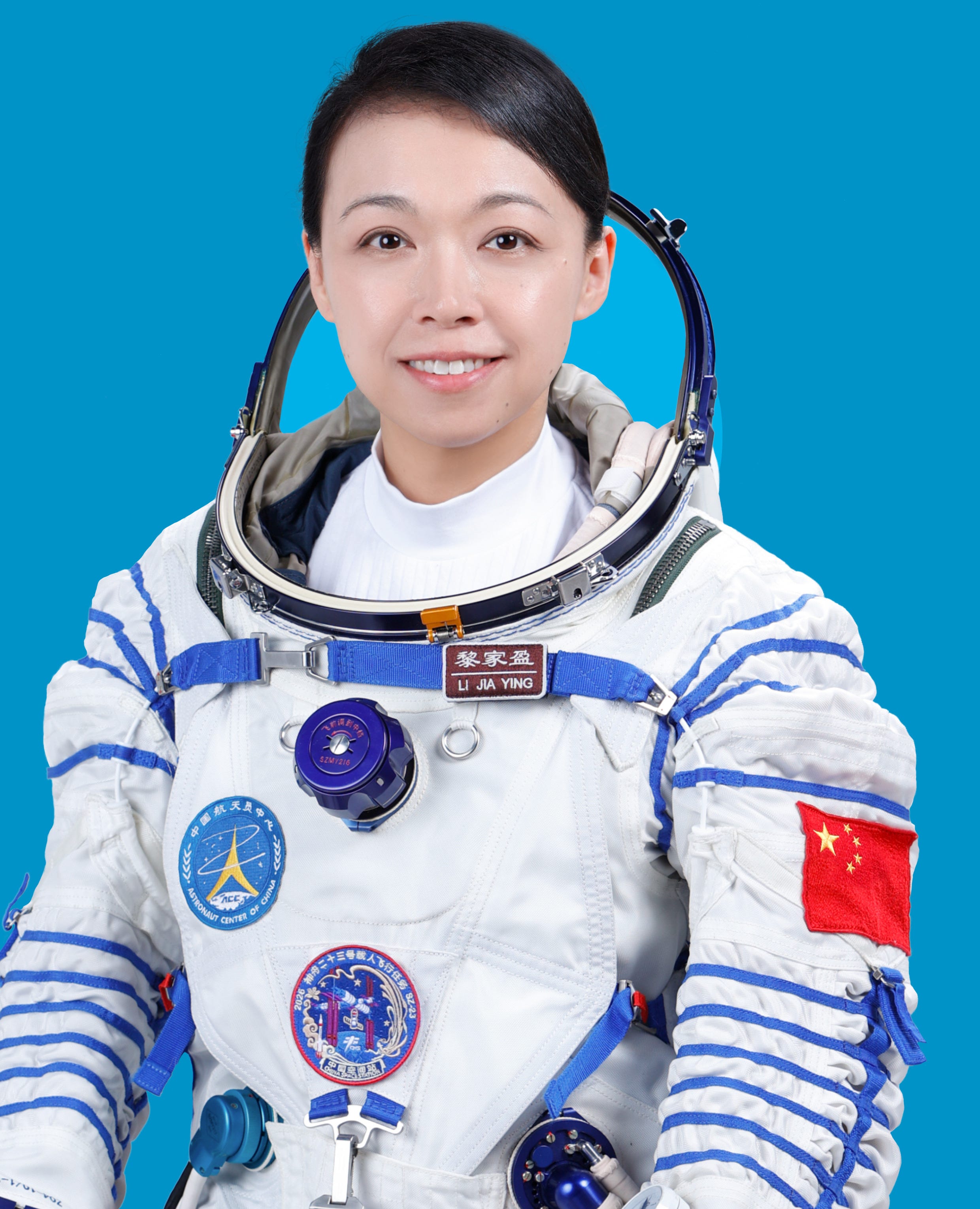
Li Jiaying, whose name can also be written as Lai Ka-ying, will be the first taikonaut selected from one of China’s Special Administrative Regions, Hong Kong (香港) in her case, having been born there in November 1982, to head to space, with her flight expected by officials since the middle of 2025. For the Shenzhou-23 mission she is serving as a Payload Specialist.
When asked how she felt about being Hong Kong’s first taikonaut and the mission ahead, Li Jiaying shared:
“As an ordinary Hong Konger, I’m honoured to join the taikonaut team and join this crew to perform the mission and have this precious opportunity. It is something I had never dared to dream before. At the moment, my heart is filled with gratitude and honour. I also greatly feel the mission and its responsibility. … I would like to thank the Hong Kong Special Administrative Region government for the full support and for all the training along the way. … Every taikonaut around me is excellent, I’m very honored to train with them, I feel really lucky to be friends with them [and to mutually encourage each other]. For this mission, as the commander said, I will go all out to complete all the tasks and shoulder the missions, and to make my own contribution to the nation.”
“For me, growing up in Hong Kong, the ‘lion rock’ spirit has always been engraved in my heart. This spirit to grow strong in adversity and never giving up is consistent with the spirit of human spaceflight. We need to be brave and persevering. It is with this perseverance that I have made it to where I am today. To the youth in Hong Kong, dreams are not far away, and they do not depend on your background, as long as we have the country in our hearts, love life, and stay true to ourselves, contribute our wisdom and strength to Hong Kong and the motherland, we can all shine our own light.”
Prior to being chosen for training as part of the fourth taikonaut group, she was a Chief Inspector of the Hong Kong Police Force and holds a PhD in computational and information science-related subjects.
Zhang Zhiyuan (张志远)
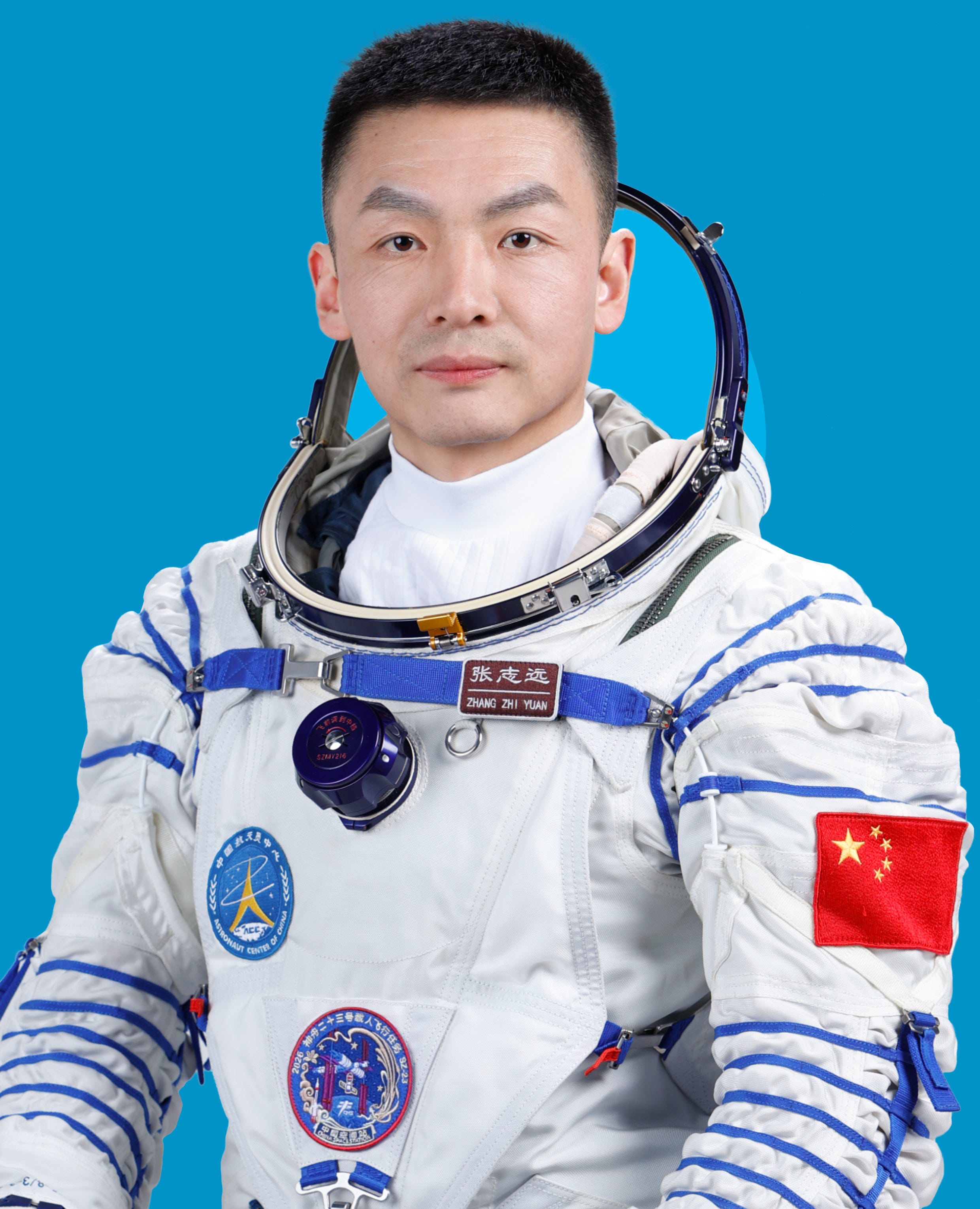
Zhang Zhiyuan, born in Gansu (甘肃) province in June 1986, has been chosen as the mission’s Spacecraft Pilot for his first trip to space.
In response to questions about personal dreams of space and an outlook on Shenzhou-23, Zhang Zhiyuan said:
“Tomorrow I will go to space to fulfill my dream. From having dreams to fulfilling them, it is a long journey of fate and perseverance. … Dear young friends, we are in the prime of our lives for passionate dreams, every difficult problem solved in studies, and every drop of sweat on the training ground is paving the way. As long as we have passion and never give up, we can reach our own sea of stars.”
“Since completion, our crewmates have been taking turns to [go to the space station] and return victorious. While we are proud of them, I look forward to exploring space, passing the baton of space exploration. … My expectation is that we will be united as one, in space and on the ground, to fulfill all tasks.”
Before being selected as a taikoanut as part of the third group, he served in the People’s Liberation Army Air Force as a pilot, where he achieved the rank of Colonel. He has been a member of the Communist Party of China since 2011.
What will Shenzhou-23 do?
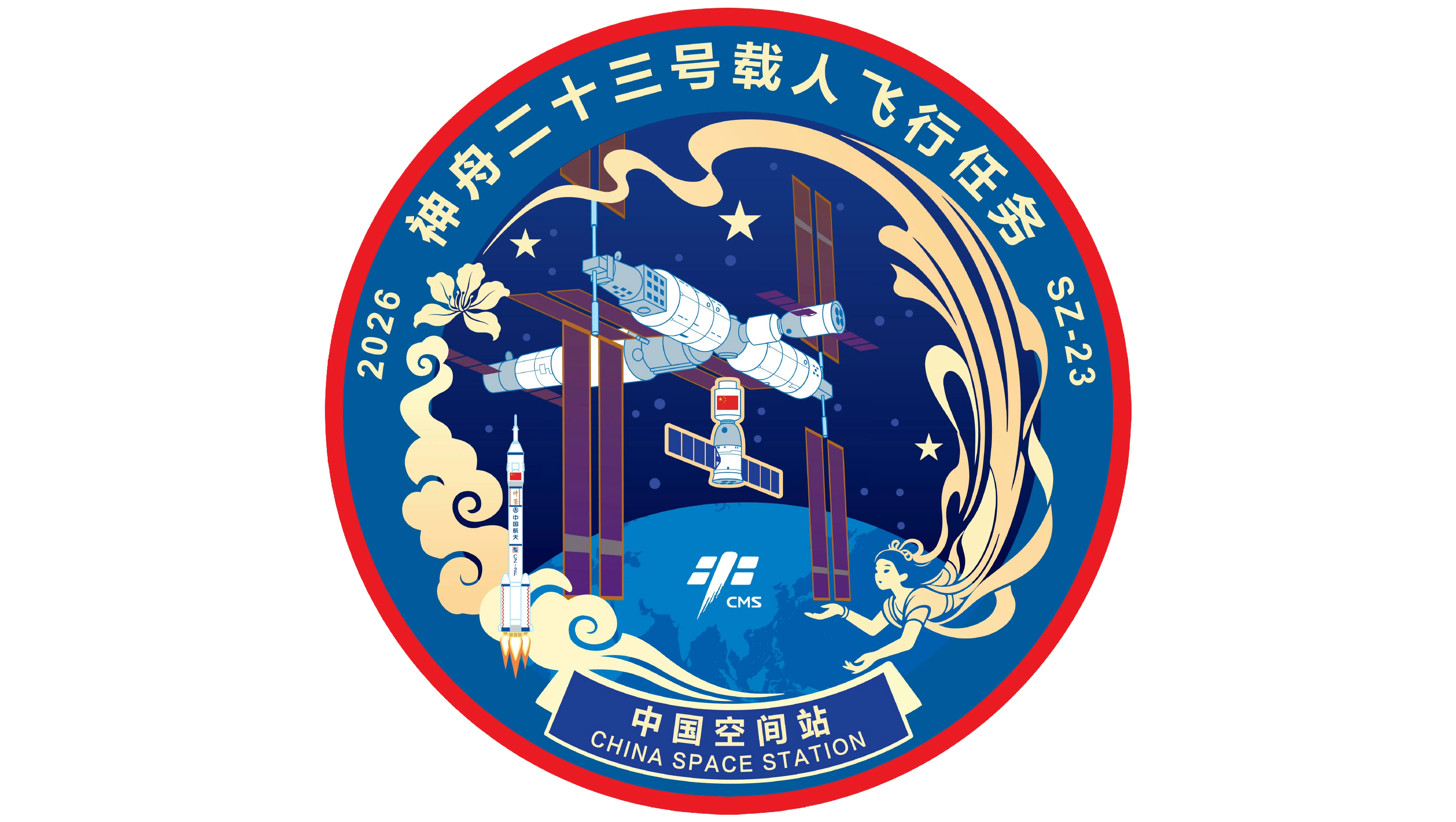
While in space aboard the Tiangong Space Station, the Shenzhou-23 trio are expected to support several dozen experiments across the Tianhe, Wentian, and Mengtian modules, as well as perform space walks to maintain the orbiting laboratory. In the first week of the mission, they will relieve the Shenzhou-21 crew, who have been in space since October 31st 2025.
Experiments that will be supported by the crew were stated to number over one hundred and are in areas such as space life sciences, material sciences, fluid behaviour in microgravity, space medicine, and new technology. Many of those have recently been delivered by Tianzhou-10, with select items being:
Embryo experiments from zebrafish, mice, and stem cell-derived artificial human one to understand how the space radiation and microgravity enviorment effects reproduction and development.
A greenhouse gas monitoring instrument, from the Hong Kong University of Science and Technology (香港科技大学), that will be mounted on the outside of the station to observe concentrations of methane and carbon dioxide in Earth’s atmosphere.
Experimental Lunar fibers, based upon soil samples collected by Chang’e 5 to undergo space exposure testing to understand if it is a viable material for in-situ development during missions in the 2030s.
New flexible solar cells that are eighty micrometers thick will undergo testing in Earth’s orbit, to be held outside by the Mengtian modules’ cargo airlock.
Research related to human health in microgravity will also be supported by one of the crew members remaining in space for around a year.
Pakistani astronauts in training
Regarding the status of the visit by a Pakistani astronaut later this year, officials shared that two candidates are being actively trained, which is proceeding well. The two candidates are also being intensively taught the Chinese language to be able to continue through mission preparations and to work on board Tiangong.
Crewed Moon missions to have test flights
When asked about the crewed missions to the Moon later this decade, set to send taikonauts to the surface before 2030, China Manned Space Agency officials stated that Tiangong has enabled the establishment of a solid talent pool to choose taikonauts from.
On hardware, it was shared that the Mengzhou crewed spacecraft will head into orbit multiple times over the next two years to prove its systems, with a few trips to the space station. A test flight of the Long March 10 series was said to be set for the near future, not specifying what or if a payload would be launched by it.
It was previously known that the Mengzhou-1 mission will head to Tiangong uncrewed later this year. In early April it was reported that the Long March 10A had its first flight moved up for a satellite-carrying mission.
Additionally, as part of an update on Chang’e 7, the China Manned Space Agency mentioned that they are now managing the Chinese Lunar Exploration Program (中国探月工程) moving forward, as part of a best use of resources and efficiency when planning robotic and crewed missions. A transfer of management happened sometime before Chang’e 7 arrived at the Wenchang Space Launch Site in April.
Preparations at Jiuquan
In preparation for the Shenzhou-23 mission tomorrow, the Jiuquan Satellite Launch Center has been a hub of activity. On May 16th, the Long March 2F/G launch vehicle was transported from its assembly building to Launch Site 91, with the Shenzhou-23 spacecraft atop of it.
At the launch pad, the launch vehicle, spacecraft, the Shenzhou-23 crew, and site staff have performed rehearsals of launch attempt and emergency procedures, to guarantee the safety of all involved. One such procedure had staff suiting up in protective gear to practice finding missing and trapped individuals after an anomalous event.
When the Shenzhou-23 mission lifts off atop the Long March 2F/G, teams will be tracking it from Jiuquan with a brand new tracking and data processing systems, ensuring the launch is heading along the correct path. The new system is reported to be able to conduct its tasks at an improved rate and in parallel to others within launch control.