

LandSpace Successfully Debuts Zhuque-3, Falls Barely Short of Landing [Zhuque-3 Y1]
China's first partially reusable rocket has reached orbit, but booster reuse will have to wait a little longer.

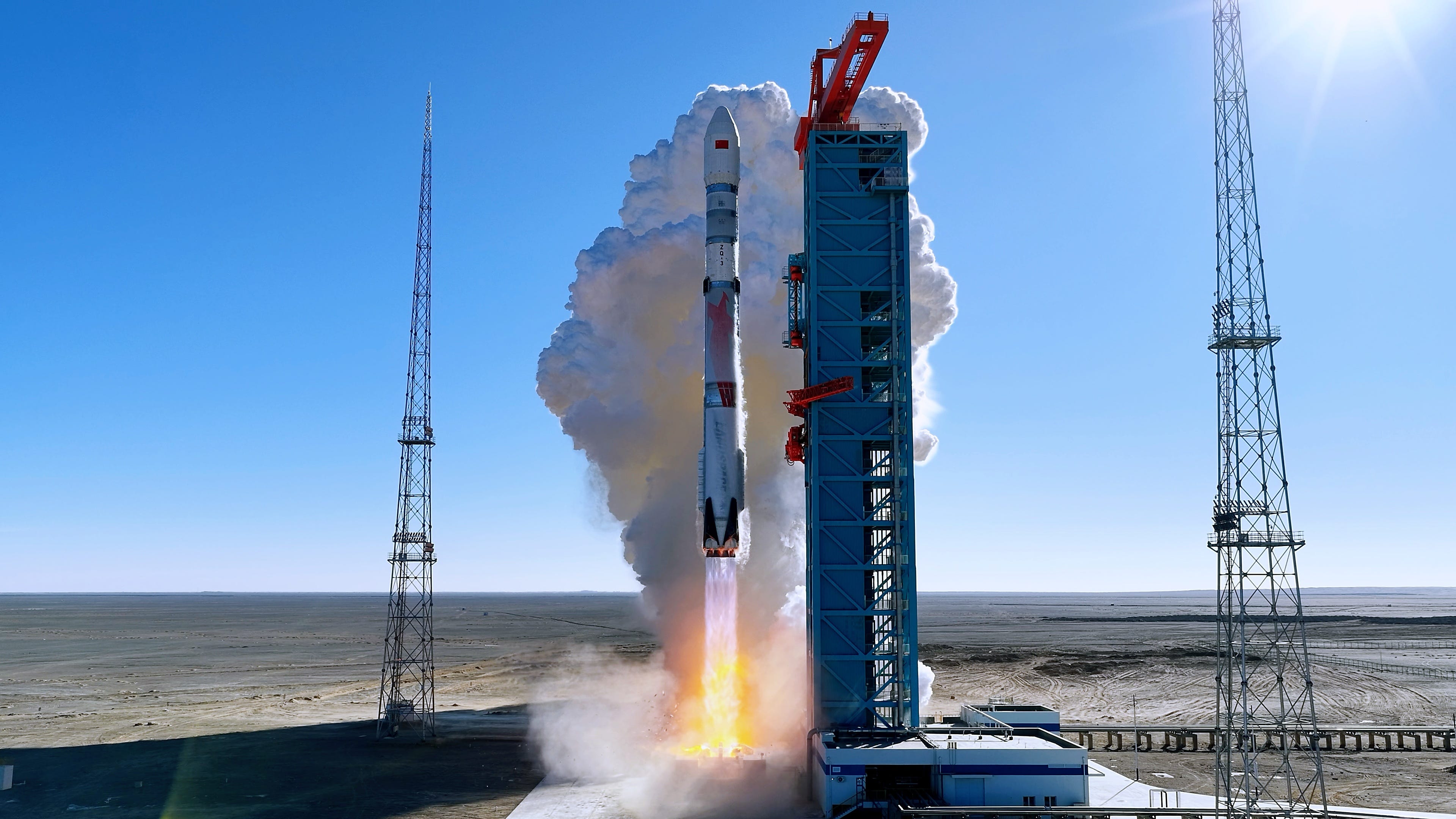
From Launch Area 96B at the Jiuquan Satellite Launch Center, LandSpace’s Zhuque-3 blasted off at 12:00 pm China Standard Time (04:00 am Universal Coordinated Time) on December 3rd, heading for low Earth orbit with ‘dummy payloads’ acting as the expected mass for satellites.
In the build-up to liftoff, the two stainless steel stages’ liquid methane and liquid oxygen tanks were filled as planned, followed by ignition of the nine TQ-12A engines to carry the vehicle skyward via 750 tons of thrust. First-stage ascent was entirely successful, with a clean separation of the second-stage and its ignition of the single TQ-15A engine.
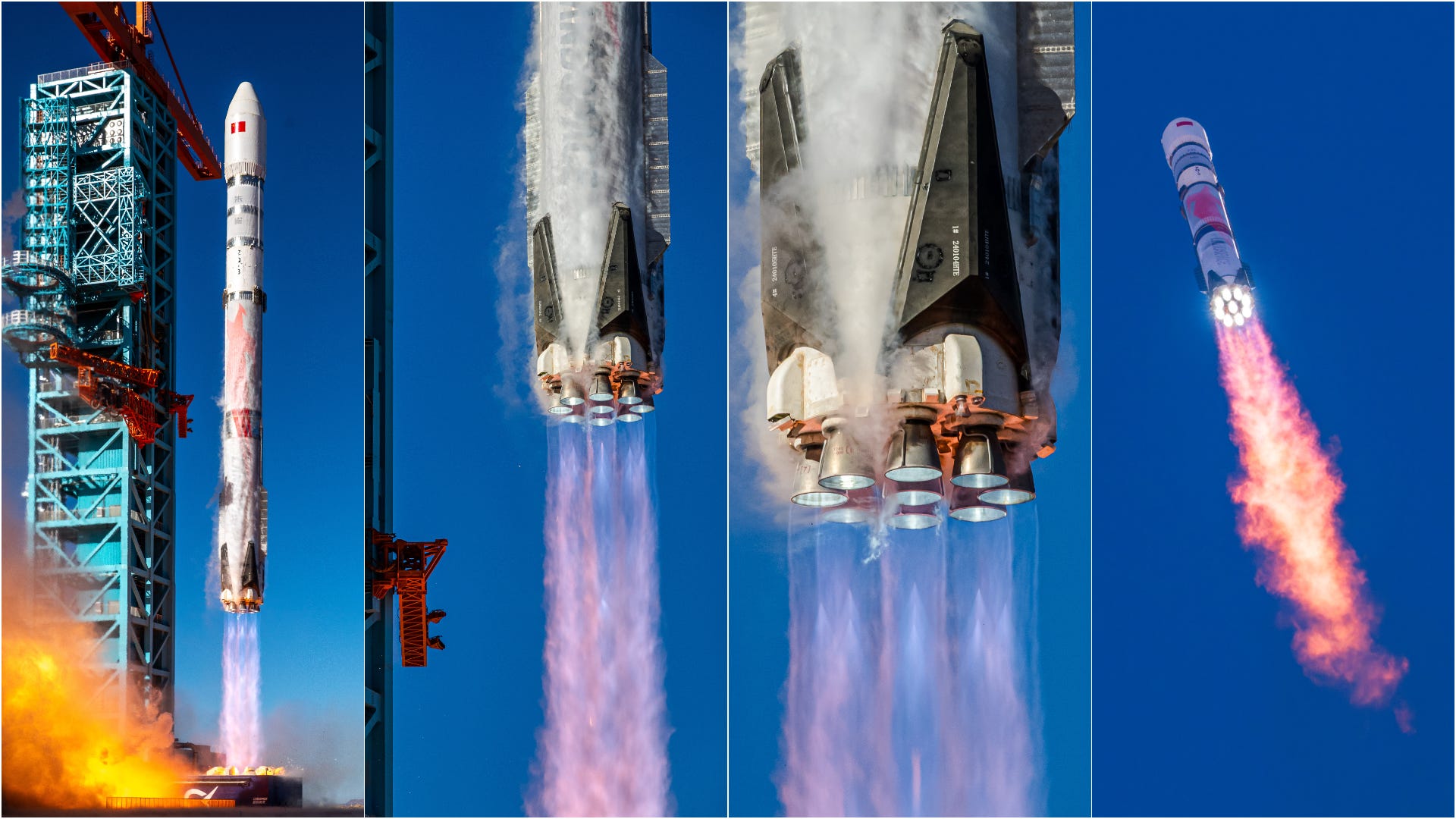
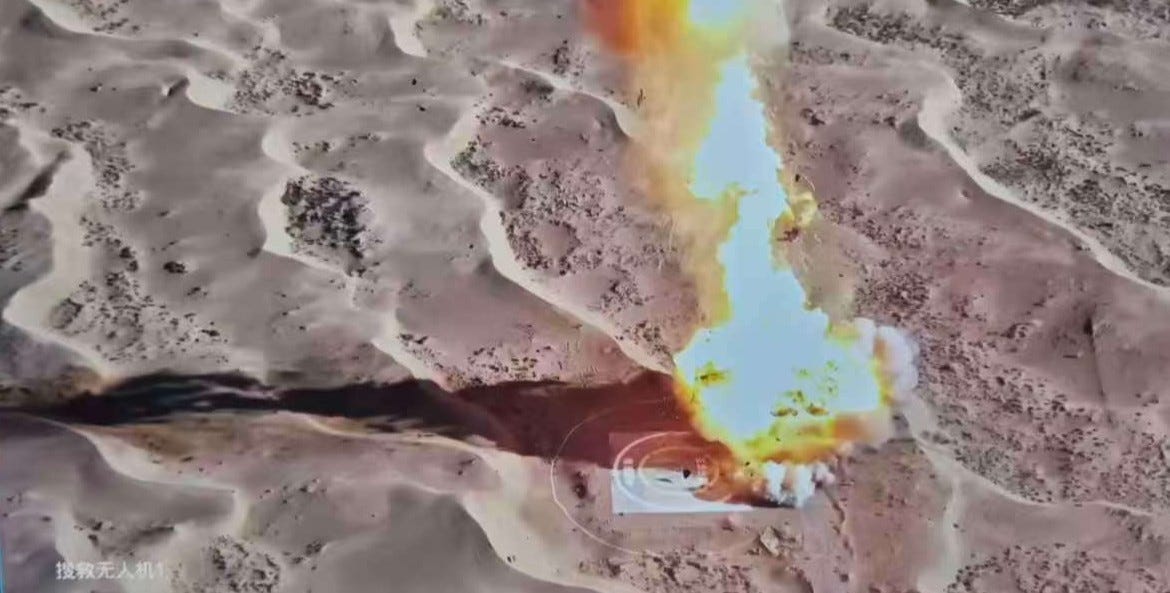
After that, the first-stage started to head back towards Earth, aiming for its landing pad at Minqin County (民勤县), under the authority of the city of Wuwei (武威市) in Gansu (甘肃) province. Just before entering the atmosphere, an approximately 46-second burn was performed to protect the stage from intense reentry heat, allowing for a continuation of the descent. Almost a minute after that, the landing burn began, but an anomaly occurred shortly afterward, resulting in the booster undergoing a partial, rapid, unscheduled disassembly before hitting the ground at speed. This is still a massive success for LandSpace, as it surpasses Blue Origin’s New Glenn’s first flight by a significant margin, and is far along in SpaceX’s testing process for Falcon 9 by comparison.
Meanwhile, second-stage was heading for low Earth orbit under the power of its TQ-15A. Its flight was rather uneventful in comparison, successfully reaching orbit and proving that Zhuque-3 is ready to deliver satellites into orbit. A second burn was performed with the stage too, putting it into a 142 by 1,402-kilometer orbit, followed by a passivation process.
A few hours after launch, LandSpace declared Zhuque-3’s debut flight a complete success, saying that it proved their technical development choices while demonstrating five important technology breakthroughs. In their words, those were:
For the first time in China, a reusable liquid oxygen-methane launch vehicle with a completely new overall design has achieved orbital flight. Breakthroughs were achieved in key technologies for multi-disciplinary coupled design across propulsion, aerodynamics, flight control, and structural engineering. The innovative first-stage configuration features a fuel tank positioned above the oxygen tank, coupled with an aerodynamic layout characterized by symmetrical winglets, P-shaped partially swept grid fins, and streamlined landing leg fairings. This design effectively reduces propellant consumption during reentry while enhancing payload capacity under reusable flight modes.
This achievement marks the first time in China that a nine-engine parallel liquid oxygen-methane propulsion system has been integrated and applied. This breakthrough in stable, high-flow propellant delivery technology meets the demands for multiple engine starts and deep thrust variations across complex mission profiles. It enables effective cryogenic propellant management and reliable bottoming during high-attitude maneuvers in weightless conditions during the glide phase. The system also resolves the challenge of methane freezing during full-supercooled loading, enabling high-flow full-supercooled loading two hours prior to launch.
Pioneered a novel high-strength stainless steel high-performance laser welding material and process system for propellant tank manufacturing in China. Independently developed a complete set of laser welding equipment and production lines for stainless steel storage tanks, achieving an eighty percent reduction in manufacturing costs for large-diameter, ultra-thin-walled stainless steel storage tanks compared to aluminum alloy, while shortening the production cycle by forty percent.
Achieved the first-ever flight verification in China of high-precision reentry navigation, guidance, and control technology for orbital-level reusable launch vehicles. Successfully demonstrated in-flight trajectory optimization, attitude stabilization, and high-precision control technologies under complex constraints, extensive state variations, and highly uncertain environments.
For the first time domestically, a hybrid redundant distributed integrated electronic design and application for reusable launch vehicles has been achieved, establishing a service-oriented open system integrating control, measurement, and system health management. A high-bandwidth, high-reliability real-time communication platform built on high-speed Powerlink real-time Ethernet delivers communication speeds exceeding 100Mbps, a hundredfold improvement over the traditional 1553B standard used in rockets. An advanced high-reliability computing platform from automotive electronics was adopted to develop a high-computing-power return control computer, achieving over tenfold improvement in computational capability compared to traditional launch vehicles. This initiative fosters a new productive force integrating rocket avionics systems with high-end advanced manufacturing.
Regarding future mission, the company stated that the first flight has provided valuable data that will be used to comprehensively review what occurred during the booster landing while implementing software and hardware adjustments on upcoming vehicles. A few Zhuque-3 launch vehicles are currently under production at LandSpace’s manufacturing facility in Jiaxing (嘉兴市), in Zhejiang (浙江) province.
With Zhuque-3’s debut mission now completed, LandSpace is confident that they can start offering low-cost, high-frequency, and large-scale launches for China’s various mega-constellations, starting in 2026.
Today’s launch was the 1st for the partially reusable Zhuque-3. This was also the 78th launch from China in 2025.
Mission recaps via LandSpace on Twitter and Weibo.
Unofficial liftoff video via PhilLeafSpace, 航天爱好者网 and China航天 on Weibo. Landing site footage via 航天爱好者网, and 机飞弹打_航空航天 on Weibo.
Check out LandSpace’s previous launch
LandSpace Experiences in-Flight Failure [Zhuque-2E Y3]
![LandSpace Experiences in-Flight Failure [Zhuque-2E Y3]](https://substackcdn.com/image/fetch/$s_!5XKA!,w_1300,h_650,c_fill,f_webp,q_auto:good,fl_progressive:steep,g_auto/https%3A%2F%2Fsubstack-post-media.s3.amazonaws.com%2Fpublic%2Fimages%2F3ef6bffd-05d7-41b4-a769-67cf1159f1c2_2160x1301.jpeg)
LandSpace’s Zhuque-2E rocket departed from Launch Area 96A at the Jiuquan Satellite Launch Center on August 15th at 09:17 am China Standard Time (01:17 am Universal Coordinated Time) heading for low Earth orbit. Sadly, the rocket did not reach its intended orbit.
What is Zhuque-3?
This section is for those less familiar with China’s various commercial launch vehicles.
Zhuque-3 is LandSpace’s two-stage partially reusable launch vehicle that flying from the Jiuquan Satellite Launch Center. Zhuque-3 burns liquid methane and liquid oxygen propellants in its engines on both stages, which are built out of stainless steel.
For Zhuque-3’s debut flight and a few afterwards, a ‘block one’ version of the rocket is said to be able to lift:
11,800 kilograms to low Earth orbit when expended
8,000 kilograms to low Earth orbit with a first-stage landing downrange.
LandSpace claims that Zhuque-3 ‘block two’ will be able to:
21,300 kilograms to low Earth orbit when expended
18,300 kilograms to low Earth orbit with a first-stage landing downrange
12,500 kilograms to low Earth orbit with a return to launch site landing.
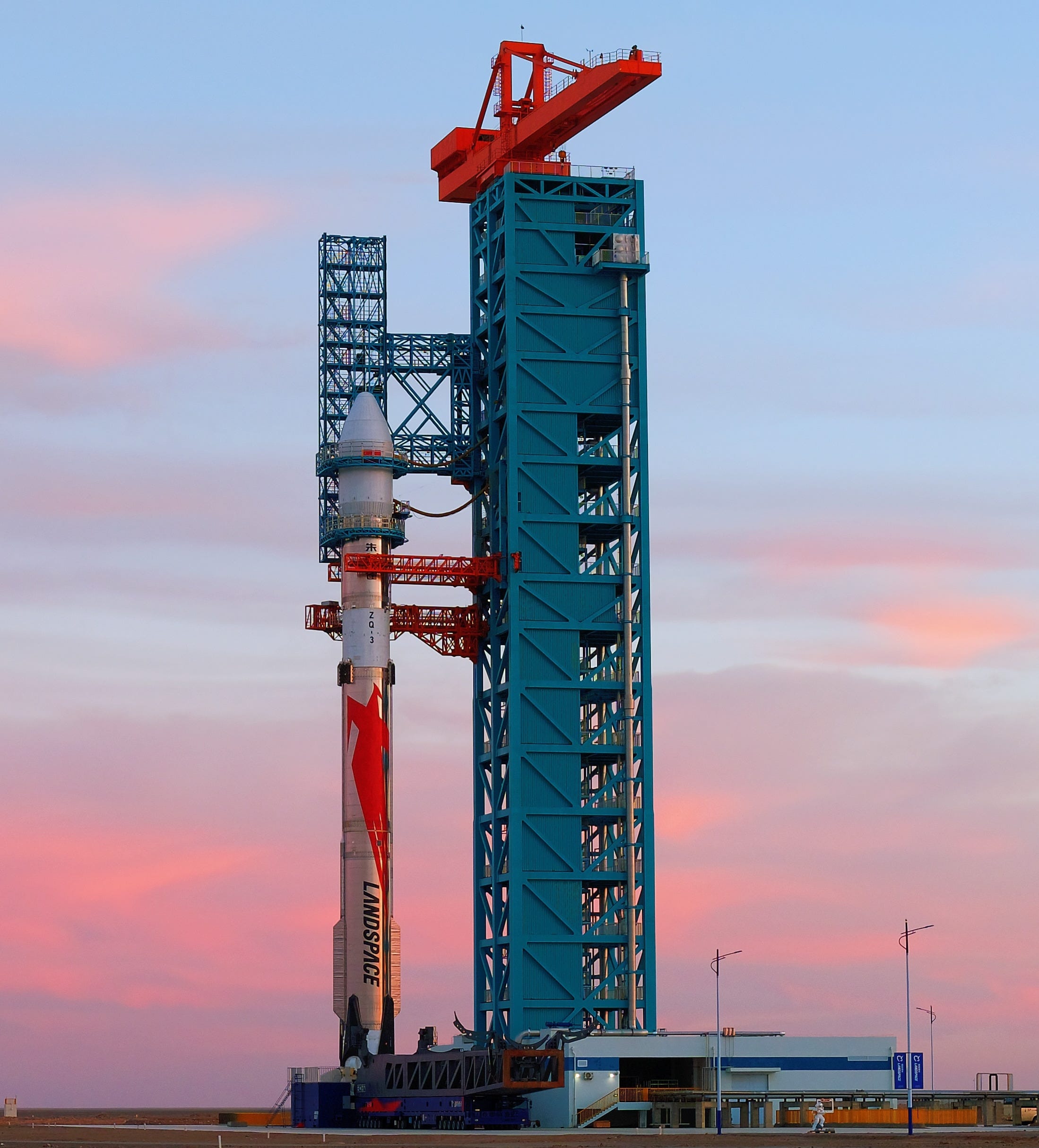
The first-stage of Zhuque-3 is powered by nine TQ-12B engines, although initially using the TQ-12A, generating an approximate combined 900 tons of thrust (750 tons with TQ-12A) while burning liquid methane and liquid oxygen. LandSpace is also looking to fly each first-stage twenty times, with the potential to certify them for more flights. The second-stage of Zhuque-3 is powered by one TQ-15B generating a believed 100 tons of thrust while also burning liquid methane and liquid oxygen.
To facilitate reuse of the first-stage, three engines light during re-entry followed by one being lit again for landing on a drone ship or landing pad. For boost-back burns, the booster turns around in-flight after separation and relights one engine.
The boosters and second stage have a diameter of 4.5 meters. The fairing is 5.2 meters in diameter and split into two halves. The total height of Zhuque-3 is currently planned to be 76.6 meters, in its ‘block two’ form, with it having a fully fuelled mass of approximately 660,000 kilograms. A ‘block one’ vehicle stands 66 meters tall and weighs 570,000 kilograms loaded with propellant.


It was an amazing brilliant effort by Landspace and I am sure they are very close . Few things to be considered in the next launch.
1. Booster landing thrusters did not get started as expected and I guess that was the reason we saw booster landing was very very fast , infact so fast that booster almost burned up during the reentry. So Landspace should focus on MECO (Main Engine Cut Off) to analyze the issues.
2. Rocket structure does not seem to be very solid , because even if the booster thrusters failed , still booster should somehow be flying down intact but we did not see this so the structure should be made more solid.
3. Since Landspace is in the process of trying and experiments , so why not target a bigger rocket like Heavy-Lift instead of Medium-Lift because ultimately they need to go to the higer number . Even though if Landspace got succesful next time in these variants of boosters but due to cost and other factors they again need to do experiments for the heavier onces and again they would need to spend more time , more money and more manpower. One such example is SpaceX , even though SpaceX has an amazing Falcon 9 rocket but for Starship , SpaceX has done 10 experiments so far and still need few more to master this technology for heavier ones . The reason is that , scaling rockets to bigger size is not a simple mathematics problems , it is really hard , had it not been hard, then Japan , India , Korea and Israel could have developed Heavy-Lift rocket sooner but we still don't see that from those countries.
4. Landspace can also simultaenoulsy focus on some sea based platform to launch those reusable structures because sea based platform offers many advantages over the land based platforms like
a) Residential areas are far far apart so in case of serious anomaly , there is very little of
chance that some people might get hurt but I know some sea creatures like Fish , Snakes
and Turtles would get upset.
b) If the structure of rocket is solid and booster did not get burned during reentry then we
are very sure that booster would splash down in the sea from where it could be again
extracted to get more insights about the systems and the softwares that did not work
during the reentry that's why China's SeaEpoch startup is promising booster landing
concept.