

Orienspace Performs Sea-Based Satellite Rideshare for Third Mission [Gravity-1 Y4]
Nine remote sensing and technology verification spacecraft have been placed into orbit by the massive solid propellant launch vehicle.

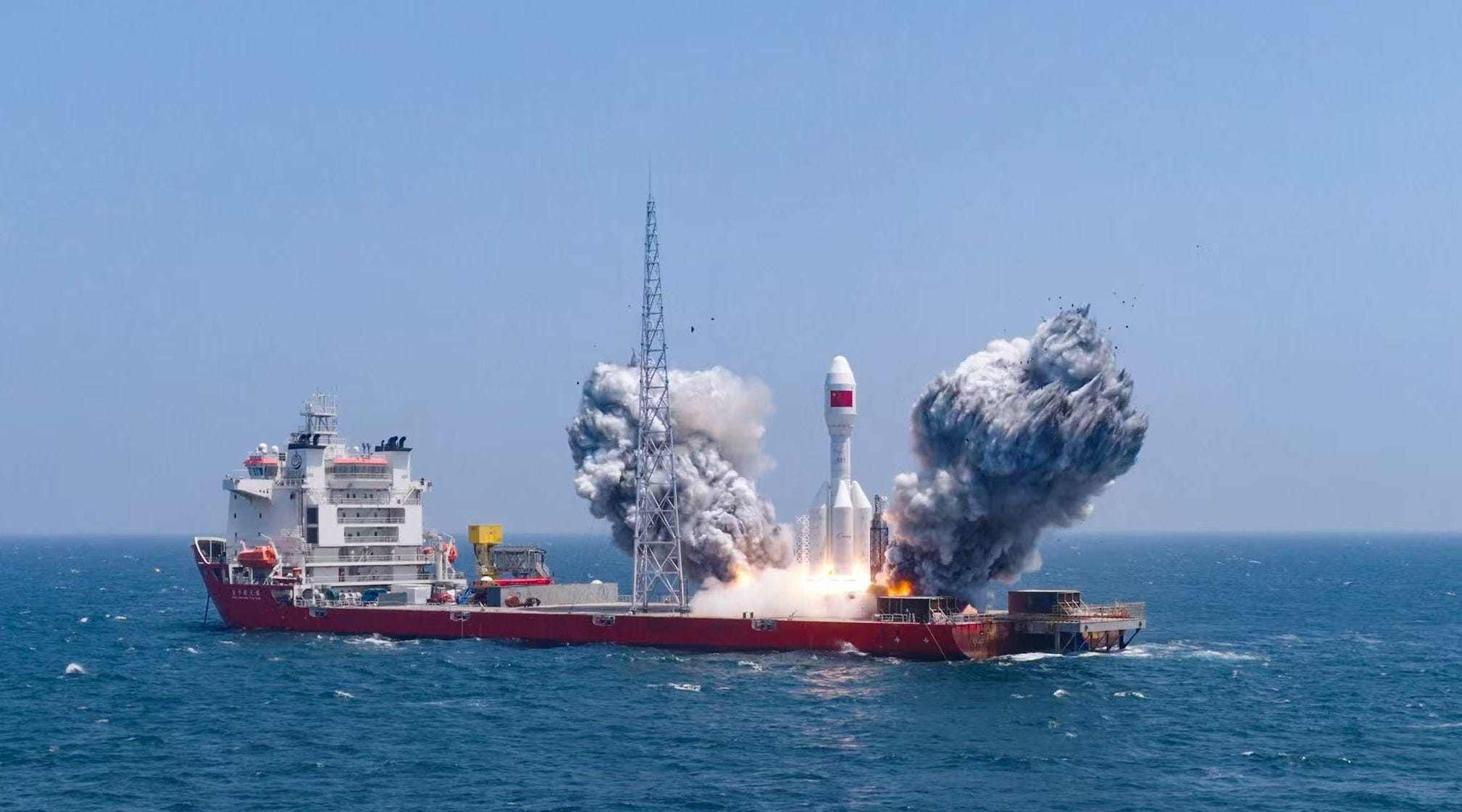
From the waters of the East China Sea near (上海市), Orienspace’s Gravity-1 blasted off from a dedicated launch ship at 10:45 am China Standard Time (02:45 am Universal Coordinated Time) on July 22nd, flying towards a sun-synchronous orbit with a handful of customer satellites.
Among those being released into orbit was the 50-kilogram Tianyi-49 (天仪49星) built by SpaceTY (天仪研究院) to perform remote sensing and Earth observation technology verifications. This satellite is also known as BUPT-4 (北邮四号卫星) for a partnership with the Beijing University of Posts and Telecommunications (北京邮电大学).
From Xi’an Zhongke Xiguang Aerospace Technology Co Ltd (西安中科西光航天科技有限公司), Xiguang-2-01 (西光贰号01星) is another remote sensing satellite that was delivered, with this one able to capture hyperspectral and full-color optical images, then processing them with an onboard artificial intelligence solution developed by Zhejiang Lab (之江实验室)1. Xiguang-2-01 is expected to prioritize tasking by the Yunnan Provincial Bureau of Geological and Mineral Exploration and Development (云南省地质矿产勘查开发局) as the first member of a small constellation.
A replacement satellite in Zidingxiang-3 (紫丁香三号卫星), or Lilac-3, additionally designated Kaiyun-2 (开运二号), produced by the Harbin Institute of Technology (哈尔滨工业大学) was flown too. The first satellite designated Lilac-3 is believed to have been lost in the failed inaugural Ceres-2 launch. Like its original, Lilac-3 is expected to verify thermal, mechanical, attitude control, and drag characteristics of extremely thin spacecraft.
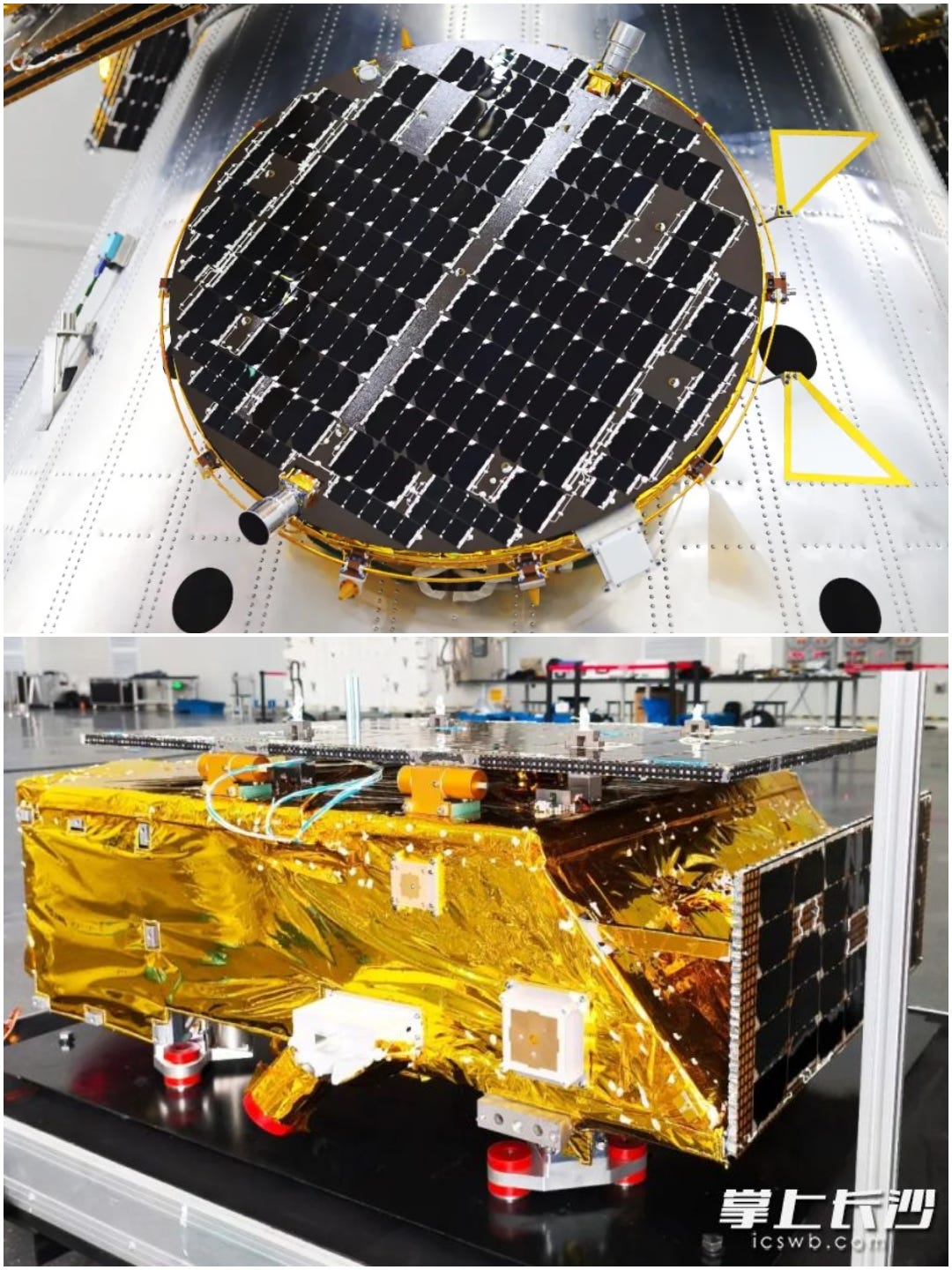
The remainder of the payloads stop of the launch vehicle were six Dongpo (东坡) Earth monitoring satellites, designated Dongpo-13 (东坡13), Dongpo-14 (东坡14), Dongpo-17 (东坡17), Dongpo-18 (东坡18), Dongpo-19 (东坡19), Dongpo-20 (东坡20), from Huantian Wisdom Technology Co Ltd (环天智慧科技股份有限公司), a subsidary of MinoSpace (微纳星空). Four of those are designed around synthetic aperture radars while two have optical instruments.
One of them, Dongpo-14, has the Southwestern University of Finance and Economics (西南财经大学), located in Chengdu (成都市), Sichuan (四川) province, as a partner for its tasks, with its collected imagery to be applicable to insurance data and investment considerations. The university disclosed that the satellite has optical instruments able to image at a resolution of 0.5 meters, while weighing 280 kilograms with the use of electric propulsion systems.
All six are part of the wider Dongpo fleet, now up to twenty, to enable frequent imaging of desired sites in any weather at any time for supporting natural resource monitoring, disaster prevention planning, and conservation efforts, among others. Those six satellites are also the first to be made by a new ‘super factory’ located in Wuxi (无锡市), Jiangsu (江苏) province, out of a planned one hundred and fifty per year.
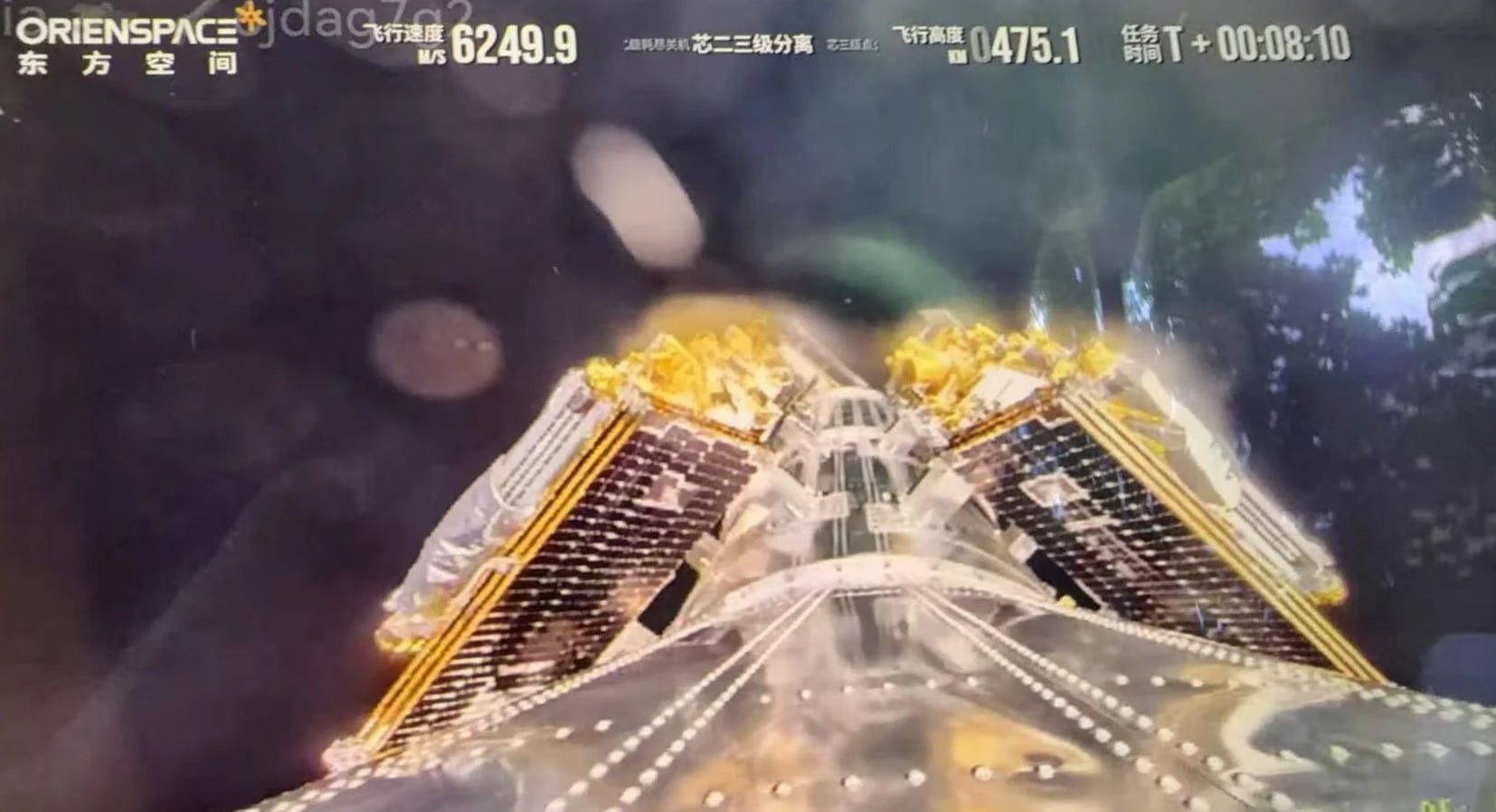
Through launching the nine customer satellites, Orienspace has boasted that they now hold the record for the heaviest mass launched by a commercial space enterprise in China. A specific figure was not provided for that claim, but based on the upper limit of capabilities for other vehicles2, it should be at least 2,000 kilograms.
With this launch, Orienspace has also reduced the time between Gravity-1 missions, from the lows of twenty-one months between its January 2024 debut and October 2025 second flight, as this was nine months after the last. Future flights should have even smaller intervals between them thanks to simultaneous preparation efforts at the Haiyang Oriental Spaceport (海阳东方航天港) and internal leadership changes, which has already allowed Orienspace to speak with reclaimed confidence at industry events.
Today’s launch was the 3rd mission for Gravity-1. This was also the 49th launch from China in 2026.
Liftoff footage via PhilLeafSpace, 中国航天文化, and China航天 on Weibo.
Check out the previous Gravity-1 launch
Gravity-1 Returns with Customer Carrying Sea-Launch! [Gravity-1 Y2]
![Gravity-1 Returns with Customer Carrying Sea-Launch! [Gravity-1 Y2]](https://substackcdn.com/image/fetch/$s_!-X5p!,w_1300,h_650,c_fill,f_webp,q_auto:good,fl_progressive:steep,g_auto/https%3A%2F%2Fsubstack-post-media.s3.amazonaws.com%2Fpublic%2Fimages%2Fc46f5d2a-2a4c-4428-b673-f7144e9f0640_5742x2825.jpeg)
Orienspace’s Gravity-1 launch vehicle blasted off from a sea-launch platform in the Yellow Sea off the coast of Haiyang (海阳市), Shandong (山东) province, at 10:20 am China Standard Time (02:20 am Universal Coordinated Time) on October 11th, for a flight into…
What is Gravity-1?
This section is for those less familiar with China’s various commercial launch vehicles.
The Gravity-1 is a commercial launch vehicle developed and manufactured by Orienspace. Gravity-1 utilizes solid propellant across all its three 2.65-meter-diameter atmospheric ascent stages, with a solid-fuelled fourth-stage for orbital insertion of payloads housed within a 4.2-meter-diameter fairing.
The payload capacity of the launch vehicle is currently as follows:
6,500 kilograms to low Earth orbit
4,200 kilograms to a 500-kilometer sun-synchronous orbit
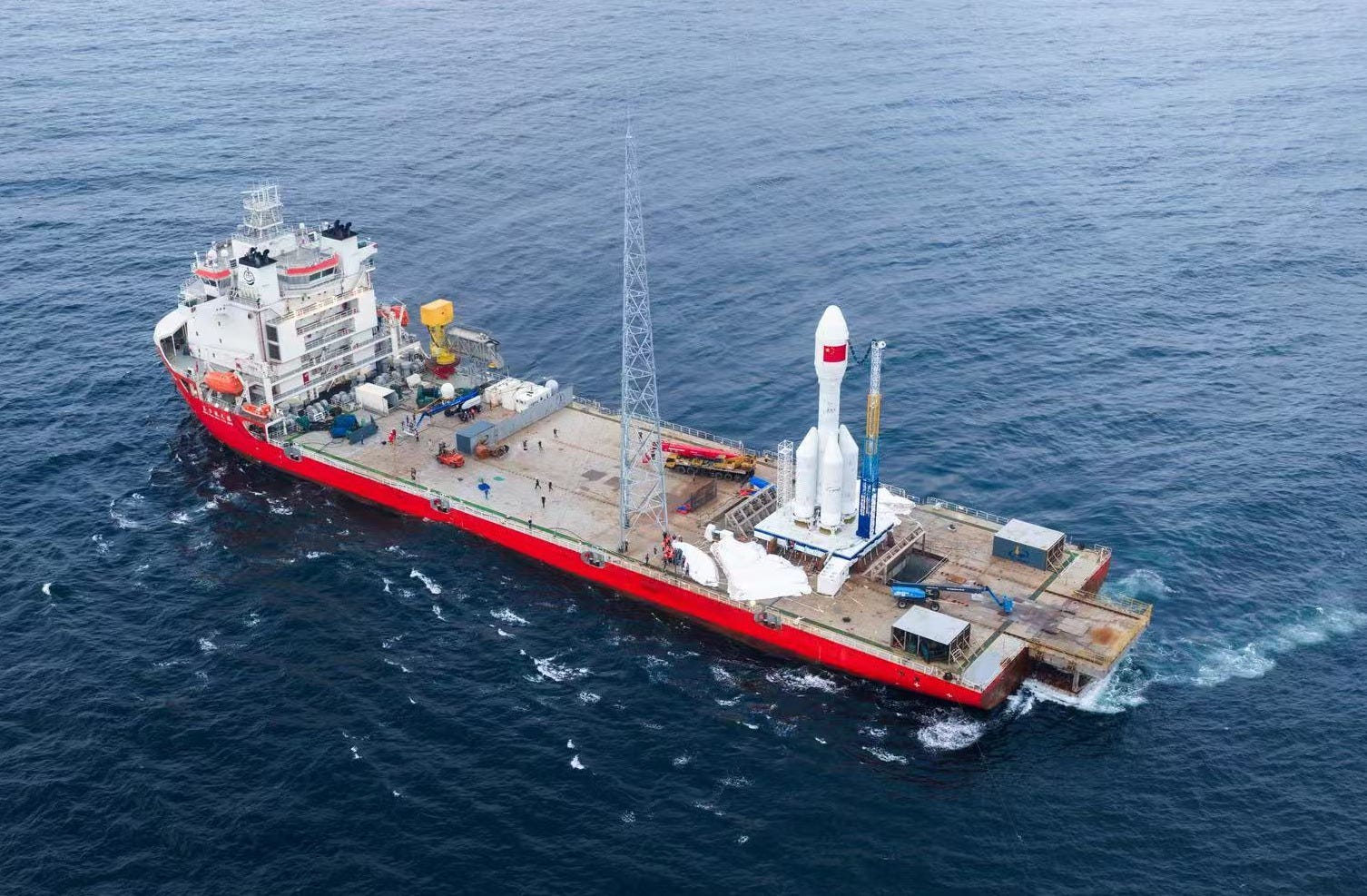
When prepared for flight, Gravity-1 stands 30 meters tall and weighs 405,000 kilograms. The first-stage consists of four solid rocket boosters, each generating 150 tons of thrust using an unspecified solid propellant, for a combined thrust of 600 tons. The second and third stages are both high-altitude-optimized solid rocket boosters, though their specific thrust levels have not been disclosed.
Currently, OrienSpace’s Gravity-1 is launched from floating sea platforms once prepared for launch.


Who are also heavily involved with ADA Space’s Three-Body Computing Constellation.
CAS Space’s Kinetica-1 is previously thought to hold that record, and is designed to carry up to 2,000 kilograms.