

Potential Space Data Centers Attracts Interest From State and Commercial Enterprises
Few plans exist currently, but massive amounts of computing power could be placed into orbit.

In recent months, putting data centers in space has become a compelling idea to U.S. space companies due to cheap solar energy and a usually cold environment, with SpaceX having its future bet on a million-satellite AI computing constellation. In China, the idea is being explored too, via enterprises in the nation’s space sector.
The first Chinese effort looking to deploy significant amounts of computing power into orbit is the Three-Body Computing constellation from ADA Space, which saw its first launch in May 2025. That constellation is planned to be an orbiting AI infrastructure of up to 2,800 satellites1 for accelerating intelligent applications across multiple industries, including processing other spacecraft’s data and performing energy-intensive computing tasks.
Recently, in January, the computing constellation had the Qwen3 AI large language model from Alibaba Cloud (阿里云) deployed onto its orbiting spacecraft, where it completed a complex task sent up from the ground, had it jointly processed in space, with results sent back to Earth. The task was reportedly completed by the satellites in under two minutes, thanks to previous in-space model training in September 20242, and was boasted to be further ahead than the single-satellite U.S. equivalent Starcloud.
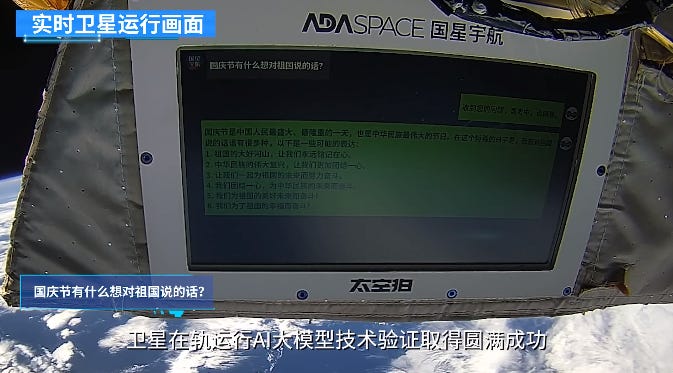
This year, the Three-Body Computing constellation is planned to be expanded in orbit with the launches of its second and third satellite groups, boosting combined processing power. At the moment, just twelve spacecraft are in orbit for it.
Meanwhile, during the year newcomer Beijing Astro-Future Institute of Space Technology (北京星辰未来空间技术研究院) plans to launch its first demonstration computing satellite. Development of its was completed late last year following a first funding round of at least 140 million Yuan (20.1 million United States Dollars, as of February 4th) in June 2025, with reported backing from electronics giant Lenovo and the municipal government of Beijing (北京)3.
Between now and 2030, the Astro-Future Institute plans to prove out the economics of high-power computing in space, aiming for at least cost equivalence with Earth-based solutions. Eventually, the Astro-Future Institute is looking to deploy dedicated data centers into a 700 to 800-kilometer sun-synchronous orbit, set for the first half of the 2030s. Those would not be many in number, but would be quite large, with concepts of a sixteen-spacecraft constellation of ‘interlinked’ gigawatt-scale data centers.
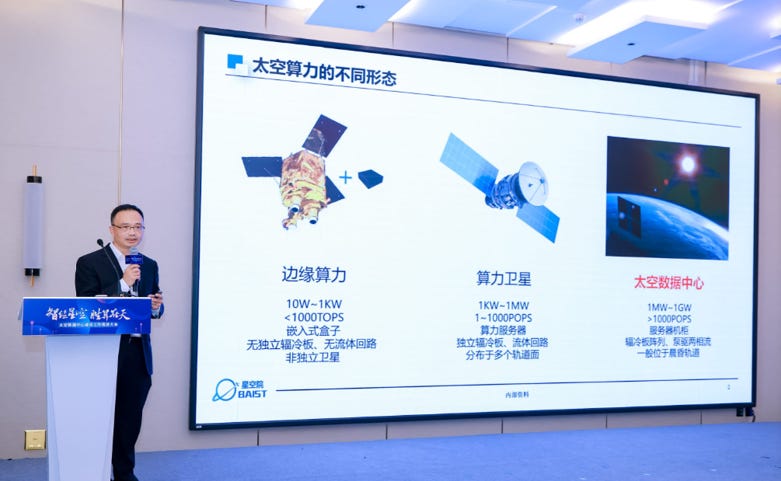
The most unknown plan for in-space computing comes from the China Aerospace Science and Technology Corporation4, as ahead of the 15th Five-Year Plan, running from 2026 to 2030 and expected to be published no earlier than March, brief details of four focus areas for the coming years were shared. Those were space tourism, space traffic management, space resource development, and space infrastructures. Regarding space infrastructures, the following was written:
“Build gigawatt-scale space-based digital and intelligent infrastructure, establish a new space architecture integrating cloud, edge, and endpoint computing, achieve deep integration of computing power, storage capacity, and transport capabilities, and empower ‘space-based computing with terrestrial data’, ‘terrestrial computing with space-based data’, and ‘simultaneous space-ground computing’.”
If there are any problems with this translation please reach out and correct me.
While quite politically written, the infrastructure section is effectively saying space data centers are being seriously explored, along with a network to link them5 to data sources and existing Earth-based compute. Further details, like spacecraft numbers and orbits, on China Aerospace Science and Technology Corporation’s plans will be revealed in the coming weeks6. Development and deployment of a ‘gigawatt-scale’ space data center could be accelerated with existing work for space-based solar power stations. China has been researching technologies for them since 2008 and pursuing technology testing since 2013.7
Like many small computing nodes pooling processing power to jointly work on major tasks. This is enabled by 100-gigabit satellite laser links for the Three-Body Computing constellation.
News regarding that:
China’s in-orbit satellite performs AI large-model tests (Xinhua / People’s Daily)
A Hong Kong University Launched the World’s First Large-Scale AI Model Earth Observation Satellite (The Diplomat)
China satellite completes AI large-model tests in orbit (Space Daily)
The municipal government is also listed as a ‘guiding unit’.
The nation’s dominant space contractor and owner of the China Academy of Launch Vehicle Technology, Shanghai Academy of Spaceflight Technology, China Academy of Space Technology, and many other space enterprises.
This could be done via currently planned connectivity mega-constellations.
Via documents for the 15th Five-Year Plan.
Space data centers could use much of the power-generating and thermal management hardware of a space-based solar power station. It would also be a convenient way to test generating and managing massive amounts of power in orbit, with the added benefit of a probably useful output from the data center’s computing tasks. Any space data centers would not have the means to transfer the generated power down to Earth. Technology to transfer power at scale is still being researched and properly understood.