

Qianfan Wants 100+ New Satellites Launched by End of July
A handful of launches will be needed to wrap up the constellations 'first phase' in an impressively brief time.

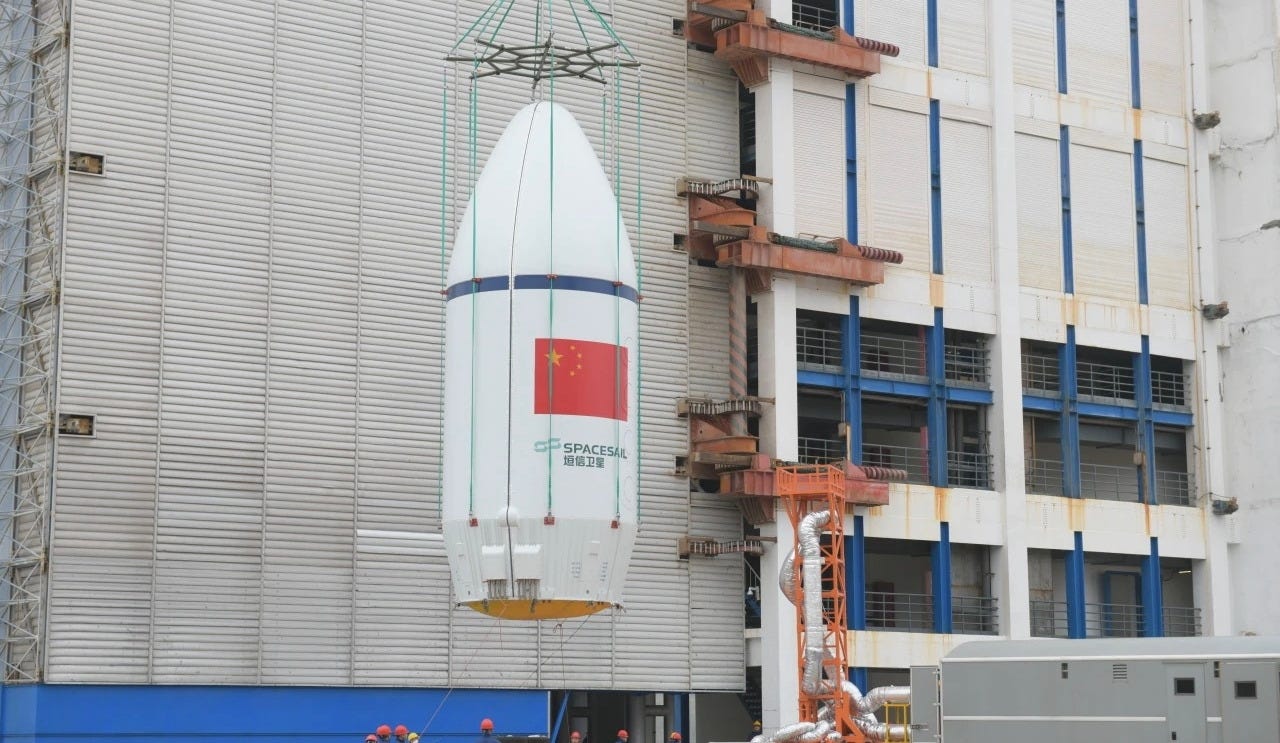
With a recent return to routine deployments of the Qianfan (千帆) connectivity constellation, China Central Television (中国中央电视台) conducted an interview with Hu Haiying (胡海鹰), who is President of the Innovation Academy for Microsatellites, Chinese Academy of Sciences (中国科学院微小卫星创新研究院), which produces some of satellites making up the constellation.
While mainly talking about why and how Chinese enterprises are deploying low Earth orbit constellations, Hu notably disclosed that Shanghai Spacesail Technologies Co Ltd (上海垣信卫星科技有限公司), operator of the constellation, aims to have a total of 324 satellites deployed by the end of July to complete a ‘first phase’. At present, there are 200 Qianfan satellites in orbit, having been launched in twelve groups over twenty-two months.
To fulfill that aim, the constellation would need to have seven launches over the next seven weeks, if deploying the usual groups of 18 satellites. Bulk bought launch services and a stockpile of contracted satellites, recently enabled six deployments over two months, starting in April and running through to early June.
Deploying 124 satellites in seven weeks would be an impressive feat for the constellation, but it may be a sign that Shanghai Spacesail Technologies has strong confidence in its launch providers and manufacturers. It could also mean that demonstration missions contracted to LandSpace, CAS Space, and Space Pioneer are set for the near future.
According to a presentation in December 2025, it was detailed that a total of 324 satellites for the Qianfan constellation are set to be deployed throughout this year1, then matched in 2027. At the start of deployments in mid-2024, Shanghai Spacesail Technologies was aiming to have 648 satellites in orbit by the end of 2025. That was missed after several satellites appeared to fail during maneuvers towards operational orbits.
Another interesting detail disclosed by Hu Haiying was that the Microsatellite Academy’s price for a Qianfan satellite, either to manufacture or charged to the constellation operator, has fallen to around 10 million Yuan (1.47 million United States Dollars, as of June 10th). According to CGTN, that is a roughly ninety-six percent cost reduction compared to traditional connectivity satellites. Multiplying that cost by the average count deployed via a launch mission, it comes to about 180 million Yuan (26.5 million United States Dollars).
Compared to the individual spacecraft cost for SpaceX’s Starlink constellation, floating around a million United States Dollars per external estimates and regulatory filings, it is not a significant difference. A notable point of divergence is that Shanghai Spacesail Technologies contracts Qianfan satellite production to several enterprises, state-owned and commercial.
Unlike Starlink, the Qianfan constellation is yet to begin providing its space-based connectivity services to individual users and corporate customers, which will generate revenue for its operator. Towards the end of the year, services are reportedly expected to start in at least Brazil and China. Agreements are also in place to bring those to Malaysia, Kazakhstan, Türkiye, and airlines as well.
So far, 92 out of 324.