

Qingzhou to Bring Cargo to Tiangong in Early 2027
The spacecraft’s first mission is still underway, but confidence has been gained for its main purpose to start next year.

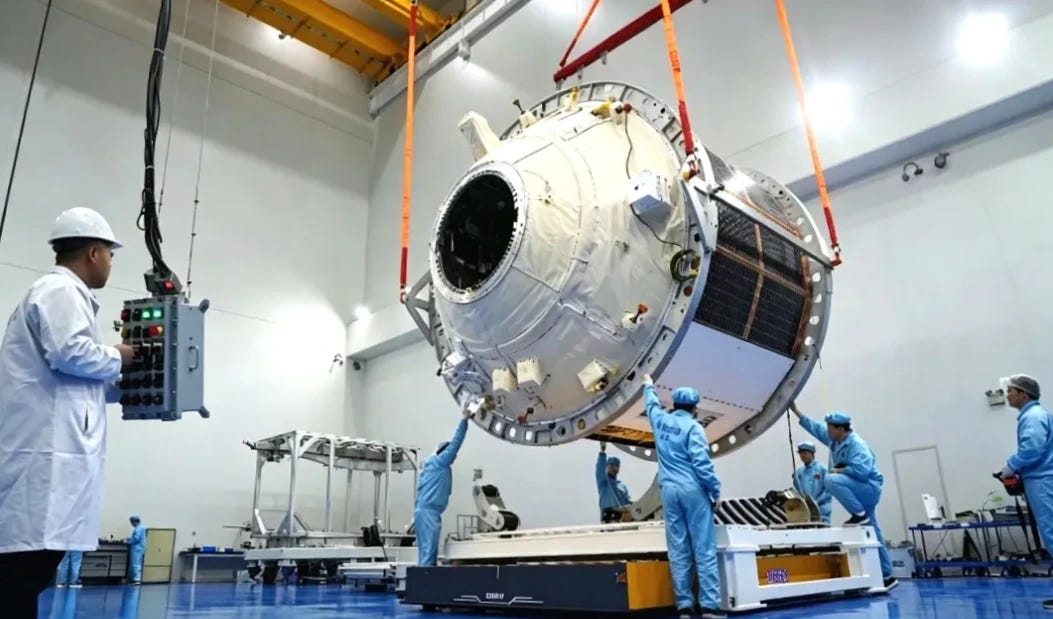
It has been just over two months since the first Kinetica-2 launch vehicle headed into low Earth orbit, bringing the Qingzhou (轻舟) cargo spacecraft with it. Since entering orbit, the spacecraft has been busily conducting tests of its many systems according to its developer, the Innovation Academy for Microsatellites, Chinese Academy of Sciences (中国科学院微小卫星创新研究院).
Those tests are going well, as the Microsatellite Academy announced at the end of a recent blog post that the second Qingzhou mission will begin in early 2027 and that it will visit the Tiangong Space Station, something contracted in late 2024. As part of that announcement, it was detailed that hardware for the cargo spacecraft is well into production, without detailing the status of components. A docking port, to allow taikoanuts to enter the spacecraft to move cargo, is one of the undetailed parts, which may be directly provided by the China Manned Space Agency.
Due to the mission being at least six months away, the amount of cargo that will be brought to Tiangong is still being considered. Qingzhou is capable of carrying 1,800 kilograms of various items, crew commodities and experiments, while allowing for the disposal of 2,000 kilograms from the space station.
The cargo spacecraft’s first visit to the orbiting laboratory is likely to be similar to the first mission of Northrop Grumman’s Cygnus. That had the inaugural Cygnus slowly approach the International Space Station over the course of a few days, for safety and system checks, before being berthed1 to it for a little over a month. Cygnus was also loaded with more cargo for disposal than it delivered2.
Qingzhou’s first visit won’t carry as much risk as Cygnus’ first flight, as the Microsatellite Academy has been trusted to operate within small satellites in the proximity of Shenzhou-7 in 2008 and Tiangong-2 in 2016 to image both while they were crewed. The cargo spacecraft has also been demonstrating maneuvers in orbit as well.
As for how that first delivery of items to Tiangong will leave Earth, the Microsatellite Academy is openly procuring a launch solution from whoever can fulfill it in China’s space sector. That solicitation was initially inferred as for the debut of Qingzhou when announced in December 2025. Requirements for selection are a launch vehicle able to send around 5,000 kilograms into the orbit of the Tiangong Space Station with a fairing that can house a 5.3-meter-long and 3.78-meter-wide spacecraft3.
Mentioned earlier is that the cargo spacecraft has undergone tests of its systems. In addition to those, several experiments are on board to make use of available cargo space and to practice incorporating and loading externally designed items. A new space-rated refrigerator, myoelectric detectors for muscles, blood cell analyzers, and a space debris collection adhesive had their prolonged use verified recently. Many items on board will have tests and experiments continuing until the first months of 2029.
Free-flying, experiment-carrying Qingzhou missions are intended to continue into the future, building experience and reducing cost through regular missions, as a way of performing microgravity experiments without unintended human interference4 like on Tiangong. The Microsatellite Academy revealed that by sharing:
“Not only will it routinely carry out cargo resupply missions, the spacecraft will, in accordance with the overall development plan for the Qingzhou program, further expand the scope and depth of its scientific experiment platform services.”
If there are any problems with this translation please reach out and correct me.
Berthing to the International Space Station involves a visiting spacecraft being grabbed by a robotic arm and brought to an available docking port. Doing so means a spacecraft does not need to perform delicate thruster firings while heading to or from an open port.
700 kilograms of cargo was brought up. 1,290 kilograms of various items were loaded for disposal.
Operational launch vehicles able to fulfill those requirements are CAS Space’s Kinetica-2, LandSpace’s Zhuque-2E and Zhuque-3, Orienspace’s Gravity-1, and most members of the Long March series.
As in vibrations and subtle shakes when using various equipment.