


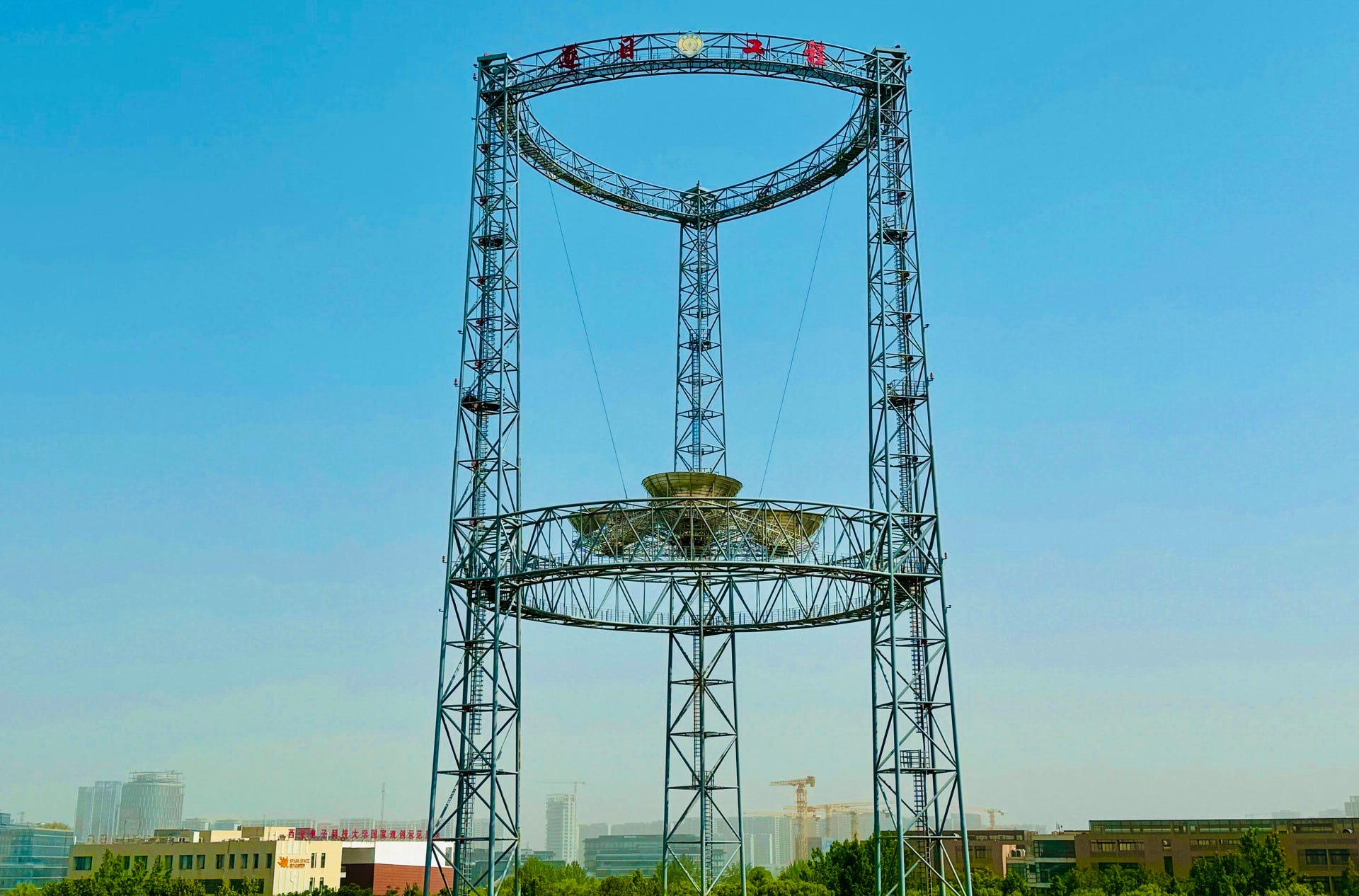
On May 18th, Xidian University (西安电子科技大学)1 shared, through national media, that its ‘Zhuri (逐日工程)’ space-based solar power research project has completed a new milestone in the proving of the futuristic technology by beaming power wirelessly to devices nearby.
According to the reports, those devices were over one hundred meters away and received around eighty-eight percent of the power transmitted, stated to be 1,180 watts to multiple devices simultaneously. Transmission tests with moving tests were also performed, with one drone flying at thirty kilometers per hour, receiving 143 watts.
Speaking with the media, leader of the research project Duan Boayan (段宝岩), professor at the university and academian at the Chinese Academy of Engineering (中国工程院), said that space-based solar power is becoming increasingly possible, with his team moving into ‘phase two’ to prove collecting power generated in orbit and sending it to Earth or a target satellite in space. The increasing possibility is likely thanks to the improvements in solar power technology and cost, which China has invested heavily in, alongside new capable launch vehicles2.
Back in 2014, Duan Boayan’s team proposed a version of their current prototype system, with semi-spherical collectors for the beams, with work on it starting in 2018. By June 2022, a ‘full-link, full-system ground validation‘ test with its prototype receiver was performed. Since then tests of increasing complexity have been occurring.
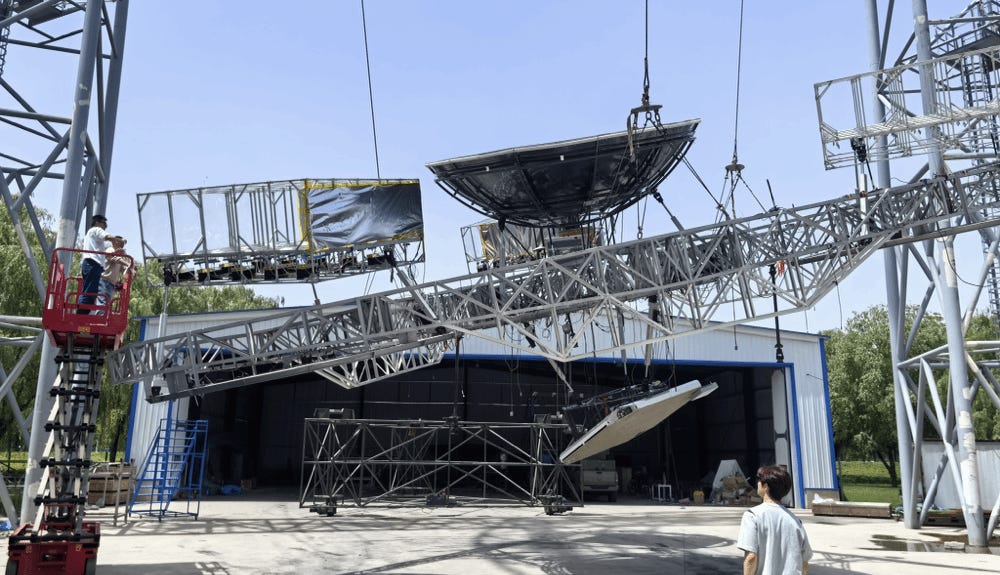
Elsewhere, in Chongqing’s (重庆) Bishan district (璧山区), Chongqing University (重庆大学) has set up a test site where space-based solar prototype equipment can be attached to balloons to demonstrate beaming power at increasingly greater distances. As of 20213 those tests had power transmitted from a height of over three hundred meters. That site and the prototype at Xidian University are supported by the China Academy of Space Technology, with both universities working in collaboration with each other.
Within China, space-based solar power has been listed as a key national research program since 2008, while being thought of as a means of providing massive amounts of clean power to meet the growing energy demands of the nation of 1.4 billion people, who have a rising standard of living each year with the appliances for it. There is also the goal of becoming net-zero for emissions by 2060. As such, demonstration missions are hoped to be in orbit before and around 2030.
Around the world space-based solar power is under research to varying degrees. At the California Institute of Technology the hardware to beam power has been demonstrated at a small scale in orbit within a satellite, but detectable to instruments on Earth. In a step up from that, sometime this year Japan’s ‘OHISAMA’ project may launch a spacecraft to prove beaming power to Earth. Additionally, the European Space Agency is conducting a feasibility study into a demonstration mission, while the U.S. military is exploring the technology for use in warfare.

In Xi’an (西安市), Shaanxi Province (陕西).
Those able to send over a dozen tons into orbit with wide fairings to secure payloads.
No newer tests stating distances have been shared.