

Reusable Long March 12B Fires Up Ahead of First Flight
Another new reusable launch vehicle is preparing to fly from China within a few weeks.

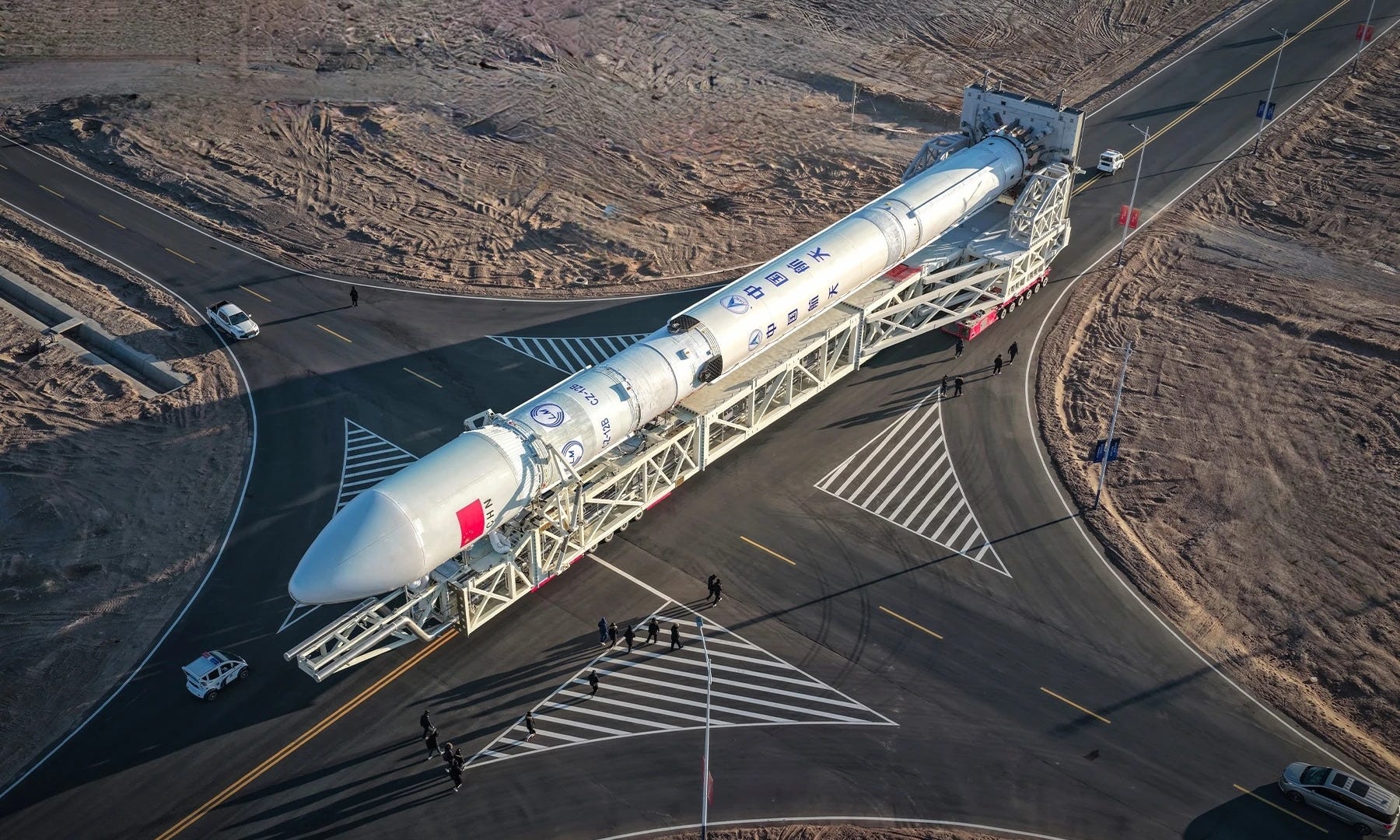
On January 16th, the China Aerospace Science and Technology Commercial Launch Vehicle Group Co Ltd (中国航天科技集团商业火箭有限公司) announced that their partially reusable Long March 12B launch vehicle had completed its pre-flight first-stage static fire, taking place at the Long March 12 series’ Jiuquan Satellite Launch Center launch pad.
For the static fire, the 72-meter-tall vehicle’s first and second stages, both 4.37 meters in diameter, were loaded with rocket-grade kerosene and liquid oxygen via the launch pads transporter-erector. Once propellant was onboard, the first-stage’s nine YF-102R fired up to each generate 85.1 tons of thrust, for a total of 765.9 tons.
According to the Commercial Launch Vehicle Group, which developed the vehicle in partnership with the Shanghai Academy of Launch Vehicle Technology and the China Academy of Launch Vehicle Technology1, the static fire comprehensively simulated the entire pre-launch process, with real operations almost reaching the point of liftoff. Data gathered is said to have enabled teams at Jiuquan to move toward the Long March 12B’s first flight. Some relevant flight data is already known from its relatives, the four-times-flown expendable Long March 12 and the reusable methane-using Long March 12A.

No dates have been announced for when the Long March 12B will perform its first flight. Rumours suggest it will fly before this year’s Spring Festival (春节), starting February 15th.
For the flight, four grid fins, for guiding the first-stage booster during unpowered descent, are installed but four landing legs aren’t, despite attach points being there. Those landing legs may be installed before launch, to enable a soft touchdown on a landing site around 500 kilometers away in Minqin County (民勤县), in Gansu (甘肃) province. Alternatively, the Long March 12B’s booster may only be aiming to verify a smooth reentry and in-flight engine startup before a controlled crash, due to the first Long March 12A’s poor condition after atmospheric reentry, resulting in it falling five kilometers away from the landing site.
Way before the static fire, the vehicle’s second-stage and the vacuum-optimized YF-102V engine, also generating around 85.1 tons of thrust, were tested in March 2025. That test verified the YF-102V’s throttle control of the engine, the ability for multiple engine startups and shutdowns, and confirmed the design of the stage with propellants loaded.
When the launch vehicle does, it will become China’s third reusable launch solution2, following LandSpace’s Zhuque-3 and the Shanghai Academy of Spaceflight Technology’s Long March 12A in December 2025. Unlike those two, the Long March 12B does not use liquid methane as a propellant, allowing it to become China’s first rocket-grade kerosene-utilizing reusable rocket.
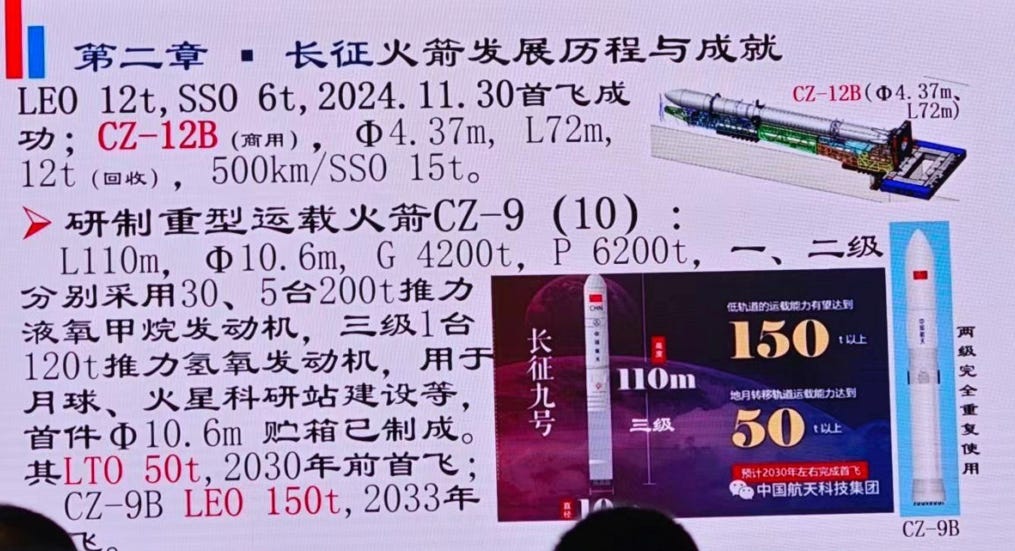
Like several other launch vehicles currently underdevelopment in China, the Long March 12B’s main payloads are planned to be the country’s handful of connectivity mega-constellations. For that, the launch vehicle is set to carry up to 20,000 kilograms to low Earth orbit or 15,000 kilograms into a 500-kilometer sun-synchronous orbit within its 5.2-meter-diameter fairing. During development (see below), aims were to have the Long March 12B possessing equal or greater capability than its expendable relative.
All three are subsidiaries of China’s dominant state-owned space contractor, the China Aerospace Science and Technology Corporation (中国航天科技集团有限公司).
Space Pioneer with its Tianlong-3 has made no progress towards launch since delivering the launch vehicle to the Jiuquan Satellite Launch Center in November 2025. It was previously expected to fly in December 2025.
Appreciate the rundown. Regarding payload capacity the “12t (回收)” entry on the slide would lead me to believe that the 20t to LEO and 15t to SSO figures discussed elsewhere are probably only possible in an expendable configuration.
Really good progress and more reusable launches should be planned because each failure will provide valuable data that the next iteration should improve on and I am sure that successful reusable rocket by China is getting nearer and nearer.
Regards