

Scientists Publish Model of Potential Lunar Water Ice Locations Ahead of Chang'e 7 Mission
Permanently shadowed regions could hold water ice and other chemicals on the Moon; searching for and analyzing it is a key part of the next flagship Chang’e mission.

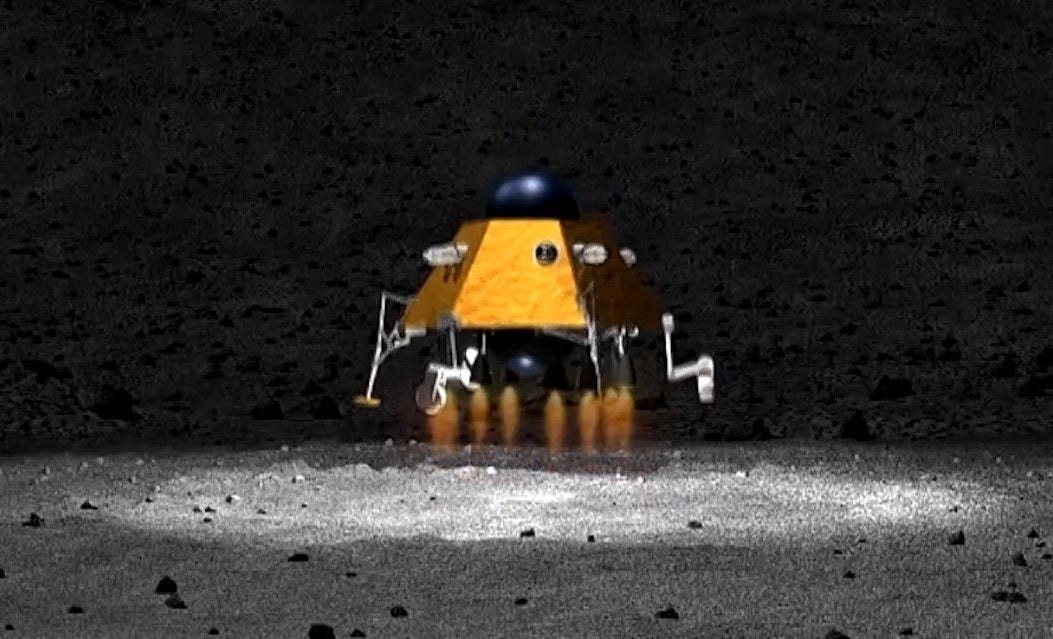
This August, China’s Chang’e 7 mission will launch toward the Moon atop of a Long March 5 launch vehicle, then landing near the Shackleton Crater at the lunar south pole within weeks. The mission, which is planned to last eight years, will primarily search for water ice within permanently shadowed regions.
To search for water ice, Chang’e 7’s orbiter, lander, and robots have an extensive suite of science instruments, from Chinese and international institutions, to study possible deposits. Instruments looking for water ice will analyze lunar regolith up close via hops into permanently shadowed craters, where the Sun never reaches, and from orbit.
Supporting and possibly accelerating the study of lunar water ice, scientists and researchers from the State Key Laboratory of Solar Activity and Space Weather (太阳活动与空间天气全国重点实验室), National Space Science Center (国家空间科学数据中心), and College of Earth and Planetary Sciences (大学地球与行星科学学院), all under the Chinese Academy of Sciences (中国科学院), have published a model of likely locations housing water ice, along with a series of illustrative maps outlining where it is. Both were recently published in the Planetary Science Journal via a paper titled ‘Thermal Stability of Ice at Shackleton Crater: Implications for Water Ice Detection for the Chang’e-7 Mission’.
To produce the model, the team behind the paper utilized high-resolution terrain data from NASA's Lunar Reconnaissance Orbiter, then simulated how sunlight, reflected radiation, and heat from the Moon's interior combine to determine temperatures across and around the crater. Those temperatures were then checked against measurements from the Reconnaissance Orbiter Diviner1 instrument and previous detections of surface water ice from India’s Chandrayaan-1 spacecraft2. Once checked, the team theorized how fast water ice and other frozen chemicals would evaporate at different depths below the surface and where they would last long term.
Chemicals expected to be within Shackleton Crater are water ice (H2O), obviously, ammonia (NH3), sulfur dioxide (SO2), and hydrogen cyanide (HCN) on or just below the surface regolith. All of those chemicals are theorized to be within permanently shadowed regions, with pockets of water ice elsewhere in cold traps, up the crater walls, and nearby in smaller craters. Additionally, depending on local conditions, some of those chemicals may coexist side by side.
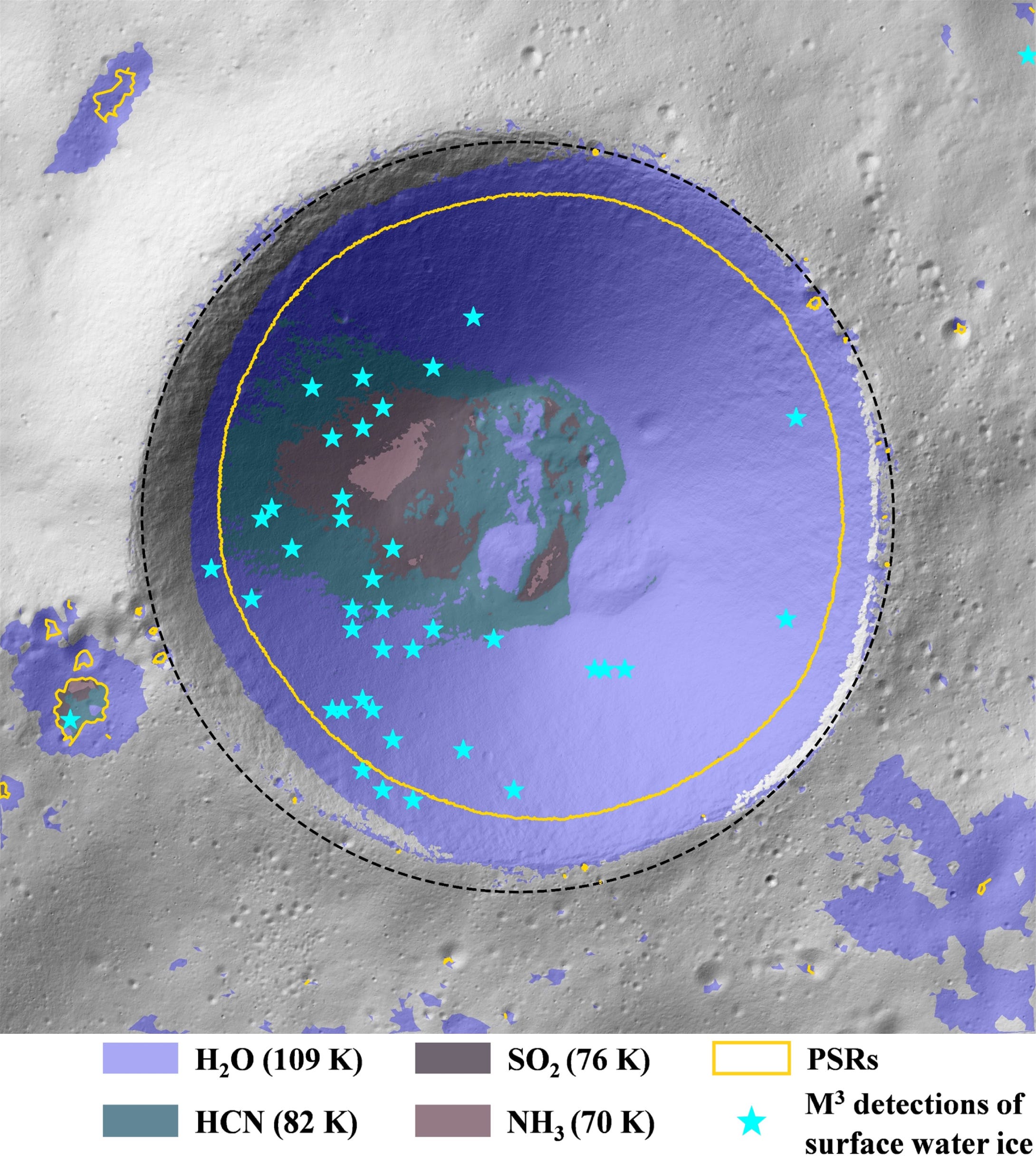
With their model, the team believes there’s a significant amount of possible water ice within Shackleton Crater that Chang’e 7’s robots can find and perform research on to understand the Moon, as well as other theorized chemicals. Regarding both, the team wrote in the paper:
“Most of the surface of lunar regolith inside Shackleton crater is favorable for the stable preservation of water ice. . . . identified cold traps could preserve a rich history of volatile accumulation and serve as targets for in situ exploration of water ice during the [Chang’e]-7 mission.”
The amount of water ice and other chemicals in the crater won’t be confirmed until Chang’e 7 explores it and the surrounding areas. But with a planned eight-year lifespan, water ice research around Shackleton should be going on well into the 2030s.
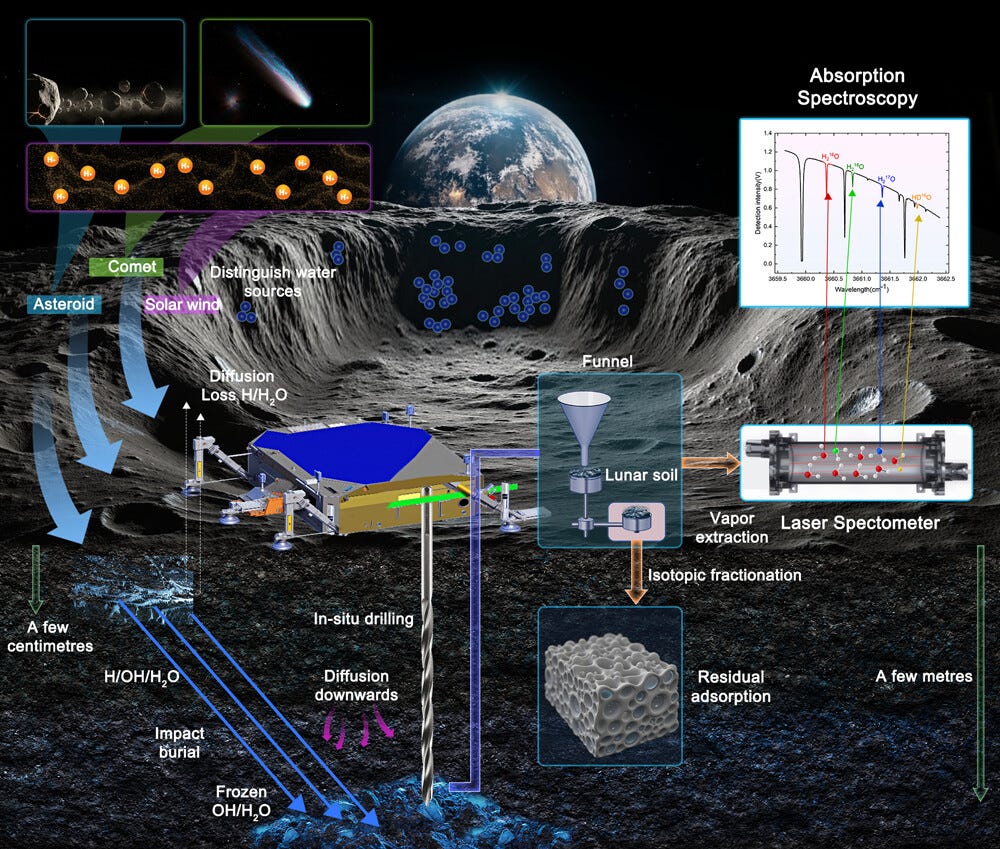
Much of the water ice analyzed during the Chang’e 7 mission will be done via its small hopping spacecraft, which will fly in and out of permanently shadowed craters with the Lunar Soil Water Molecule Analyzer (LUWA) instrument, guided by its Differential Absorption Spectrometer which determines if frost is present on surface regolith. The LUWA instrument will drill into the lunar regolith and collect about one gram of likely water ice and other chemicals, then heating up its sample, inside the ceramic-based Lunar Soil Heating Module, to two hundred degrees Celsius to extract whatever was held inside or on the regolith. During and after the heating process, collected regolith will be observed by LUWA’s Tunable Laser Spectrometer and the Time-of-Flight Mass Spectrometer.
Via the instruments team:
“The Diviner Lunar Radiometer Experiment . . . is the first instrument to create detailed day and night surface temperature maps of the Moon.”
Which orbited the Moon from November 9th 2008 to August 29th 2009.