

Sea Launch Delivers Second Group of Ten Navigation Satellites [Jielong-3 Y10]
China Rocket's Jielong-3 has now flown from the sea for the tenth time, all successfully so far.

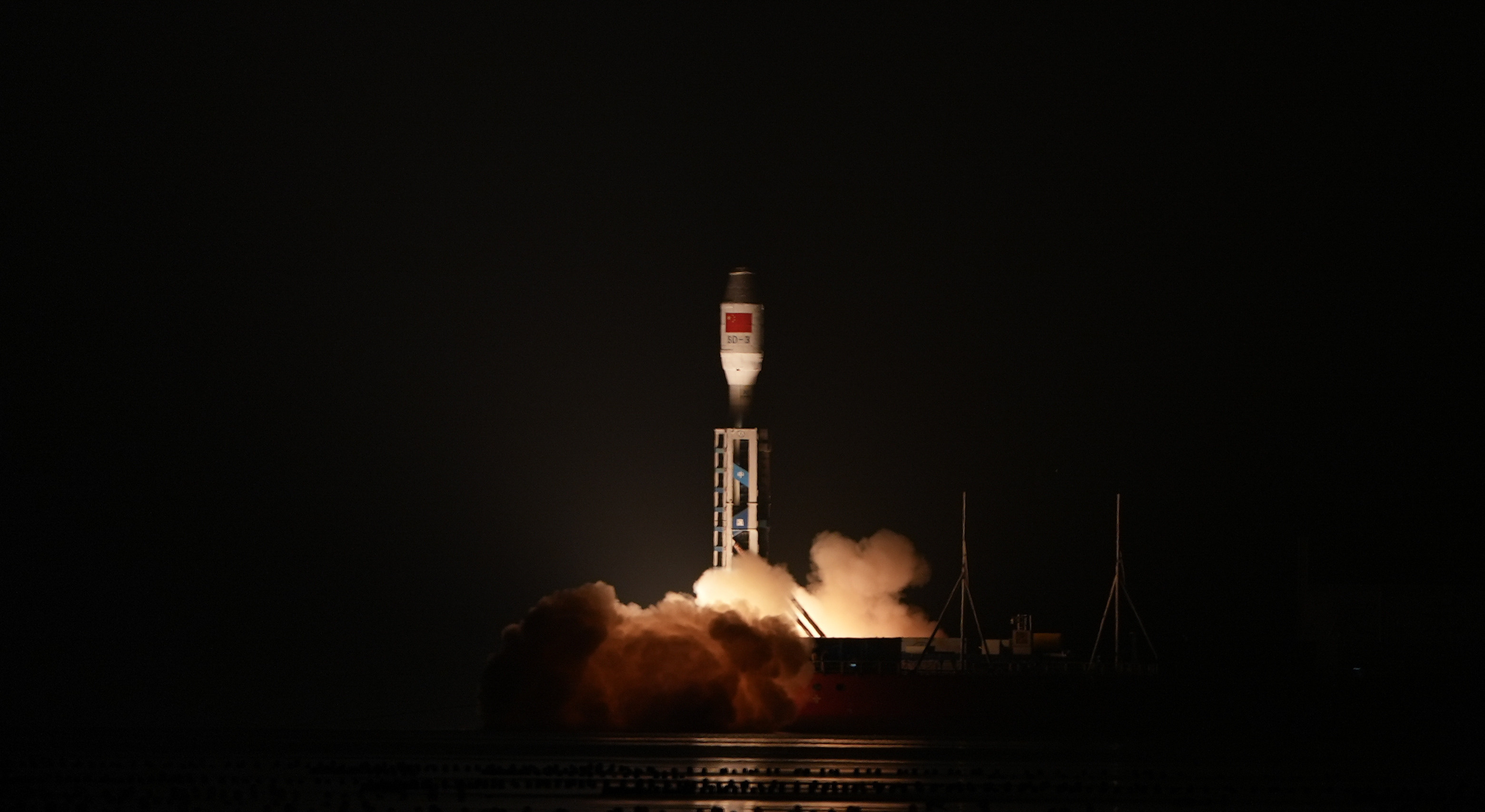
From the Yellow Sea near Haiyang (海阳市), Shandong (山东) province, a Jielong-3 blasted off at 23:49 pm China Standard Time (15:49 pm Universal Coordinated Tme) on March 22nd, carrying ten satellites towards sun-synchronous orbit.
The ten satellites onboard were the second group of CentiSpace (微厘空间02组卫星) navigation spacecraft from Beijing Future Navigation Technology Co Ltd (北京未来导航科技有限公司), or Future Navigation (未来导航) in short. Each of the satellites weighs approximately 100 kilograms, part of that being taken up by high-speed inter-satellite communications links, while having a ten-year planned useful life.
With this launch, Future Navigation should be able to begin basic services from the CentiSpace network in the near future. Services from the constellation include positioning of Internet-of-Things devices (mobile phones and autonomous vehicles), support of smart grids, as well as land surveying and disaster monitoring. Once more satellites are launched, navigation services from the network are planned to have an accuracy as low as ten centimeters.
Deployment of the second group of CentiSpace satellites comes fourteen months after the first group, also launched via a Jielong-3 from the Yellow Sea. Future Navigation plans to eventually have one hundred and ninety satellites in orbit for the CentiSpace network to provide global services.
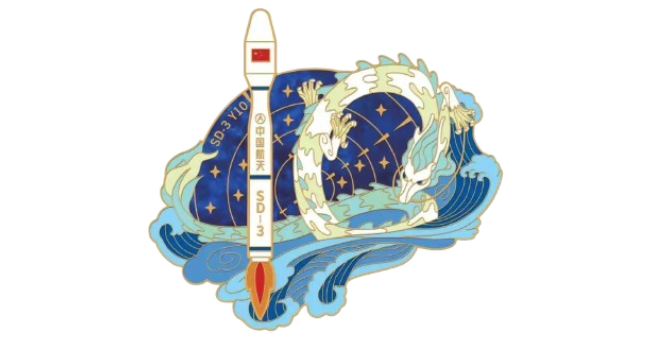
Following today’s launch, the China Academy of Launch Vehicle Technology, owner of the Jielong series operating enterprise China Rocket (中国火箭), highlighted that this was the tenth flight of the Jielong-3 launch vehicle, with ten successful missions delivering ninety-three satellites to date. Looking forward, the Launch Vehicle Academy said that they will continue to accelerate Jielong-3’s mission frequency to offer economical and flexible launch solutions for China’s space sector.
It was also noted by involved enterprises that this Jielong-3 had its environment measurement and control systems improved, with electromagnetic interference around its launch location eliminated, while launch preparation times were shortened.
This launch was the 10th mission for the Jielong-3 launch vehicle. This was also the 15th launch from China in 2026.
Liftoff video via 我们的太空 on WeChat and PhilLeafSpace on Weibo.
Check out the previous Jielong-3 launch
Pakistani, Hong Kong Satellites Deployed via Launch From South China Sea [Jielong-3 Y9]
![Pakistani, Hong Kong Satellites Deployed via Launch From South China Sea [Jielong-3 Y9]](https://substackcdn.com/image/fetch/$s_!5u3u!,w_1300,h_650,c_fill,f_webp,q_auto:good,fl_progressive:steep,g_auto/https%3A%2F%2Fsubstack-post-media.s3.amazonaws.com%2Fpublic%2Fimages%2Fa1ba4b98-3686-4266-8e71-b7de1c028c9f_4061x2187.jpeg)
Off of a dedicated launch ship near Yangjiang (阳江市), Guangdong (广东) province, in the South China Sea, a Jielong-3 blasted off at 14:37 pm China Standard Time (06:37 am Universal Coordinated Time) on February 12th, heading toward sun-synchronous orbit …
What is Jielong-3?
This section is for those less familiar with China’s various commercial launch vehicles.
Jielong-3, also referred to as Smart Dragon-3, is a four-stage solid-fueled launch vehicle manufactured by the China Academy of Launch Vehicle Technology. The vehicle is operated commercially via a wholly-owned subsidiary of the China Academy of Launch Vehicle Technology called China Rocket. All four stages are believed to burn an unspecified solid propellant, with the first-stage generating 200 tons of thrust.
The payload capacity of the launch vehicle is currently as follows:
1,600 kilograms to a 500-kilometer sun-synchronus orbit.
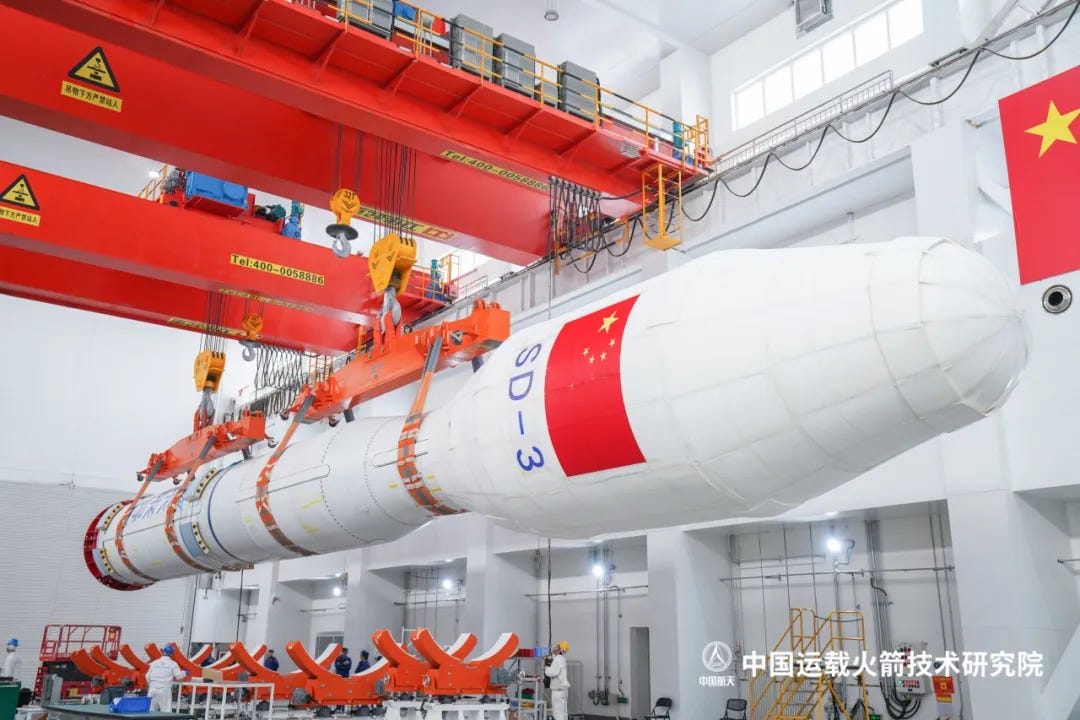
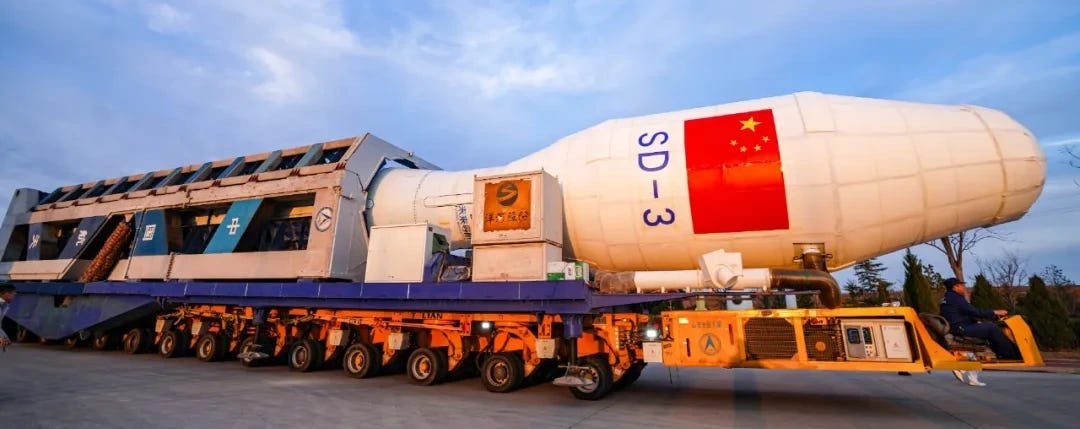
On a launch platform, Jielong-3 is believed to be 31 meters tall. Details about the four stages of the vehicle are scarce but the first two stages have a diameter of 2.64 meters, with the fairing having a diameter of 3.35 meters. When prepared for launch Jielong-3 weighs a believed 145,000 kilograms.
So far Jielong-3 has flown from sea launch platforms in the East China Sea, South China Sea, and Yellow Sea.
Good , but this is the exact rocket that should be made reusable because its least risky as we know the launch is in sea and booster will also land back to landing pad in sea. CATL , guys , you did that for Long March 10A , so also make that happen here for this kind of rocket.
Regards