

Second Environment Monitoring Satellite Delivered to Orbit out of Jiuquan [Long March 4C Y41]
Daqi-2 is heading towards sun-synchronous orbit to begin monitoring Earth's atmosphere and gases that warm it.

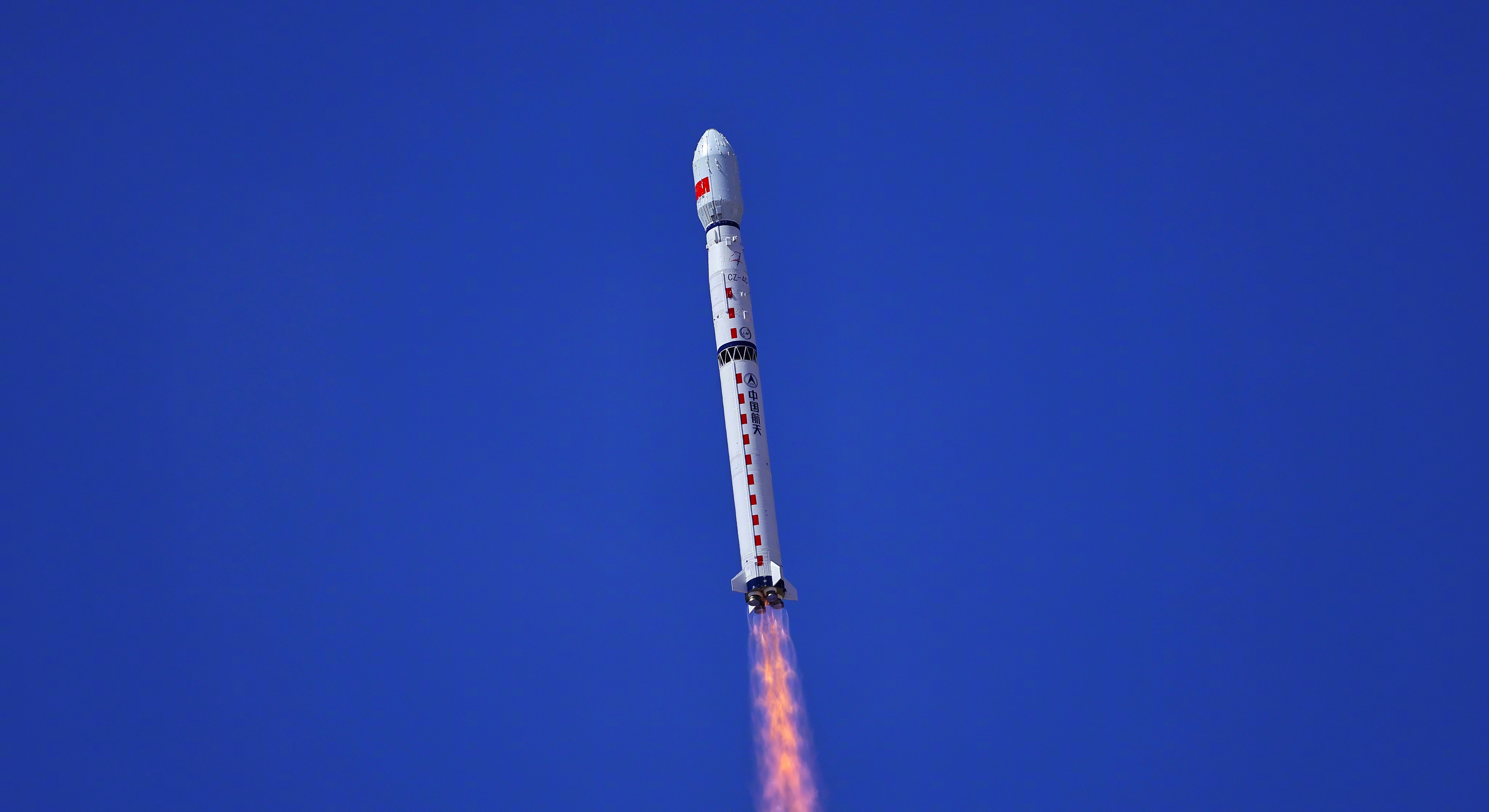
Off of Launch Site 94 at the Jiuquan Satellite Launch Center, a Long March 4C lifted off and flew towards sun-synchronous orbit at 12:10 pm China Standard Time (04:10 am Universal Coordinated Time) on April 17th, carrying an environmental monitoring satellite.
The environmental monitoring satellite being launched was Daqi-2 (大气二号), also known as ‘High-Precision Integrated Greenhouse Gas Observation Satellite (高精度温室气体综合探测卫星)‘, developed by the Shanghai Academy of Spaceflight Technology and planned to operate for seven years. As the satellite’s longer name suggests, it is tasked with measuring and monitoring gases that warm Earth’s atmosphere via five onboard instruments:
Atmospheric Detection Lidar (大气探测激光雷达)
Cloud and Aerosol Imager (云和气溶胶成像仪)
Wide-Swath Hyperspectral Greenhouse Gas Monitor (宽幅高光谱温室气体监测仪)
Infrared Hyperspectral Atmospheric Composition Detector (红外高光谱大气成分探测仪)
Ultraviolet Hyperspectral Atmospheric Composition Detector (紫外高光谱大气成分探测仪)1


Daqi-2 is the second satellite in its line, joining April 2022-launched Daqi-1 (大气一号), which will end operations in 2030. That satellite is most well known for beaming a green laser over Hawai’i in January 2023. According to the United Nations Observing Systems Capability Analysis and Review Tool, both satellites are managed under the Gaofen (高分) remote sensing spacecraft system. Working in tandem, the two satellites are planned to:
“[Provide] technical support for ecological and environmental management, including global climate change research, energy conservation and emissions reduction, environmental diplomacy and treaty compliance, and pollution control.”
If there are any problems with this translation please reach out and correct me.

For today’s launch mission, the Long March 4C’s 3.8-meter-diameter payload fairing was stated to have been improved to a new composite material variant. That reduced its mass, increased structural strength, and slightly improved space for payloads within.
Today’s launch was the 59th mission for the Long March 4C, the 117th launch for the Long March 4 series, the 263rd Long March vehicle launch from the Shanghai Academy of Spaceflight Technology, and the 638th launch of the Long March launch vehicle series. This was also the 24th launch from China in 2026.
Liftoff video via 大漠问天 and 我们的太空 on WeChat.
Check out the previous Long March 4C launch
Night Launch Delivers New Weather Spacecraft [Long March 4C Y45]
![Night Launch Delivers New Weather Spacecraft [Long March 4C Y45]](https://substackcdn.com/image/fetch/$s_!Pkx2!,w_1300,h_650,c_fill,f_webp,q_auto:good,fl_progressive:steep,g_auto/https%3A%2F%2Fsubstack-post-media.s3.amazonaws.com%2Fpublic%2Fimages%2F16c4a2eb-a49b-4130-a5c0-cb2be4f7d77b_2160x1207.jpeg)
Out of Launch Area 4 from the Jiuquan Satellite Launch Center at 03:28 China Standard Time on September 27th (19:28 Universal Coordinated Time on September 26th), a Long March 4C blasted off heading for polar orbit with a single payload.
What is the Long March 4C?
This section is for those less familiar with China’s Long March series of launch vehicles.
The Long March 4C is another older generation low Earth and sun-synchronous orbit workhorse of the Shanghai Academy of Spaceflight Technology. All three stages of the rocket burn Dinitrogen Tetroxide and Unsymmetrical Dimethylhydrazine, with the third-stage capable of engine restart.
The payload capacity of the launch vehicle is currently as follows:
4,200 kilograms to low Earth orbit
2,800 kilograms to a sun-synchronous orbit
1,500 kilograms to a geostationary transfer orbit
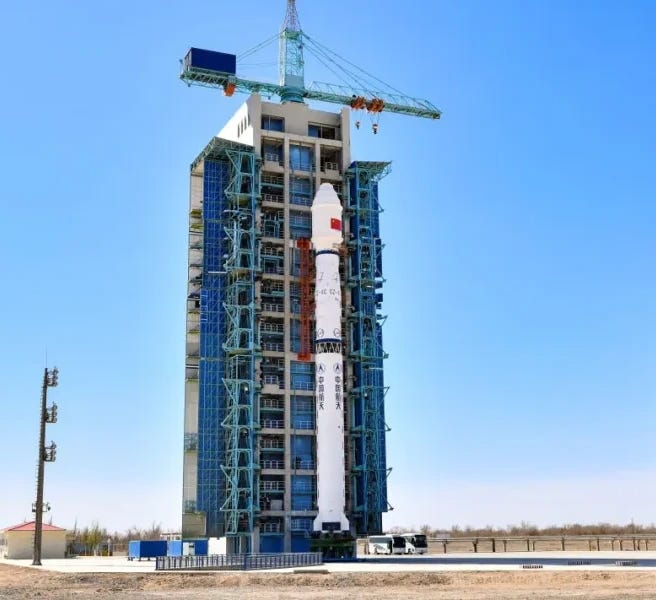
The first-stage is powered by four YF-21C engines, which generate 302 tons of thrust, burning Dinitrogen Tetroxide and Unsymmetrical Dimethylhydrazine. The second-stage is powered by a single YF-22C engine and four YF-23C verniers that generate 80 tons of thrust while also burning Dinitrogen Tetroxide and Unsymmetrical Dimethylhydrazine. The third-stage is propelled by two YF-40A engines that provide 10 tons of thrust by once again burning Dinitrogen Tetroxide and Unsymmetrical Dimethylhydrazine.
On the launch pad, the Long March 4C is 45.9 meters tall and weighs 249,200 kilograms when fully fuelled. The first and second-stage have a diameter of 3.35 meters, while the third-stage has a diameter of 2.9 meters, and a fairing diameter of 3.8 meters.
So far, the Long March 4C has flown from all three inland launch sites, the Jiuquan Satellite Launch Center, the Taiyuan Satellite Launch Center, and the Xichang Satellite Launch Center.


Collaboratively developed with the Hefei Institutes of Physical Science (合肥物质科学研究院).