

Second Retrograde Yaogan Remote Sensing Satellite Placed into Orbit [Long March 6A Y28]
Made by a different academy, Yaogan-50-02 joins Yaogan-50-01 in a reverse orbit, rapidly overflying imaging targets.

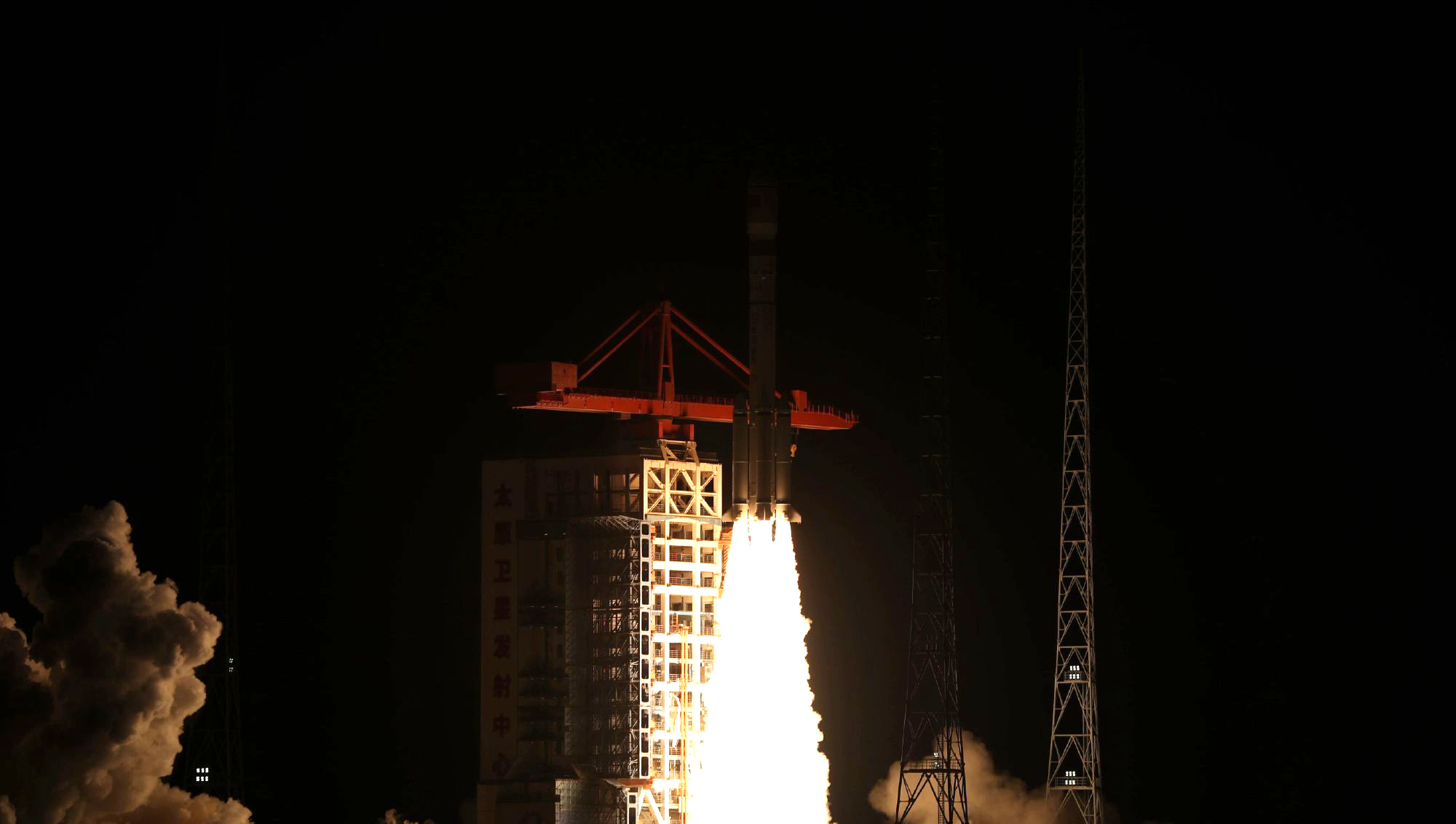
A Long March 6A blasted off from Launch Complex 9A at the Taiyuan Satellite Launch Center on March 15th at 21:22 pm China Standard Time (13:22 pm Universal Coordinated Time), heading into a retrograde low Earth orbit with a single satellite.
Being placed into orbit was the remote sensing satellite Yaogan-50-02 (遥感五十号02星), developed by the China Academy of Space Technology. The satellite will reportedly primarily be for land survey, crop yield estimation, and disaster mitigation and prevention, but the developer added that innovation breakthroughs were achieved with Yaogan-50-02’s development, mainly regarding communications bottlenecks.
Yaogan-50-02 has an identical stated task to Yaogan-50-01, launched in mid-January, while being placed into a similar orbit. The two remote sensing satellites have different developers, as the first was produced by the Shanghai Academy of Spaceflight Technology.
Like the first satellite, the second one was also put into a retrograde low Earth orbit, allowing the two of them to pass over their imaging targets at a more rapid pace than a regular low Earth orbit. Its inclination, from flying southwest out of Taiyuan, will also allow the two Yaogan-50’s to image most of China.
In their post-launch blog post, the Shanghai Academy of Spaceflight Technology stated that all risks with launch preparations are strictly controlled, with new staff intensively briefed in team seminars. This comes after extensive efforts to optimize processes at Taiyuan for shortening preparation times and increasing the launch vehicles’ flight rate.
Today’s launch was the 21st mission for the Long March 6A, the 260th Long March vehicle launch from the Shanghai Academy of Spaceflight Technology, and the 633rd launch of the Long March launch vehicle series. This was also the 13th launch from China in 2026.
Liftoff video via 解放军报 on Weibo.
Check out the previous Long March 6A launch
China's First 2026 Launch Enters Retrograde Orbit With Imaging Spacecraft [Long March 6A Y27]
![China's First 2026 Launch Enters Retrograde Orbit With Imaging Spacecraft [Long March 6A Y27]](https://substackcdn.com/image/fetch/$s_!ndaq!,w_1300,h_650,c_fill,f_webp,q_auto:good,fl_progressive:steep,g_auto/https%3A%2F%2Fsubstack-post-media.s3.amazonaws.com%2Fpublic%2Fimages%2Fb8eb3aa0-0f91-475e-aa74-cee8ea23d3fa_965x565.jpeg)
For China’s first launch mission of the year, a Long March 6A blasted off from Launch Complex 9A at the Taiyuan Satellite Launch Center on January 13th at 22:16 pm China Standard Time (14:16 pm Universal Coordinated Time), carrying a single payload into retrograde low…
What is the Long March 6A?
This section is for those less familiar with China’s Long March series of launch vehicles.
The Long March 6A is the first new-generation launch vehicle in China to utilize a combination of solid and liquid propellants. This vehicle was developed by the Shanghai Academy of Spaceflight Technology and utilizes a two-and-a-half-stage design, the boosters burn an unspecified solid propellant with the first and second stages burning rocket-grade kerosene and liquid oxygen.
The payload capacity of the launch vehicle is currently as follows:
8,000 kilograms to low Earth orbit
4,500 kilograms to a 700-kilometer sun-synchronous orbit
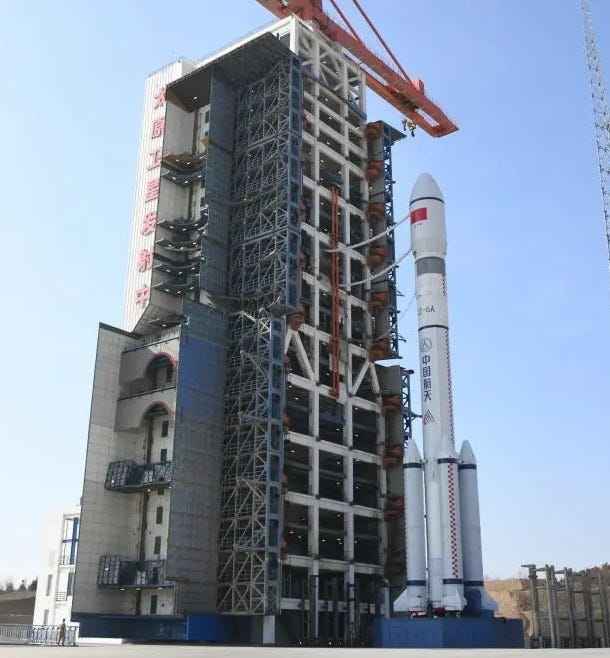
The first-stage is powered by two YF-100 engines, generating a combined thrust of approximately 244 tons using rocket-grade kerosene and liquid oxygen. The first-stage is augmented by four solid rocket boosters, each producing 124 tons of thrust from an unspecified solid propellant, resulting in a combined booster thrust of 492 tons. Together, the first-stage and boosters generate a total thrust of 736 tons. The second stage is powered by a single YF-115 engine, producing 18 tons of thrust using also burning rocket-grade kerosene and liquid oxygen.
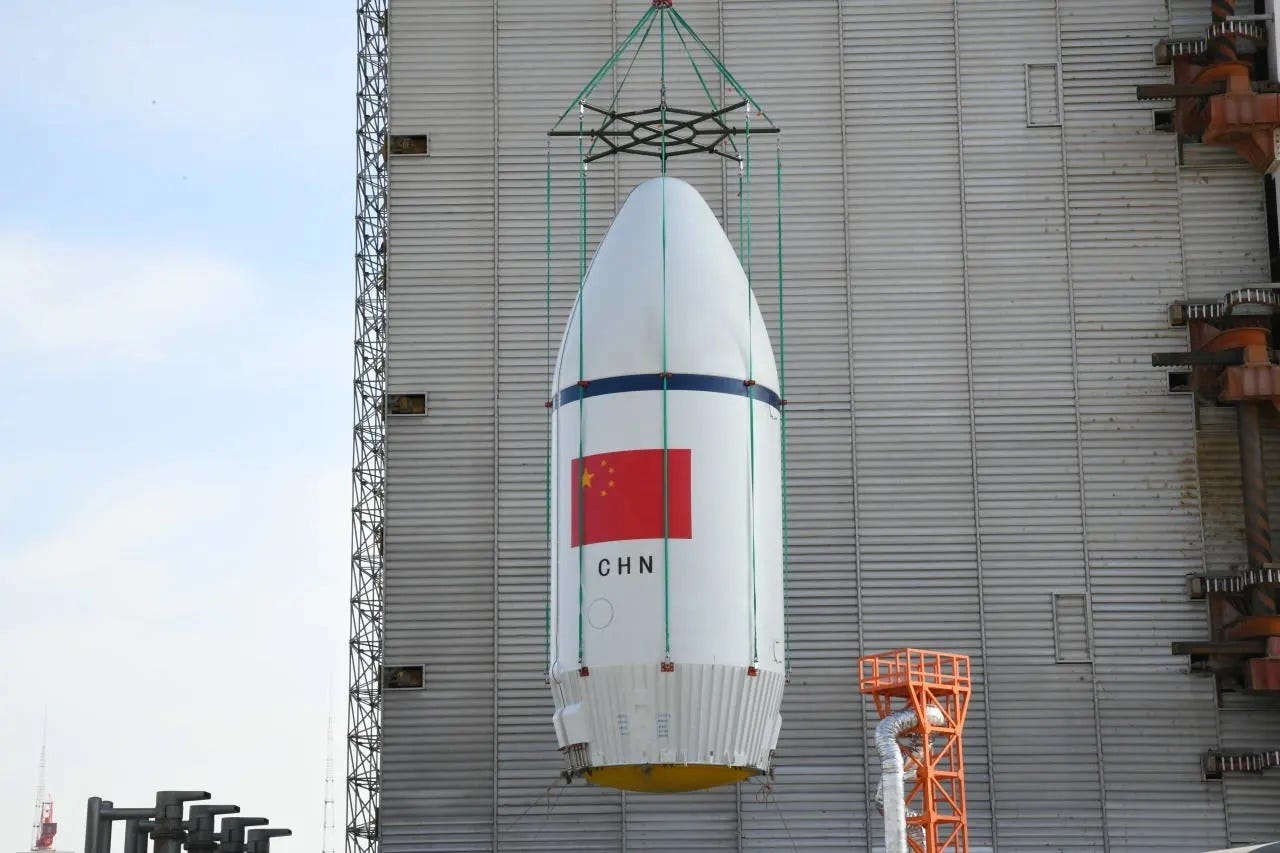
On the launchpad, the Long March 6A is believed to be up to 52 meters tall, a handful of fairings are available, and weighs 530,000 kilograms when fully fuelled. The first and second stages of the vehicle have a diameter of 3.35 meters while the solid-fuelled boosters have a diameter of 2 meters, the fairing has a diameter of 4.2 meters.
So far, every Long March 6A has launched from the Taiyuan Satellite Launch Center, in the north of Shanxi province.
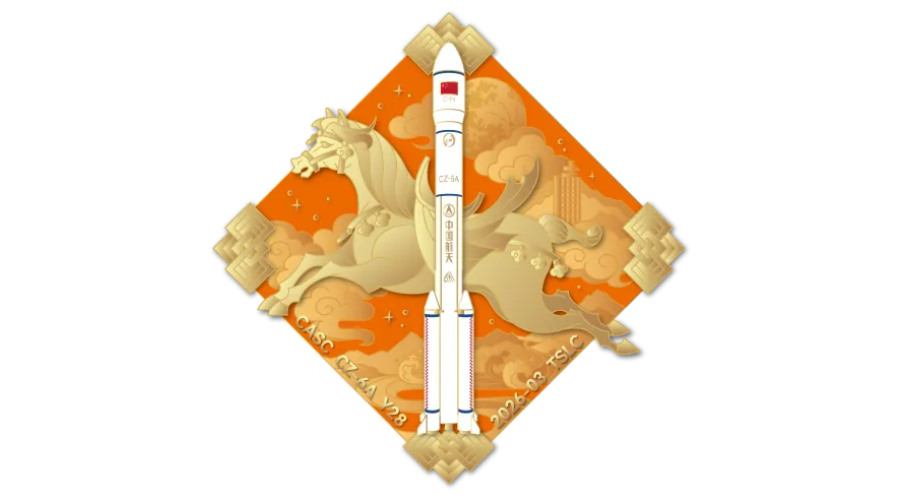
Благодарю Jack C. за эмблему миссии!