

Shanghai Academy Exploring Methane-Powered Economical Lunar Landers
Cheaper lunar landers may support frequent deliveries of cargo to the Moon's surface in support of science, crewed missions, and infrastructure development.

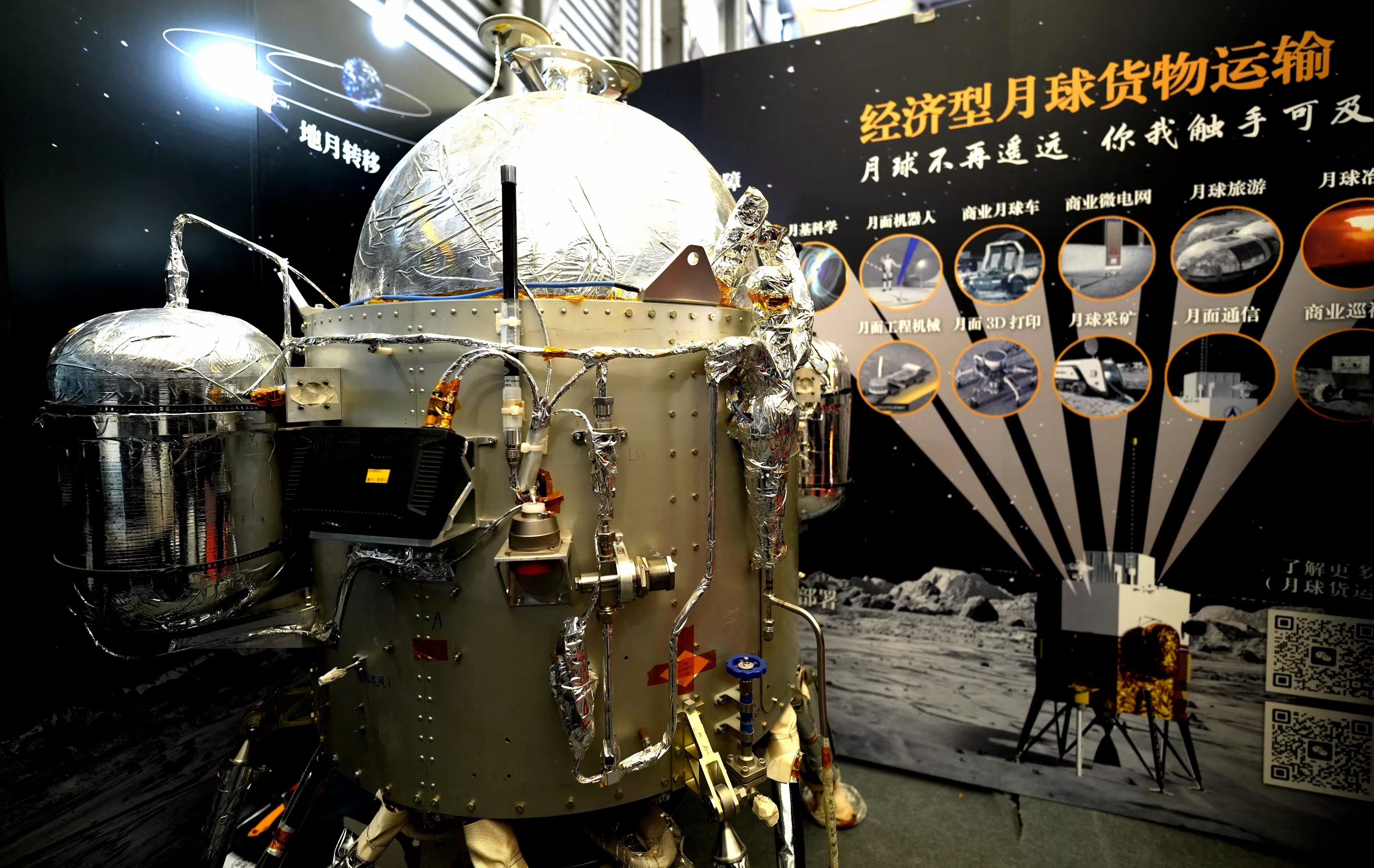
At the Shanghai International Commercial Space Exhibition 2026 (2026首届上海商业航天大会暨展览会)1, the state-owned Shanghai Academy of Spaceflight Technology is displaying many of its space systems and satellite offerings. One item of particular interest on display was a lunar lander prototype.
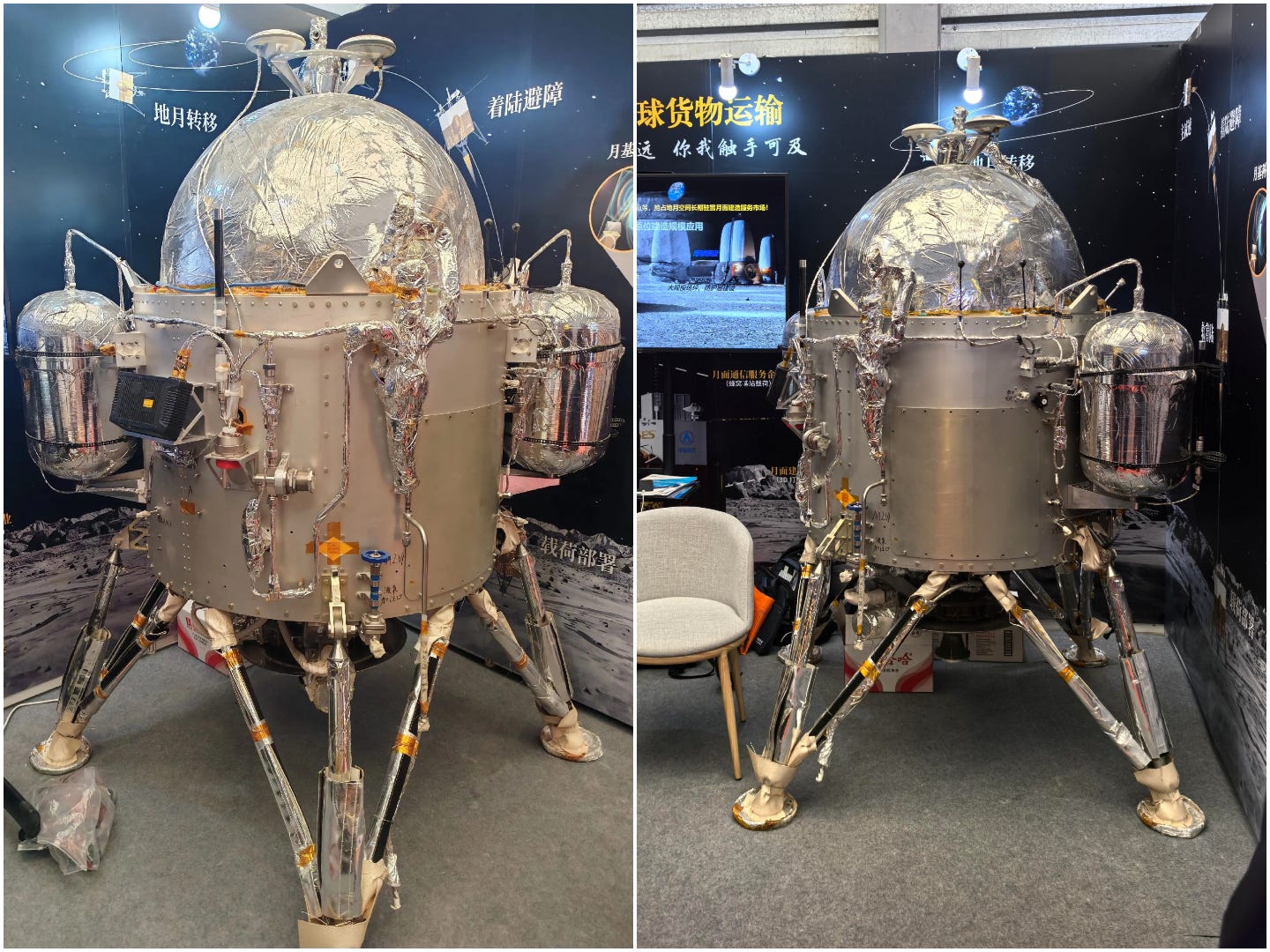
The lander prototype, hidden away in its own booth, is quite barebones. It has a single engine at the base with four reinforced landing legs to handle Earth gravity, two liquid oxygen tanks mounted symmetrically on the sides, and a sizeable liquid methane tank protruding from the time of its bare-metal structure. Running around the outside of the structure are many commodities and electrical systems.
Despite its appearance, the lander prototype has already completed some testing. In undated footage shown in the booth, the prototype performed a minute-long hop, proving its ability to hover for a dozen seconds before gently coming to a powered landing. That test was tethered to a crane to prevent the prototype from flying away if control was lost.
Due to the recent revealing of the lander at the exhibition, not much is known beyond what was on display, but Shanghai Institute of Space Propulsion (上海空间推进研究所), part of the Shanghai Academy, detailed in February that a 300-newton (30 kilograms) thrust attitude control thruster had begun test firings. That attitude thruster was stated to be for deep space exploration missions and upcoming reusable launch vehicles.
Various components yet to be tested for the Shanghai Academy’s lunar lander, tentatively known as ‘Economical Lunar Lander’, include a refined general structure for mounting the systems needed to guide the lander from the Moon’s orbit to the surface, insulation to keep propellant and computers cool, as well as locations for customer payloads or experiments. Additionally, mechanisms to deploy solar panels upon landing will be needed.
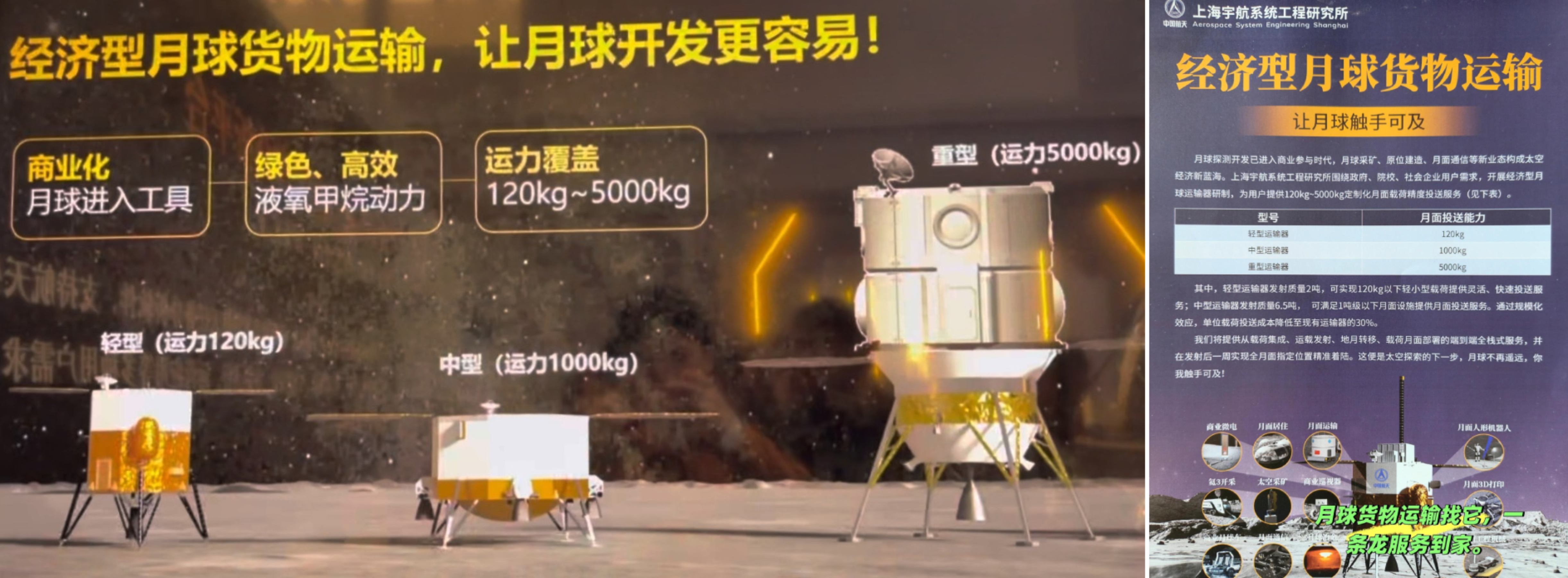
Looking further into development and operation, the Shanghai Academy envisions three variants of the ‘Economical Lunar Lander’, all using liquid methane and liquid oxygen. Those variants and their current proposed capabilities are:
Small-duty: equipped with one landing engine, able to bring about 120 kilograms to the lunar surface2.
Medium-duty: utilizing four landing engines, capable of delivering 1,000 kilograms to the lunar surface3.
Heavy-duty: using a single larger engine to carry up to 5,000 kilograms to the lunar surface4.
All of the landers are designed to fly uncrewed, delivering cargo wherever customers need on the Moon within a week from Earth departure, while being thirty percent cheaper than other solutions5. That cargo could be rovers and robots for exploration, pre-staging hardware to support human exploration, systems to support extended human surface stays, and vehicles for mining lunar materials.
With the Shanghai Academy labeling the proposed spacecraft the ‘Economical Lunar Lander’, they may be positioning themselves to be a key contracted enterprise for a Chinese equivalent of NASA’s somewhat successful Commercial Lunar Payload Services program, likely to support the thirteen-nation-member International Lunar Research Station. China has already started to mirror the U.S.’ space station resupplying Commercial Orbital Transportation Services program with the awarding of two contracts in November 2024 to bring cargo to the Tiangong Space Station. If lunar cargo contracts are awarded, the Shanghai Academy will have a leg up on other enterprises due to its involvement with the Chang’e missions.
Officially shortened to CACE 2026.
The small-duty lander is stated to weigh around 2,000 kilograms and could be delivered to a trans-lunar injection by a Long March 8A.
The medium-duty lander is stated to weigh about 6,500 kilograms and would need to be launched to a trans-lunar injection by Long March 5.
Assuming a desire to use launch vehicles flying this decade, the heavy-duty lander may weigh no more than 27,000 kilograms and would require a launch to a trans-lunar injection via the tri-core Long March 10 Moon rocket.
The wording of being cheaper was quite vague and may be in reference to Chang’e landers or U.S. solutions like Firefly Aerospace’s Blue Ghost or Intuitive Machines’ Nova-C.