

Shenzhou-21 Crew Unload Tianzhou-10's Cargo Delivery Into Tiangong
Tiangong TV: May 17th 2026.

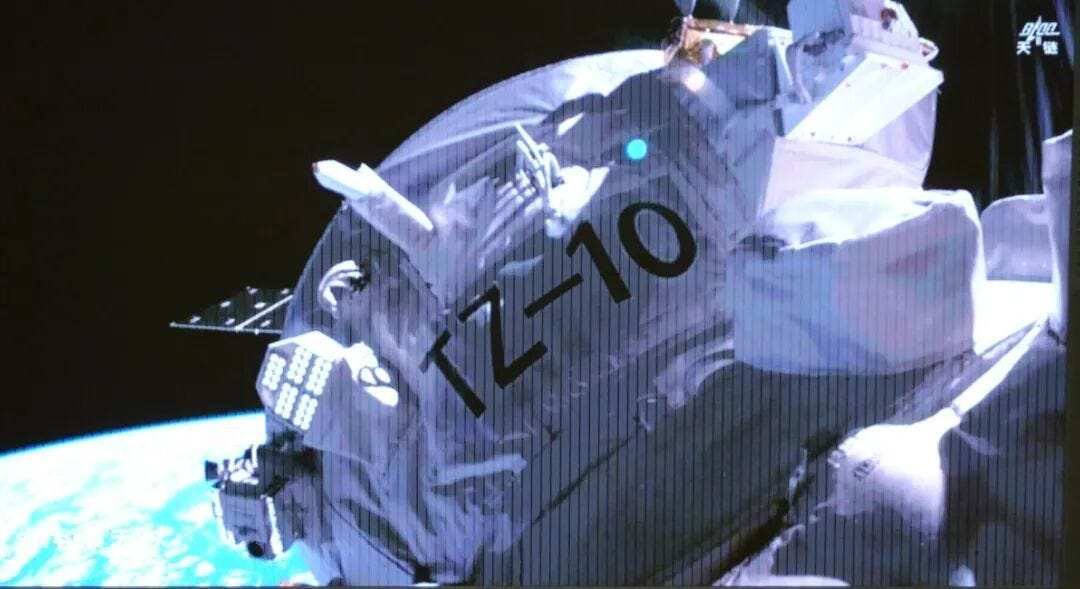
Having departed Earth on the morning of May 11th, the Tianzhou-10 cargo spacecraft arrived at the Tiangong Space Station’s Tianhe modules aft docking port later that same day, being received at 13:11 pm China Standard Time (05:11 am Universal Coordinated Time). A few hours after docking, the hatches of the Tianhe module and the cargo spacecraft were opened by Shenzhou-21 taikonauts Zhang Lu (张陆)1, Wu Fei (武飞)2, and Zhang Hongzhang (张洪章)3 to unload newly delivered items.
A total of 6,300 kilograms of cargo was brought up by Tianzhou-10, including 700 kilograms of propellants for the station’s attitude control and orbit maintenance engines, but of greatest interest to the current and future crews are new consumables, like clothes, water, and food. Foodstuffs delivered by the cargo spacecraft include steaks, chicken wings, peaches, cherry tomatoes, grapes, among other fresh fruit and vegetables that can be prepared in the station’s oven.
One major item for the taikonauts to use in future activities outside of Tiangong was the third and final upgraded Feitian (飞天航天服) spacesuit, which is more comfortable for the user and can support twenty spacewalks without significant maintenance. That suit, identifiable by yellow bands and decor, joins the Tianzhou-9-delivered red and blue ones already in use.
On the outside of the cargo spacecraft is a small satellite dubbed ‘Zhizhou (智周号)’, produced by Minospace (微纳星空) on behalf of the Nanjing University of Aeronautics and Astronautics (南京航空航天大学). Once it is released in the future, the satellite will demonstrate controlled formation flight between spacecraft.
The remainder of Tianzhou-10’s capacity was occupied by forty-one new experiments and research equipment for the space station. Items mentioned ahead of the cargo spacecraft’s launch were fluid physics, new space technologies, and fish-observing4 experiments. After the spacecraft’s arrival, Xinhua shared details on other research items delivered:
Embryo experiments from zebrafish, mice, and stem cell-derived artificial human one to understand how the space radiation and microgravity enviorment effects reproduction and development.
A greenhouse gas monitoring instrument, from the Hong Kong University of Science and Technology (香港科技大学), that will be mounted on the outside of the station to observe concentrations of methane and carbon dioxide in Earth’s atmosphere.
Experimental Lunar fibers, based upon soil samples collected by Chang’e 5 to undergo space exposure testing to understand if it is a viable material for in-situ development during missions in the 2030s.
New flexible solar cells that are eighty micrometers thick will undergo testing in Earth’s orbit, to be held outside by the Mengtian modules’ cargo airlock.
Since the delivery, the Shenzhou-21 has been busy working on the new and already installed experiments, as detailed in a new episode of ‘Tiangong TV’. Attached below is a translated transcript of the newest episode:
The three taikonauts of the Shenzhou-21 crew have been in orbit for nearly 200 days. They are in good physical and mental condition, and all tasks are proceeding as planned.
Recently, the crew received about 6.2 tons of supplies delivered by the Tianzhou-10 cargo spacecraft and quickly began a new round of space science experiments. […]5 The taikonauts watched the entire launch and docking process live from orbit. The evening after launch, the crew opened the spacecraft hatch to receive another batch of space deliveries.
[…]6
[Elsewhere], the crew used laptops and testing software to conduct behavioral tests for projects such as exploration and utilization studies and vertical field-of-view studies. The data obtained were used to examine the patterns and mechanisms underlying human decision-making regarding exploration and utilization in space, as well as to investigate the effects of the microgravity environment and shifts in focus on asymmetry in taikonauts’ vertical fields of view and the underlying neural mechanisms.
In the field of microgravity physical science, the crew carried out tasks such as replacing the sampling covers of experimental modules and changing burners, in accordance with the schedule for microgravity combustion science experiments.
Regarding the maintenance of the space station complex, the crew completed tasks such as organizing supplies inside the modules and inspecting and maintaining life support system equipment, as planned.
In terms of health management and protection, the taikonauts regularly conducted a number of medical examinations, including abdominal, cardiac and vascular ultrasound examinations, electrocardiogram examinations, dynamic electrocardiogram and blood pressure monitoring, intraocular pressure and fundus examinations. By acquiring and transmitting on-orbit physiological health data, the ground team was able to continuously conduct dynamic medical monitoring and health tracking assessments of the taikonauts.
Moving forward, the crew will carry out various tasks as scheduled, including inventory checks, cargo transfers, and inspections of in-orbit equipment, to steadily advance their planned in-orbit mission. We wish them every success in their work leading up to their return.
If there are any problems with this translation please reach out and correct me.
Tiangong TV Episode May 17th 2026 originally from the China Manned Space Agency, cloned to YouTube for archival.
Zhang Lu is the Commander and Pilot of the mission for his second spaceflight, having flown for the Shenzhou-15 mission between November 2022 and June 2023. He is from Hanshou County (汉寿县), Hunan (湖南) province, and was selected as part of China’s second taikonaut group in 2010, also being considered a ‘post-70s’ taikonaut having been born in November 1976.
Before becoming a taikonaut, Zhang served in the People’s Liberation Army Air Force and achieved the rank of Senior Colonel. He also joined the Communist Party of China in April 1999. After the Shenzhou-15 mission, Zhang was awarded the Spaceflight Merit Medal (Third Class) along with the honorary title of hero taikonaut.
Wu Fei is the Flight Engineer for this mission, which will be his first trip into space. He is from Baotou (包头市 / ᠪᠤᠭᠤᠲᠤᠬᠣᠲᠠ), in the Inner Mongolia Autonomous Region (内蒙古自治区 / ᠥᠪᠥᠷ ᠮᠣᠩᠭᠣᠯ ᠤᠨ ᠤᠨᠥᠪᠡᠷᠲᠡᠭᠨ ᠵᠠᠰᠠᠬᠤ ᠣᠷᠣᠨ), and was selected as part of the third taikonaut group in October 2020, while being considered a ‘post-90s’ taikonaut having been born in 1993.
Before his selection as a taikonaut, Wu was an engineer at the China Aerospace Science and Technology Corporation. He also joined the Communist Party of China in 2015.
Zhang Hongzhang is the Payload Expert for this mission, with it being his first trip to space. He is from Binzhou (滨州市), Shandong (山东) province, and was also selected as part of the third taikonaut group in October 2020, while being considered a ‘post-80s’ taikonaut having been born in 1986.
Prior to being selected as a taikonaut, Zhang was a researcher at the Dalian Institute of Chemical Physics, Chinese Academy of Sciences (中国科学院大连化学物理研究所), where he explored new materials and technology for batteries. He also joined the Communist Party of China in 2004.
Which has taken place before for the Shenzhou-18 and Shenzhou-20 missions to understand the effects of radiation on small biological organisms and their offspring.
Words ommited regard the departure of Tianzhou-9. No new information was provided.
Paragraph skipped regards Tianzhou-10 cargo already covered.