

Shenzhou-21 Taikonauts Perform Second Spacewalk, Harvest Space Tomatoes [SZ-21 EVA-2]
More debris protection devices were installed outside of the station, while plants were ready to harvest inside.

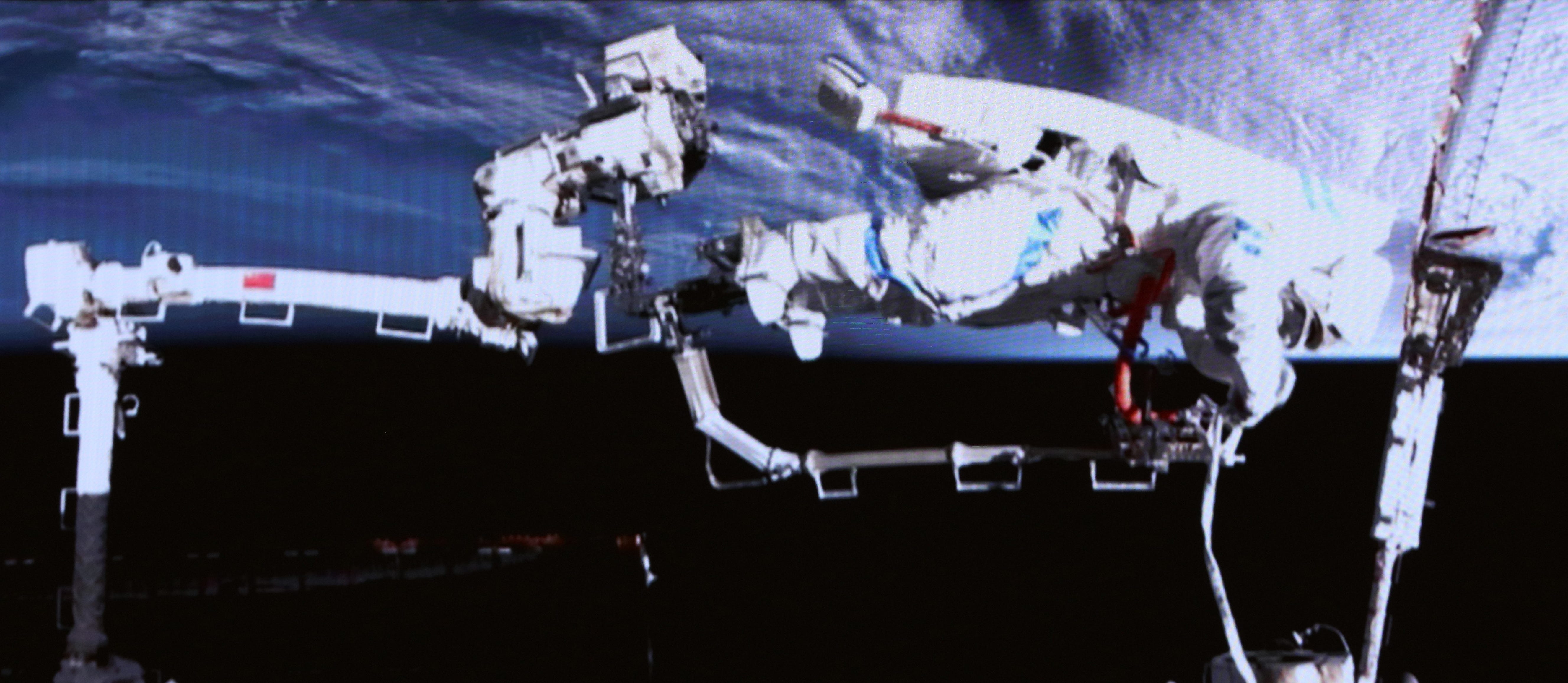
Early today at the Tiangong Space Station, Shenzhou-21 crewmates Zhang Lu (张陆)1, Wu Fei (武飞)2 ventured outside in the red and blue Feitian (飞天航天服) spacesuits, while Zhang Hongzhang (张洪章)3 remained inside to support them via many cameras and the station’s robotic arm. For this spacewalk, Zhang is likely to have used the red suit again, while Wu used the blue suit for a second time.
While outside of the station, the two taikonauts performed the usual inspections of the Tianhe, Wentian, and Mengtian modules, with Wu having the support of the station’s robotic arm, which he was attached to the end of. This spacewalk was primarily for installing more space debris protection devices on vulnerable areas of Tiangong’s exterior, a common task over several missions now.
According to the China Manned Space Agency, the mission’s second spacewalk lasted about seven hours, from 12:30 pm to 19:45 pm China Standard Time (04:30 am to 11:35 am Universal Coordinated Time) on March 16th, exiting and returning via the Wentian module’s airlock.
Today’s spacewalk was Zhang Lu’s sixth in his career (tying China’s record with Chen Dong) and second for the Shenzhou-21 mission, following his four spacewalks during the Shenzhou-15 over late 2022 and early 2023, while Wu Fei was working outside of Tiangong for a second time. Both taikonauts performed Shenzhou-21’s first spacewalk back in December 2025.
Meanwhile inside the station, the crew were rewarded with a bountiful harvest of cherry tomatoes after supporting the plants’ growth over many weeks. The taikonauts’ space harvest and other experiments supported recently were detailed in the newest episode of ‘Tiangong TV’. Attached below is a translated transcript of the episode:
Inside China’s space station, the Shenzhou-21 crew is carrying out their tasks in an orderly manner. Let’s take a look at the latest updates on the three taikonauts’ activities.
Focusing on experimental projects in the field of space materials science, they completed tasks such as cleaning samples in containerless experimental chambers, replacing experimental samples, maintaining the motors of the sample handling mechanism, and cleaning the glass windows of the sample handling mechanism. For the experimental project in the field of microgravity combustion science, they completed the replacement of the burner and sampling cover inside the combustion science experiment cabinet, as well as vacuum pumping and exhaust gas venting. Additionally, in the field of microgravity fluid physics, the crew completed tasks such as replacing experimental samples in the fluid physics cabinet.
The cherry tomatoes grown in the plant cultivation system yielded a bountiful harvest. The taikonauts photographed and harvested the ripe cherry tomatoes, then sealed and stored the plants and harvested fruits separately. The plant cultivation system is primarily used to validate key technologies for the efficient cultivation of plant payloads in a microgravity environment. Subsequent experiments involving wheat, carrots, and Arabidopsis plants will be conducted as planned, continuing to expand the variety of crops and technical capabilities for space cultivation.
The crew performed inspections and maintenance on equipment related to the life support system. The crew conducts regular monitoring of microorganisms in the human living environment to assess their growth status and provide a basis for in-orbit microbial control.
In-orbit medical rescue training helps taikonauts become more familiar with the location of equipment, review operating procedures, reinforce operational processes and skills, and become accustomed to rescue procedures and the characteristics of weightlessness in a microgravity environment.
The crew also underwent blood tests via fingerstick blood sampling, and the resulting data helps ground personnel monitor the taikonauts’ health. Meanwhile, the crew maintains daily exercise to continuously combat the physiological effects of weightlessness.
Tiangong shines in all its glory, and the journey of exploration never ends. More achievements are yet to come.
If there are any problems with this translation please reach out and correct me.
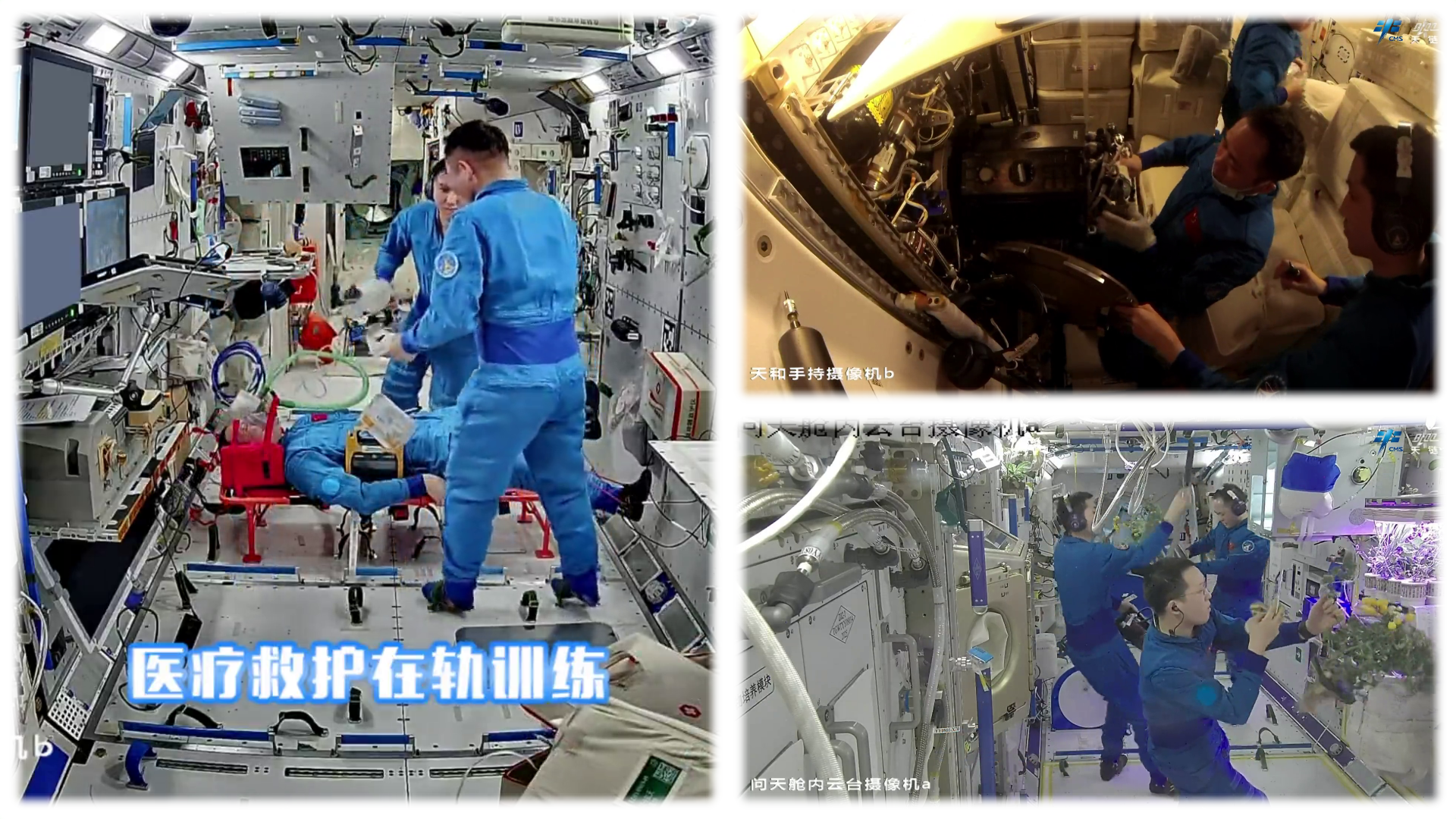
Tiangong TV Episode March 15th 2026 originally from the China Manned Space Agency, cloned to YouTube for archival.

![First Shenzhou-21 Spacewalk Inspects Damaged Spacecraft, Installs Protective Hardware [SZ-21 EVA-1]](https://substackcdn.com/image/fetch/$s_!0k0E!,w_140,h_140,c_fill,f_webp,q_auto:good,fl_progressive:steep,g_auto/https%3A%2F%2Fsubstack-post-media.s3.amazonaws.com%2Fpublic%2Fimages%2Ffd134005-a30f-48c1-baa5-0b3f9012d31d_1919x955.jpeg)
First Shenzhou-21 Spacewalk Inspects Damaged Spacecraft, Installs Protective Hardware [SZ-21 EVA-1]
Zhang Lu is the Commander and Pilot of the mission for his second spaceflight, having flown for the Shenzhou-15 mission between November 2022 and June 2023. He is from Hanshou County (汉寿县), Hunan (湖南) province, and was selected as part of China’s second taikonaut group in 2010, also being considered a ‘post-70s’ taikonaut having been born in November 1976.
Before becoming a taikonaut, Zhang served in the People’s Liberation Army Air Force and achieved the rank of Senior Colonel. He also joined the Communist Party of China in April 1999. After the Shenzhou-15 mission, Zhang was awarded the Spaceflight Merit Medal (Third Class) along with the honorary title of hero taikonaut.
Wu Fei is the Flight Engineer for this mission, which will be his first trip into space. He is from Baotou (包头市 / ᠪᠤᠭᠤᠲᠤᠬᠣᠲᠠ), in the Inner Mongolia Autonomous Region (内蒙古自治区 / ᠥᠪᠥᠷ ᠮᠣᠩᠭᠣᠯ ᠤᠨ ᠤᠨᠥᠪᠡᠷᠲᠡᠭᠨ ᠵᠠᠰᠠᠬᠤ ᠣᠷᠣᠨ), and was selected as part of the third taikonaut group in October 2020, while being considered a ‘post-90s’ taikonaut having been born in 1993.
Before his selection as a taikonaut, Wu was an engineer at the China Aerospace Science and Technology Corporation. He also joined the Communist Party of China in 2015.
Zhang Hongzhang is the Payload Expert for this mission, with it being his first trip to space. He is from Binzhou (滨州市), Shandong (山东) province, and was also selected as part of the third taikonaut group in October 2020, while being considered a ‘post-80s’ taikonaut having been born in 1986.
Prior to being selected as a taikonaut, Zhang was a researcher at the Dalian Institute of Chemical Physics, Chinese Academy of Sciences (中国科学院大连化学物理研究所), where he explored new materials and technology for batteries. He also joined the Communist Party of China in 2004.