

Shenzhou-23 Celebrates Dragon Boat Festival, Five Years of Tiangong Crews
Tiangong TV: June 21st 2026.

With this week onboard the Tiangong Space Station, Shenzhou-23’s Zhu Yangzhu (朱杨柱)1, Li Jiaying (黎家盈)2, and Zhang Zhiyuan (张志远)3 have marked two celebrations. The first, on June 17th, was the fifth anniversary of taikonauts boarding the space station for the first time4, followed two days later by the Dragon Boat Festival (端午节), with the trio being told by mission control where items to make Zongzi (粽子) had been stashed away. They are the sixth crew of a Shenzhou mission to make the rice and bamboo leaf delicacy in orbit.
Alongside the two celebrations, the three taikonauts still have a space station’s worth of experiments to support and maintain, as detailed by this week's ‘Tiangong TV’. They also performed a second emergency exercise, this time to train for the evacuation of an injured person.
Attached below is a translated transcript of the newest episode:
Inside the Chinese Space Station, where it feels like spring all year round, the Shenzhou-23 crew is steadily carrying out their planned tasks. Let’s take a look at their daily work.
Last week, the crew conducted experimental research on the gut microbiota and nutritional metabolism using the Space Raman Spectrometer. By analyzing metabolic components in urine samples, they investigated changes in the gut microbiota under long-duration flight conditions and their impact on nutritional metabolism.
Using relevant equipment and testing software in pairs, the team conducted behavioral experiments related to projects such as visual motion processing and microgravity intuitive physics. The data collected will be used to investigate the effects of gravity on the processing of visual motion information and the underlying mechanisms, as well as the effects of long-term spaceflight on the representation of intuitive physics and the mechanisms of recovery.
The three taikonauts conducted tests related to in-orbit emotion recognition and evaluation technology, as well as the assessment of emergency decision-making capabilities. The data collected will be used to investigate patterns of change in the emotional states and emergency decision-making capabilities of taikonauts during long-term stays in orbit.
In addition, the crew completed the replacement of experimental samples in the fluid cabinet, the disassembly and reassembly of two cabinet experimental modules, the installation of an external thermal imaging camera, and in-orbit maintenance of the biotechnology experiment cabinet. They also processed samples collected during experiments on the in-orbit processing of typical aquatic flora and fauna and their symbiotic interactions, and replaced modules for the in-orbit experiment on cell migration imaging.
This past week, the crew conducted their first in-orbit medical rescue training session since arriving at the station, as planned. The training allowed them to experience the differences between the space and Earth environments, helping the taikonauts become familiar with rescue procedures and failure scenarios in microgravity.
As part of their maintenance duties on the space station complex platform, the crew conducted a series of tasks, including measuring air flows and temperature inside the modules, testing air purity, and collecting microbial samples. They also completed inspections and maintenance of the regenerative life support system equipment, conducted inspections of cryogenic storage units, and performed routine cleaning of the internal environment. In addition, the three taikonauts replaced the soft fabric doors in the sleeping area of the core module.
In terms of personal health management, the crew underwent vision tests, intraocular pressure measurements, and fundus examinations. They effectively carried out preventive measures using a bone loss counter that delivers vibrational stimulation, and they actively engaged in physical exercise.
With the Dragon Boat Festival holiday upon us, this marks the first traditional Chinese festival that the Shenzhou-23 crew has celebrated together in orbit. Wishing everyone a happy and healthy Dragon Boat Festival! See you next week!
If there are any problems with this translation please reach out and correct me.
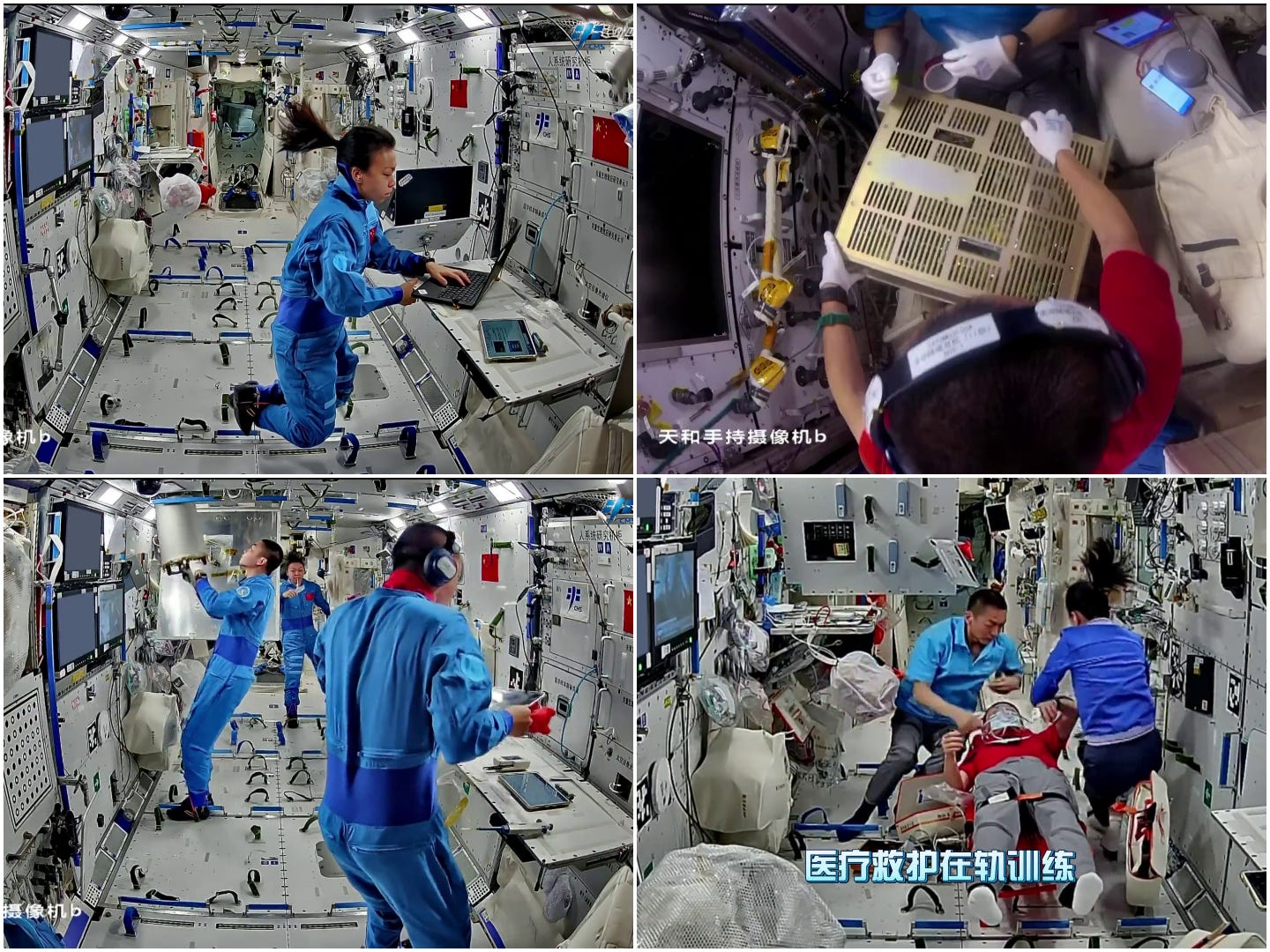
Tiangong TV Episode June 21st 2026 produced by the China Manned Space Agency, cloned to YouTube for viewing on the Western internet and archival.

Commander of the mission for his second spaceflight, having flown as part of the Shenzhou-16 mission, for 153 days from May 30th 2023 to October 31st 2023. Born in September 1986, he is from Peixian (沛县), in Jiangsu (江苏) province, and was selected as part of China’s third taikonaut group in 2020.
Before becoming a taikonaut, he worked as an Associate Professor of aerospace engineering within the People’s Liberation Army, where he achieved the rank of Colonel. Since December 2006, Zhu Yangzhu has been a member of the Communist Party of China. He has been awarded the title of ‘Heroic Astronaut’ too.
Mission Specialist for the mission, she is flying for the first time following selection as a fourth batch taikonaut in 2024. Born in November 1982, she is from the Hong Kong (香港) Special Administrative Region.
Prior to being selected, she was a Chief Inspector of the Hong Kong Police Force, reaching the rank of Superintendent, and holds a PhD in computational and information science-related subjects.
Spacecraft Pilot of the mission, he is in space for the first time after being selected as part of the third group in 2020. Born in June 1986, he is from Gansu (甘肃) province.
Before being selected as a taikoanut as part of the third group, he served in the People’s Liberation Army Air Force as a pilot, where he achieved the rank of Colonel. He has been a member of the Communist Party of China since 2011.
Tiangong has been permanently crewed since June 5th 2022, with the Shenzhou-14 mission. Shenzhou-12 (June 17th to September 17th 2021) and Shenzhou-13 (October 15th 2021 to April 16th 2022) stayed onboard for three and six months respectively, with no handovers due to the lack of available sleeping quarters, which are in Tianhe and Wentian.
Really appreciate the translations of the videos. I wish China would put out more space program PR in English, I think there's an audience for it.