

Shenzhou-23 Crew Perform In-Orbit Emergency Training, Support Many Experiments
Tiangong TV: August 16th 2026.

It has been a busy week aboard the Tiangong Space Station this week, with Shenzhou-23’s Zhu Yangzhu (朱杨柱)1, Li Jiaying (黎家盈)2, and Zhang Zhiyuan (张志远)3 supporting or participating in several areas of microgravity research, as shared in ‘Tiangong TV’. Along with that, the three taikonauts participated in training drills to evacuate the orbiting laboratory and for treating an injured person.
Attached below is a translated transcript of the newest episode:
Another week is upon us, and signs of autumn are already emerging. In the blink of an eye, the Shenzhou-23 crew has been in orbit for more than 80 days. Last week, space science experiments, in-orbit training, and drills proceeded smoothly.
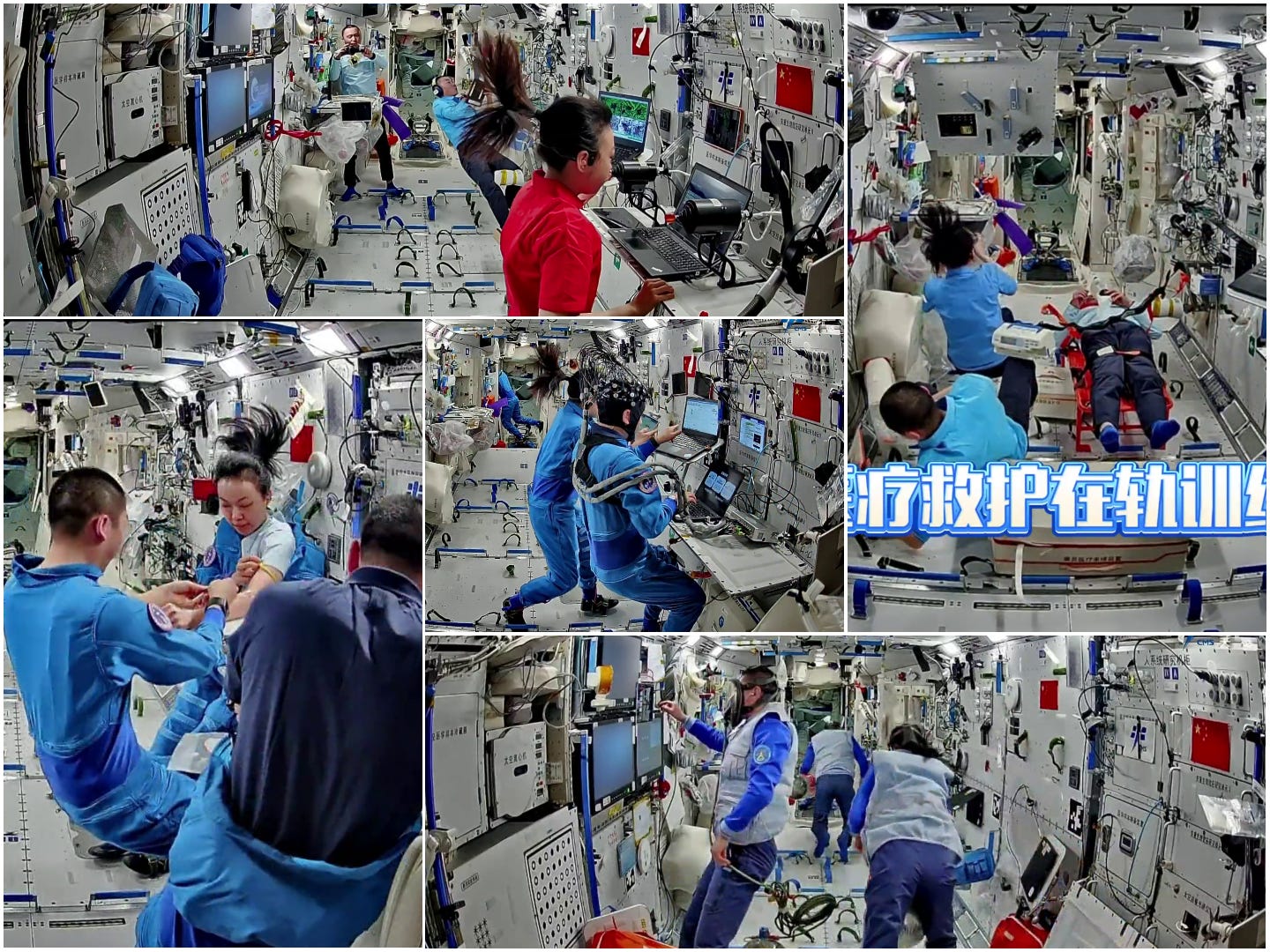
In-orbit electroencephalography testing proceeded smoothly. The crew conducted an experiment on the characteristics of spatial brain networks using near-infrared brain functional imaging equipment. The data collected will help researchers conduct in-depth studies on the effects of the long-term spaceflight environment on taikonauts’ brain functions.
The crew also completed behavioral experiments for the microgravity intuitive physics project. By collecting and analyzing in-orbit behavioral data, they supported investigations into the effects of long-term spaceflight on the ability to intuitively characterize physical phenomena and the mechanisms underlying behavioral recovery.
As part of a series of experiments focusing on human-machine interaction control and space-integrated omics, the crew collected and processed blood samples. Some of these samples will be used for in-orbit complete blood count and blood biochemistry tests, while others will be sent back to Earth to support researchers studying the patterns of changes in taikonauts’ physiological systems, including skeletal and nervous systems, during long-duration spaceflight.
Additionally, the crew conducted kinematic experiments to collect kinematic data on the performance of typical tasks in a microgravity environment, thereby providing support for the design and evaluation of exercise protocols.
Regarding research into the psychological and behavioral capabilities of taikonauts, the crew completed assessments of emergency decision-making skills and tests of in-orbit emotional states, continuing to study the patterns of change in these capabilities and conditions during long-duration spaceflight.
In accordance with the experimental schedules for various projects in the field of microgravity physics, the crew replaced the fluid physics experiment cabinet and performed in-situ maintenance and adjustments on the experimental samples inside the cabinet. They also completed tasks such as cleaning samples from the experiment chamber of the containerless cabinet, maintaining the motors of its mechanisms, and cleaning the window cover lenses.
Last week, several in-orbit training exercises were conducted as scheduled. As shown in the footage, the taikonauts used the manual rendezvous and docking in-orbit training system to practice skills such as manual docking, remote-controlled docking, and manual undocking by operating the translational control stick and the attitude control stick.
The crew also completed in-orbit medical aid training, gaining firsthand experience of the differences between space and Earth operations while familiarizing themselves with medical procedures and the characteristics of weightlessness in a microgravity environment.
Furthermore, the crew completed their second full-system emergency drill simulating cabin depressurization, further consolidating and enhancing their emergency response capabilities and their ability to coordinate with teams on the ground.
In terms of health management, the three taikonauts continue to exercise in orbit, actively using relevant equipment to combat bone loss.
If there are any problems with this translation please reach out and correct me.
Tiangong TV Episode August 16th 2026 produced by the China Manned Space Agency, cloned to YouTube for viewing on the Western internet and archival.
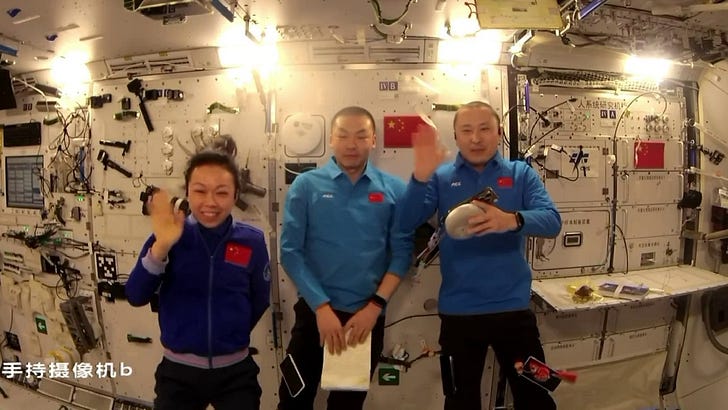
Commander of the mission for his second spaceflight, having flown as part of the Shenzhou-16 mission, for 153 days from May 30th 2023 to October 31st 2023. Born in September 1986, he is from Peixian (沛县), in Jiangsu (江苏) province, and was selected as part of China’s third taikonaut group in 2020.
Before becoming a taikonaut, he worked as an Associate Professor of aerospace engineering within the People’s Liberation Army, where he achieved the rank of Colonel. Since December 2006, Zhu Yangzhu has been a member of the Communist Party of China. He has been awarded the title of ‘Heroic Astronaut’ too.
Mission Specialist for the mission, she is flying for the first time following selection as a fourth batch taikonaut in 2024. Born in November 1982, she is from the Hong Kong (香港) Special Administrative Region.
Prior to being selected, she was a Chief Inspector of the Hong Kong Police Force, reaching the rank of Superintendent, and holds a PhD in computational and information science-related subjects.
Spacecraft Pilot of the mission, he is in space for the first time after being selected as part of the third group in 2020. Born in June 1986, he is from Gansu (甘肃) province.
Before being selected as a taikoanut as part of the third group, he served in the People’s Liberation Army Air Force as a pilot, where he achieved the rank of Colonel. He has been a member of the Communist Party of China since 2011.