

Shenzhou-23 Trio Assist With Microgravity Virology, Machine Learning Research
Tiangong TV: July 19th 2026.

Approaching the two-month mark in their mission, Shenzhou-23’s Zhu Yangzhu (朱杨柱)1, Li Jiaying (黎家盈)2, and Zhang Zhiyuan (张志远)3 have been hard at work aboard the Tiangong Space Station, as detailed in another episode of ‘Tiangong TV’. Activities this week has had the three taikonauts maintaining the orbiting laboratory, overseeing experiments, and taking part in newly mentioned virus research.
Attached below is a translated transcript of the newest episode:
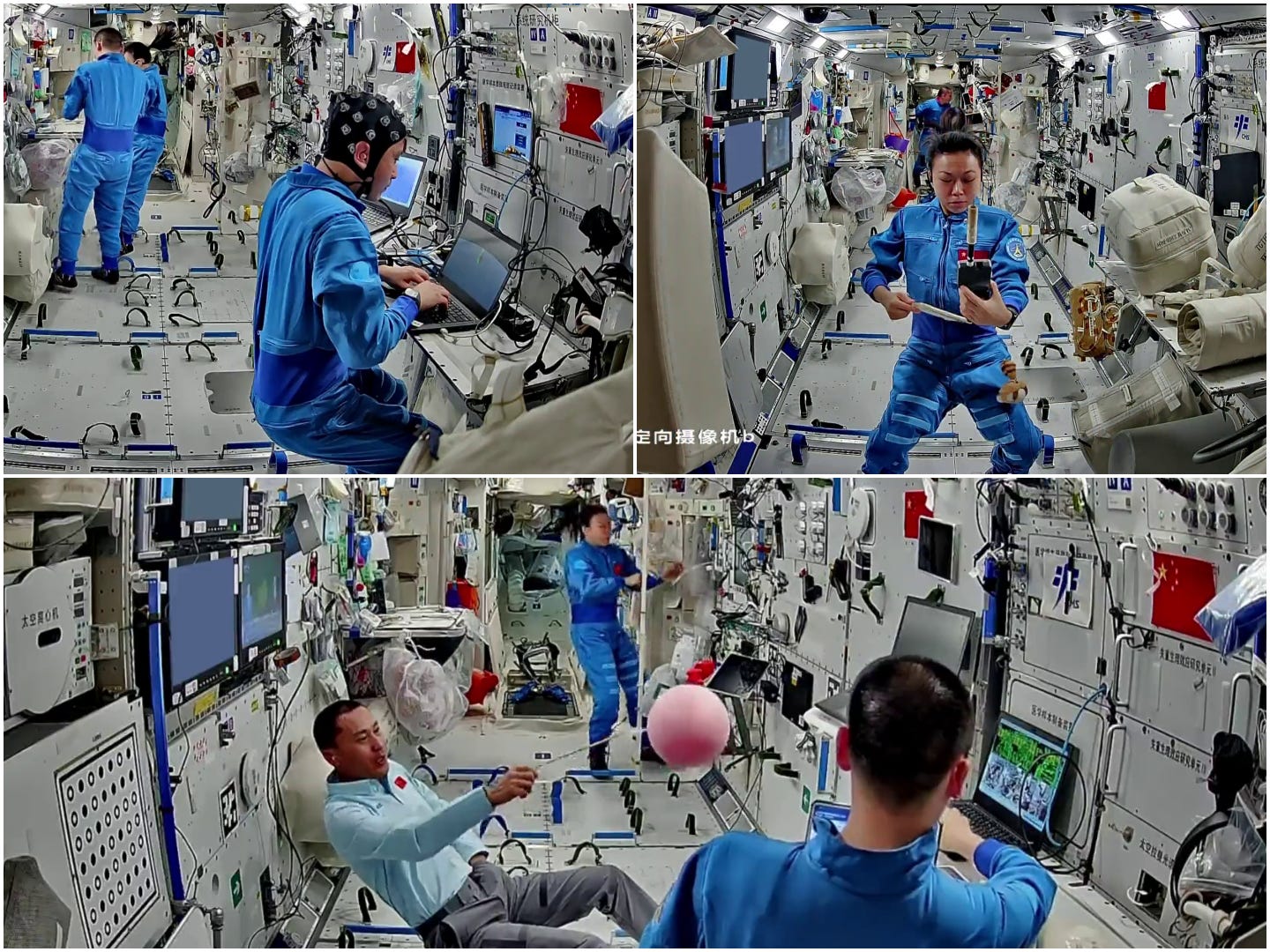
Inside the national space laboratory, the Shenzhou-23 crew has methodically carried out a range of activities, including space science experiments, maintenance of the space station complex, and personal health management. What tasks did the three taikonauts complete last week? Let’s take a look.
In the field of space medical experiments, research involving on-orbit electroencephalography studies is progressing smoothly. The crew is conducting a number of scientific tests, including weak-stimulus brain-computer interface experiments, microgravity intuitive physics experiments, and experiments on spatial cooperative coding and regulation, using electroencephalography data acquisition equipment, virtual reality headsets, and other tools. Ground-based researchers will conduct follow-up studies based on the data transmitted from the space station.
Research on the interaction between viruses and the body's immune metabolism in a long-term space environment is being carried out in orbit. Three taikonauts collected samples such as saliva and environmental surface microbial factors, which were then cryopreserved and awaiting return. In addition, ground-based researchers will conduct glycoprotein analysis and microbiome assessments on the saliva samples collected by the crew and investigate the correlations between these changes.
The crew is using a depth-sensing 3D camera to conduct long-term in-orbit research on taikonauts’ kinematic characteristics. By capturing 3D depth-sensing videos in specific work scenarios, they are collecting data on kinematic characteristics and their changes, providing data support for tasks such as ergonomic design and evaluation. In the video, [Li Jiaying] uses the index finger of her right hand to alternately touch her nose and a blue handrail, conducting a test to measure perceived mechanical forces related to proprioception, and collecting relevant data to assist ground-based researchers in their follow-up studies.
In terms of research on taikonauts’ psychological and behavioral abilities, the crew completed assessments of emergency decision-making capabilities and in-orbit emotional state tests, continuing to collect test data to investigate the patterns of change in emergency decision-making capabilities and emotional states among taikonauts during long-term stays in orbit.
In accordance with the experiment schedule for the field of physical sciences in microgravity, the crew replaced the fluid physics experiment cabinet and performed service maintenance and calibration on the experimental samples inside the cabinet. Additionally, the crew completed tasks such as clearing the samples in the containerless experiment chamber, maintaining the motors of the axial mechanism, and cleaning and replacing the window cover lenses.
Last week, the Shenzhou-23 crew carried out scheduled inspections and maintenance of the life support system equipment and replaced certain components. In conjunction, the crew used relevant instruments to measure air velocity and temperature inside the cabin, conducted air purity tests, and collected microbial samples from the drinking water dispenser outlets, thereby continuing to safeguard the habitable environment of their space home through these environmental monitoring activities.
Regarding health management, the three taikonauts continued to perform in-orbit exercises, actively using relevant equipment to counteract bone loss.
The taikonauts will soon have been in orbit for two months. What tasks will they undertake next? See you next week.
If there are any problems with this translation please reach out and correct me.
Tiangong TV Episode July 19th 2026 produced by the China Manned Space Agency, cloned to YouTube for viewing on the Western internet and archival.

Commander of the mission for his second spaceflight, having flown as part of the Shenzhou-16 mission, for 153 days from May 30th 2023 to October 31st 2023. Born in September 1986, he is from Peixian (沛县), in Jiangsu (江苏) province, and was selected as part of China’s third taikonaut group in 2020.
Before becoming a taikonaut, he worked as an Associate Professor of aerospace engineering within the People’s Liberation Army, where he achieved the rank of Colonel. Since December 2006, Zhu Yangzhu has been a member of the Communist Party of China. He has been awarded the title of ‘Heroic Astronaut’ too.
Mission Specialist for the mission, she is flying for the first time following selection as a fourth batch taikonaut in 2024. Born in November 1982, she is from the Hong Kong (香港) Special Administrative Region.
Prior to being selected, she was a Chief Inspector of the Hong Kong Police Force, reaching the rank of Superintendent, and holds a PhD in computational and information science-related subjects.
Spacecraft Pilot of the mission, he is in space for the first time after being selected as part of the third group in 2020. Born in June 1986, he is from Gansu (甘肃) province.
Before being selected as a taikoanut as part of the third group, he served in the People’s Liberation Army Air Force as a pilot, where he achieved the rank of Colonel. He has been a member of the Communist Party of China since 2011.