

Sino-European SMILE Spacecraft Launch Postponed to May 19th
The collaborative space weather mission is going to have to wait a few more weeks atop of its Vega-C before liftoff.

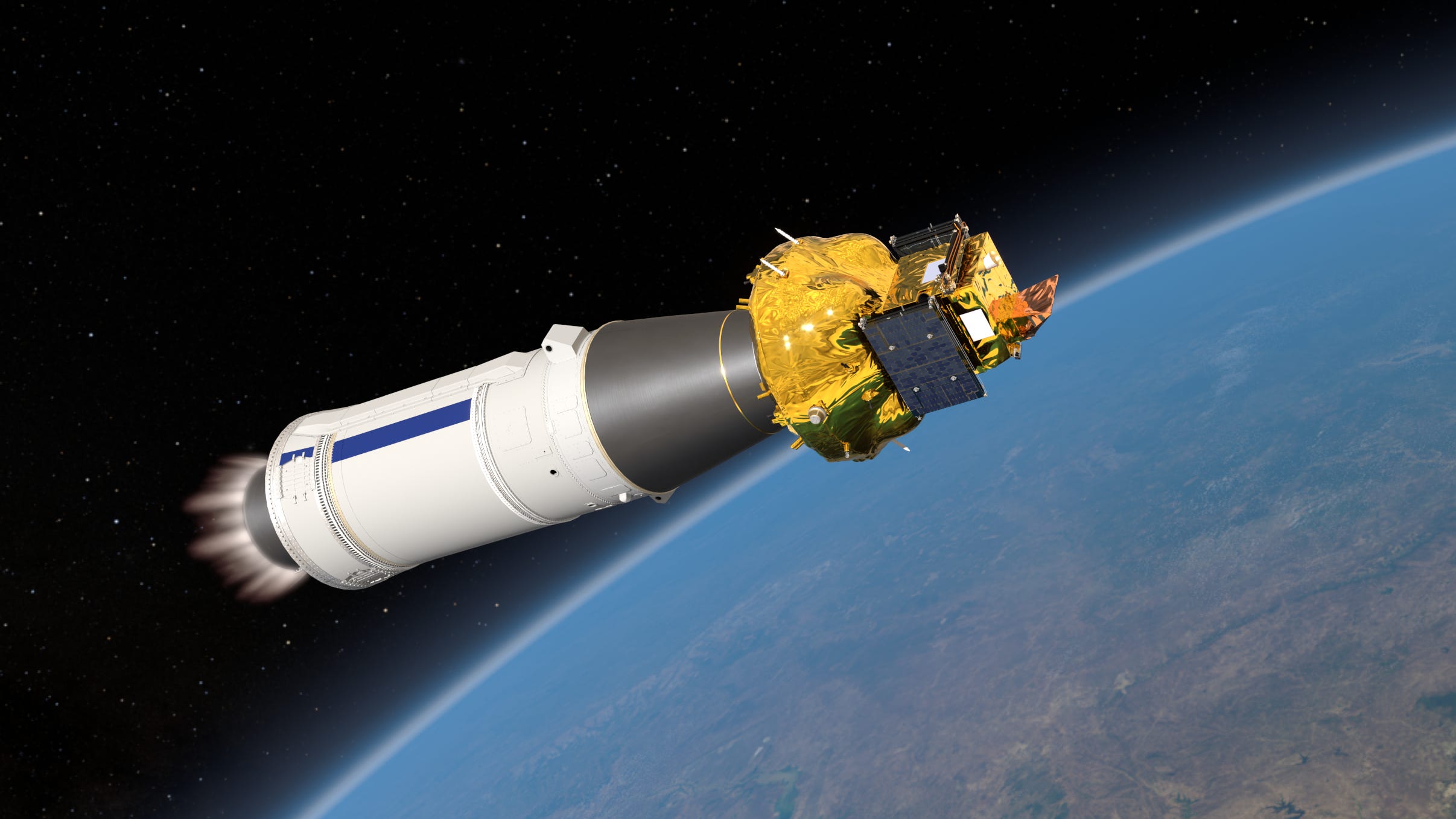
Previously expected to head into orbit as soon as April 9th, the launch of the SMILE spacecraft, a collaboration between the European Space Agency and the Chinese Academy of Sciences (中国科学院), is now slated to launch atop of a Vega-C from French Guiana no earlier than May 19th.
Regarding what caused the postponement, Avio, operator of Vega-C launch missions, shared on April 5th that they had discovered technical issues with subsystem components during production, which may have found their way onto SMILE’s rocket and thus halted the launch campaign out of caution. An investigation into the issue concluded on April 23rd, and launch efforts resumed.
While the investigation was ongoing, SMILE remained sat atop a Vega-C rocket on the launch pad, within a climate-controlled fairing. Both the spacecraft and rocket were repeatedly shared to have been in stable and safe conditions.
As for why the launch is now set for three weeks from now, it is probably to deconflict any launch site issues with an upcoming Ariane 6 mission, which is also being actively prepared and looking to fly as soon as April 28th. Due to that rocket’s extensive use of liquid hydrogen, there is a sufficiently non-zero chance its liftoff gets delayed.
Following its launch over the course of about a month, SMILE will gradually propel itself into its science-performing orbit of 121,000-by-5,000 kilometers, out of its parking orbit of 700 kilometers that it will be in around fifty-seven minutes after liftoff.
After the spacecraft is in that orbit, it will make quasi-continuous observations of key regions of Earth’s magnetosphere with both remote-sensing and in-situ instruments, with the aim of improving our understanding of solar storms, geomagnetic storms, and the science of space weather. To do that, four instruments are onboard:
Soft X-ray Imager: to spectrally map the Earth’s magnetopause, magnetosheath, and magnetospheric cusps.
Developed, built, and calibrated at the University of Leicester, United Kingdom, and other institutions throughout Europe. The charge-coupled devices are procured from e2v by the European Space Agency and calibrated by The Open University, also in the UK.
UltraViolet Imager: for imaging Earth’s auroras that appear over both the north and south poles.
A joint venture between the University of Calgary in Canada, the Chinese National Space Science Centre, the Chinese Academy of Sciences, the Polar Research Institute of China, and Centre Spatial de Liège, Belgium.
Light Ion Analyser: to understand solar wind particle properties as they head towards Earth, two are onboard.
A joint venture between the Chinese National Space Science Centre, the Chinese Academy of Sciences, University College London’s Mullard Space Science Laboratory, UK, and the Laboratoire de Physique des Plasmas, France.
A Magnetometer: Also aimed at understanding solar wind particle properties en route to Earth.
A joint venture between the Chinese National Space Science Centre, the Chinese Academy of Sciences, and the Space Research Institute, Austrian Academy of Sciences.