

Sino-European Space Weather Satellite SMILE Ready for South American Launch
Having undergone pre-launch tests and fuelling over the last few weeks, SMILE is finally atop of its Vega-C rocket and days from space.

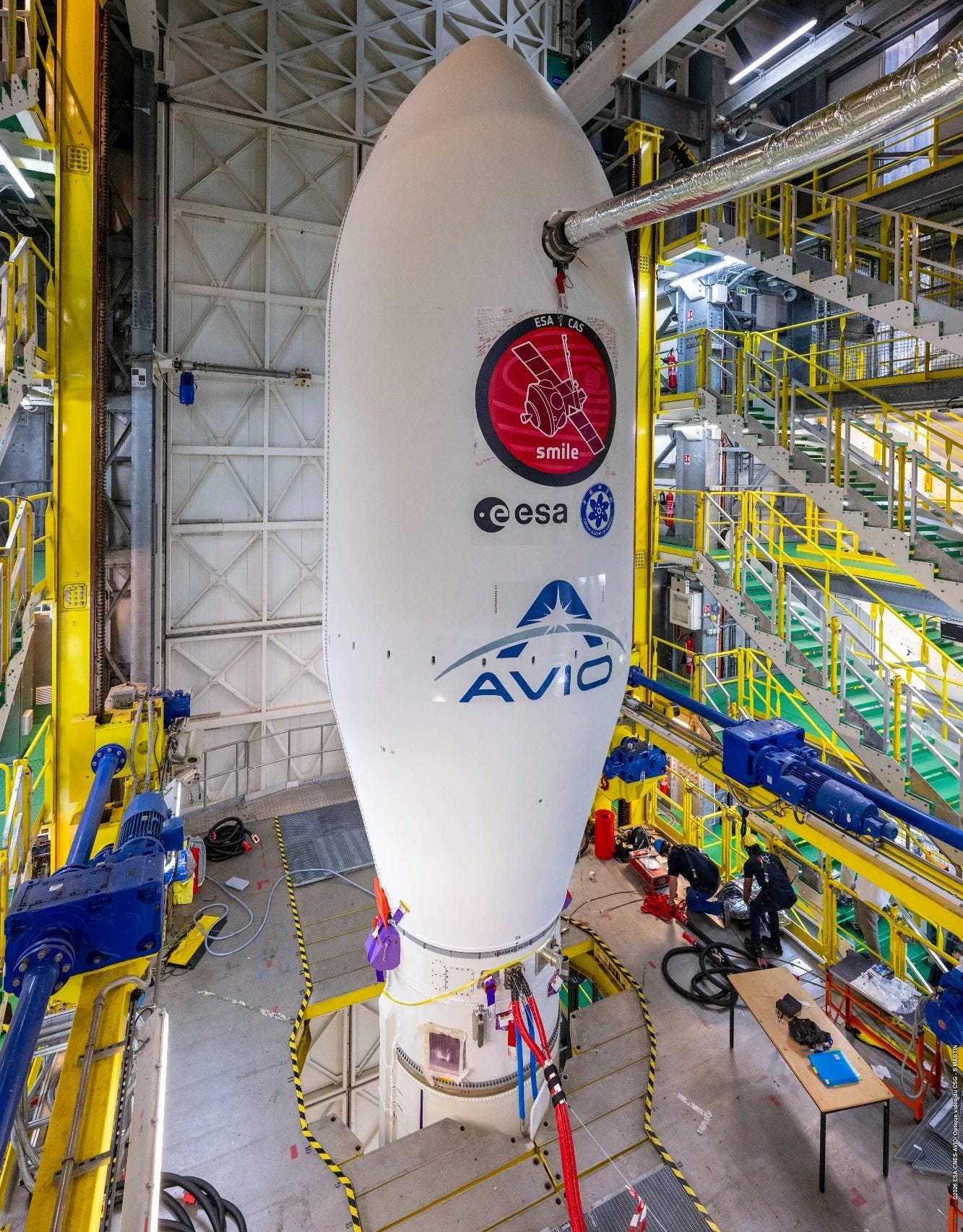
On April 3rd, the European Space Agency shared via its social media channels that the SMILE spacecraft, a collaboration with the Chinese Academy of Sciences (中国科学院)1, has been stacked atop of its Vega-C rocket on the launch pad, following a few weeks of testing and checkouts.
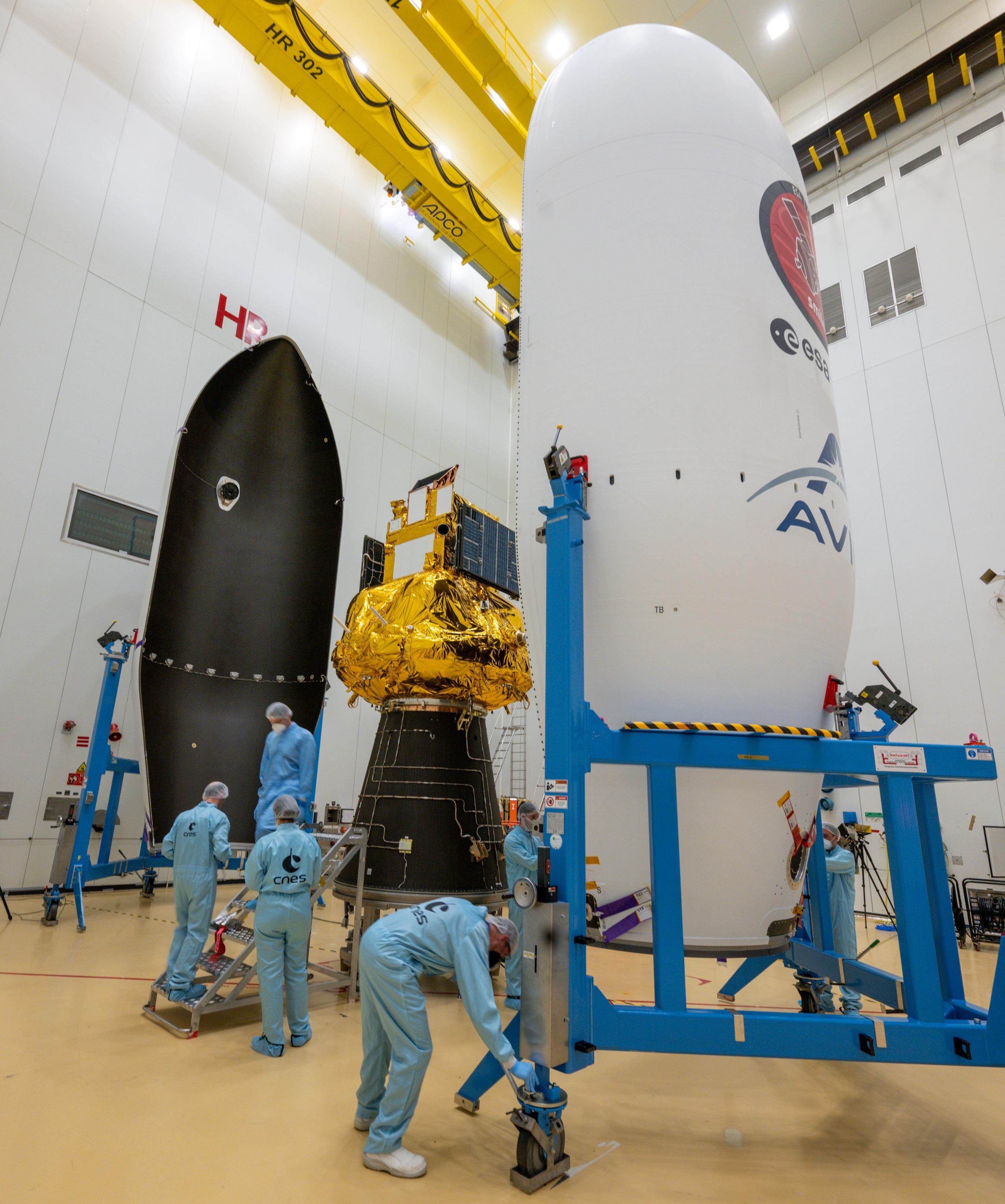
Ahead of stacking, SMILE was fuelled up with hydrazine propellant by technicians over several hours around two weeks ago. Through fueling, the spacecraft was brought up to its maximum wet mass of 2,300 kilograms, of which 1,580 kilograms is hydrazine in four propellant tanks. At the end of March, SMILE was lifted onto Vega-C’s payload adapter and encapsulated between two fairing halves. All cleanroom tasks at the launch site for the spacecraft took just over a month.
With SMILE atop of Vega-C, the mission is set to launch as soon as April 9th out of the Guiana Space Center, in French Guiana at the top of South America. Vega-C’s launch of SMILE will last just over an hour to place the satellite into an approximately 700-kilometer Earth orbit. For a few weeks post-launch, SMILE will gradually propel itself into its science-performing orbit of 121,000-by-5,000 kilometers.
In a pre-launch media briefing, the Sino-European mission team explained that once SMILE reaches its desired orbit, its instruments will look down on Earth’s magnetosphere2 to study its interaction with charged particles originating from the Sun. Those particles cause auroras and other phenomena, but can also damage electronics on the planet and within the magnetosphere. After sufficient data is gathered, SMILE will assist with space weather forecasting and predictions.
The briefing also repeated that Europe is providing SMILE’s payload module, the Soft X-ray imager, and launch, while the Chinese Academy of Sciences brought the UltraViolet Imager, the Light ion analysers, and the spacecraft platform, while also looking after in-space operations through the European Space Agency’s ESTRACK network. Various universities, enterprises, and institutions supported both sides' contributions.
While the media briefing was open to questions, Li Jing (李静), SMILE Project Manager at the Chinese Academy of Sciences, was asked about the future of Sino-European space mission collaboration, and responded:
“We are still looking forward to cooperation with the European Space Agency for space science, but now we are still looking for a common interesting project. After now there is no project, but maybe in the future we can find a common interesting field.”
Representatives of the European Space Agency added that cooperation with China requires the approval of all agency member states.
Production of the China-made spacecraft platform components was tasked to Innovation Academy for Microsatellites, Chinese Academy of Sciences (中国科学院微小卫星创新研究院).
The Soft X-ray Imager will look at the sun-facing part of the magnetosphere, while the UltraViolet Imager will focus on Earth.