

Taikonauts Support Plant and Materials Experiments, Space-Flown Mice Reproduce
Tiangong TV: December 28th 2025.

For the Shenzhou-21 mission, taikonauts Zhang Lu (张陆)1, Wu Fei (武飞)2, and Zhang Hongzhang (张洪章)3 have been busy working onboard the Tiangong Space Station, having conducted a spacewalk three weeks ago. In a new episode of the roughly weekly ‘Tiangong TV’ show, the activities of the three crew members were detailed. This was also the first commentated update since November; other episodes have been collections of various views.
Attached below is a translated transcript of the episode:
Inside the National Space Laboratory, experiments across multiple fields are progressing steadily, and the Shenzhou-21 crew is enjoying their flight.
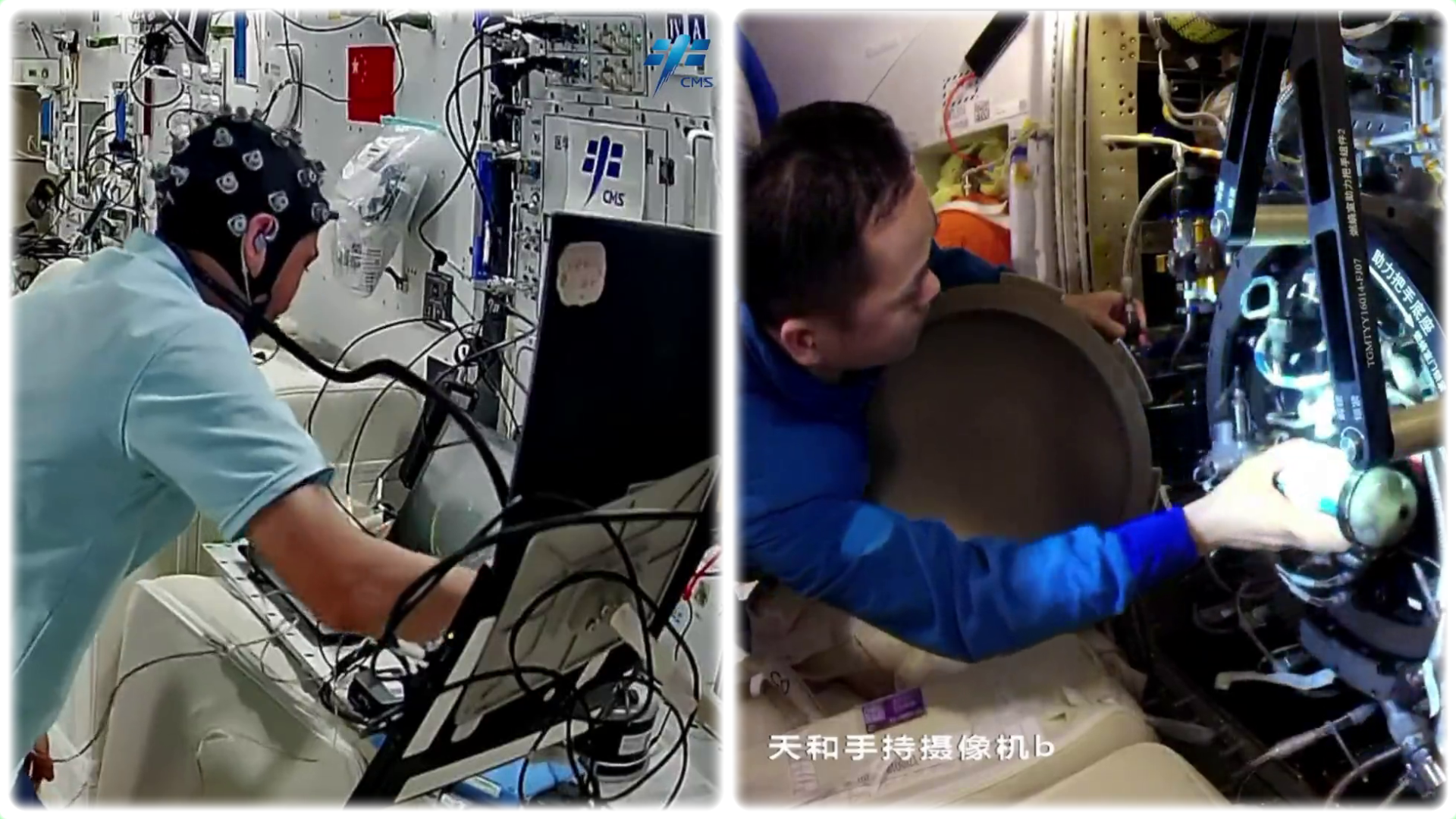
In the field of space medicine experiments, the Shenzhou-21 crew utilized electroencephalography equipment to collect data required for studies on cognitive monitoring, brain cognitive-emotional analysis, and regulation. This supports ground-based researchers in advancing their ongoing studies.
Inside the Wentian experimental module, arabidopsis thaliana seedlings made their debut. Previously serving as an assistant in Tiangong Classroom sessions, these seedlings helped participants better understand plant growth in space. During this mission, the seedlings will support scientific teams in studying the molecular networks regulating plant stem cells. Last week, the crew conducted sample collection using the scientific gloves.
In the field of microgravity physics, the crew completed the disassembly and reassembly of complex fluid experiment modules within the fuid physics experiment cabinet according to the experimental schedule, and replaced experimental samples. They also replaced the sampling cover of the gas experiment plug-in within the combustion science experiment cabinet. Additionally, the crew performed cleanup and replacement of samples in the containerless experiment cabinet, as well as maintenance work on new structural cables.
Furthermore, a project on in-situ electrochemical and optical study project for lithium-ion batteries in space applications has commenced. Leveraging the expertise of in-orbit specialist Zhang Hongzhang, the team will conduct precise adjustments to optical instruments based on independent scientific assessments. This will enable in-situ optical observation experiments of lithium-ion batteries in a microgravity environment, capturing images of the entire lithium dendrite growth process.
Regarding the inspection and maintenance of space station equipment, last week the crew conducted routine maintenance on the equipment used by the crew members and upgraded some software.
In terms of health maintenance and safeguarding, in addition to daily physical exercise, the three taikonauts underwent medical examinations including bone density measurements, electrocardiogram and blood pressure checks, and pulmonary function tests to comprehensively monitor their health status in orbit.
The Shenzhou-21 taikonauts crew has been in orbit for two months. Stay tuned for updates on the crew’s upcoming in-orbit activities. See you next week!
If there are any problems with this translation please reach out and correct me.
Space-flown mice healthy with kids
During the Shenzhou-21 trio’s launch up to the Tiangong Space Station on October 31st and the Shenzhou-20 crew’s return to Earth on November 14th, four mice were flying alongside for a short-duration experiment to study their behaviours in microgravity as well as to examine the changes to their organic tissues and mammalian organs. The four mice, recently named Wangtian (望天4), Lanyue (揽月5), Zhuiyun (追云6), and Zhumeng (逐梦7) via popular vote, are healthy following their trip to space.
Back on Earth, the four mice have undergone further scientific study relating to their tissues and organs, including the intensive demands of reproduction. According to Xinhua, back on Earth one of the female mice conceived and delivered nine offspring on December 10th, and has since begun nursing them as expected. So far, the six surviving offspring are reportedly active and healthy. Speaking with Xinhua, Wang Hongmei (王红梅) of the Institute of Zoology, Chinese Academy of Sciences (中国科学院动物研究所) shared:
“This mission showed that short-term space travel did not impair the reproductive capability of the mouse. It also provides invaluable samples for the investigation of how the space environment influences early developmental stages in mammals.”
Regarding the future of the remaining offspring, researchers plan to study their growth and development for deviations in their physiological and pathological characteristics. Their reproductive capacity will also be an area of focus as a second-generation of space-flown mice will provide insights into the effects of microgravity on mammalian organs and tissue.


Tiangong TV Episode December 28th 2025 originally from the China Manned Space Agency, cloned to YouTube for archival.
Zhang Lu is the Commander and Pilot of the mission for his second spaceflight, having flown for the Shenzhou-15 mission between November 2022 and June 2023. He is from Hanshou County (汉寿县), Hunan (湖南) province, and was selected as part of China’s second taikonaut group in 2010, also being considered a ‘post-70s’ taikonaut having been born in November 1976.
Before becoming a taikonaut, Zhang served in the People’s Liberation Army Air Force and achieved the rank of Senior Colonel. He also joined the Communist Party of China in April 1999. After the Shenzhou-15 mission, Zhang was awarded the Spaceflight Merit Medal (Third Class) along with the honorary title of hero taikonaut.
Wu Fei is the Flight Engineer for this mission, which will be his first trip into space. He is from Baotou (包头市 / ᠪᠤᠭᠤᠲᠤᠬᠣᠲᠠ), in the Inner Mongolia Autonomous Region (内蒙古自治区 / ᠥᠪᠥᠷ ᠮᠣᠩᠭᠣᠯ ᠤᠨ ᠤᠨᠥᠪᠡᠷᠲᠡᠭᠨ ᠵᠠᠰᠠᠬᠤ ᠣᠷᠣᠨ), and was selected as part of the third taikonaut group in October 2020, while being considered a ‘post-90s’ taikonaut having been born in 1993.
Before his selection as a taikonaut, Wu was an engineer at the China Aerospace Science and Technology Corporation. He also joined the Communist Party of China in 2015.
Zhang Hongzhang is the Payload Expert for this mission, with it being his first trip to space. He is from Binzhou (滨州市), Shandong (山东) province, and was also selected as part of the third taikonaut group in October 2020, while being considered a ‘post-80s’ taikonaut having been born in 1986.
Prior to being selected as a taikonaut, Zhang was a researcher at the Dalian Institute of Chemical Physics, Chinese Academy of Sciences (中国科学院大连化学物理研究所), where he explored new materials and technology for batteries. He also joined the Communist Party of China in 2004.
‘Gaze at the sky’
‘Embracing the moon’
‘Chase the clouds’
'Follow the dream’