


The Tianwen-2 asteroid sample return mission began to swing towards its target, 2016HO3/469219 Kamoʻoalewa, through June with a burn to reduce its distance to under 30,000 kilometers on June 7th. Almost two weeks later, the distance between the spacecraft and the asteroid was down to 2,000 kilometers.
Around July 4th, and announced on July 6th by the China National Space Administration, Tianwen-2 ‘arrived’ at Kamo’oalewa when it reached a distance of 20 kilometers following just over four hundred days since departing Earth. During the arrival the spacecraft also snapped an image of the asteroid.
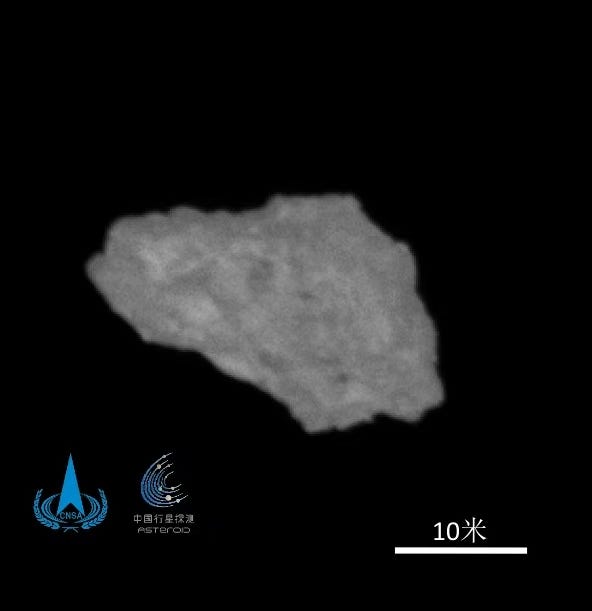
Now in proximity of Kamo’oalewa, Tianwen-2 will spend several months observing and characterizing the asteroid to understand potential dangers and look for sampling sites of scientific interest. That will be done through its cameras, navigation sensors, and radar from an altitude of about eight kilometers to achieve a mapping resolution in single-digit centimeters.
The wider scientific community has recently supported characterizations of Kamo’oalewa too, with a paper using the NASA-European Space Agency James Webb Space Telescope to determine that the asteroid is around 20 meters in diameter on average, something the recent image appears to confirm, and could be an E-type asteroid1 instead of an ejected piece of the Moon as popularly theorized.
Regardless of what Kamo’oalewa is, samples collected from it will allow for a major increase in understand what it consists of, where it may have originated from, and provide clues as to the formation of the early solar system.
As for when Tianwen-2 will collect samples from the asteroid, between 200 and 1,000 grams, that should occur no later than the end of April 2027. Collection of those will occur via touch-and-go as well as anchor-and-attach methods.
Once the samples are secured, Tianwen-2 will depart from Kamoʻoalewa not long after to flyby Earth in November 2027, where the sample return capsule will be released for a landing at a site near the Jiuquan Satellite Launch Center. Simultaneously, the spacecraft will be boosting while flying by to begin its multi-year extended mission to the asteroid belt between Mars and Jupiter, primarily focusing on asteroid 311P/PanSTARRS.
To date, Tianwen-2 has travelled over a billion kilometers through deep space and is currently trailing behind Earth in its current position. This time a year ago, the spacecraft had only ventured 12 million kilometers before reaching a halfway point between our planet and Kamo’oalewa in October 2025.
Those that have broken off from larger bodies, bigger asteroids or early celestial bodies, while having fairly featureless surfaces of Enstatite and Achondrite.