
Newer launch startup Welight (微光启航) has continued to make good progress in developing China’s first carbon fiber partially reusable launch vehicle, dubbed Weiguang-1 (微光一号), with a series of recent milestones.
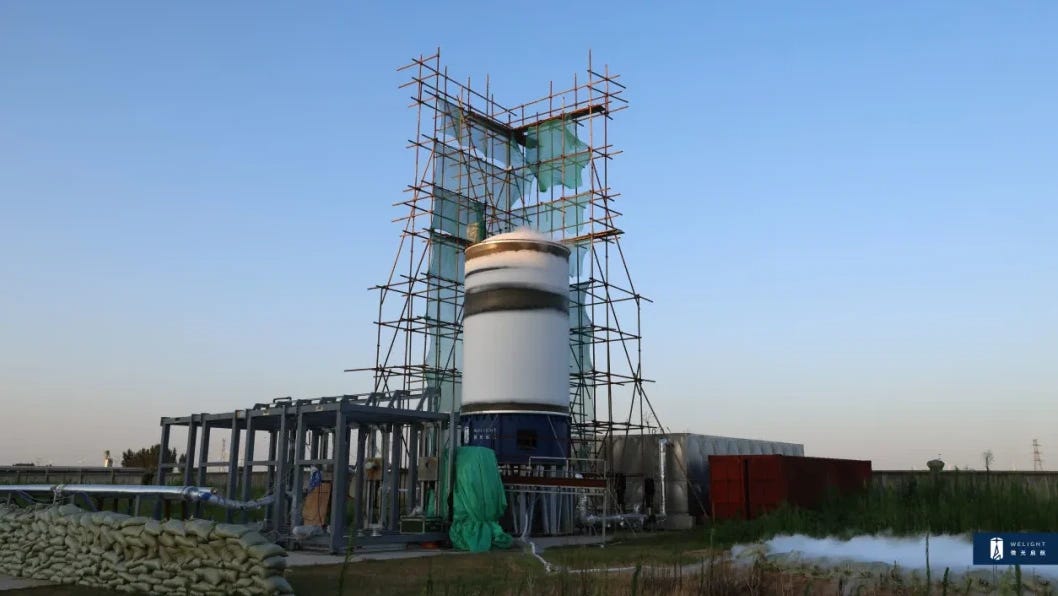
Revealed on August 10th, the company shared that a 3.8-meter-diameter development propellant tank had recently passed cryogenic testing over the course of multiple hours. For the test, the tank was loaded with an unspecified extremely cold cryogenic gas through a series of valves at the base, with pressure managed through occasional venting out of the top.
Through being loaded with a very cold gas, Welight’s engineers were able to prove that their carbon fiber production techniques can make tank walls and domes able to withstand temperatures close to that of loading a liquid propellant. The test also served as an opportunity to practice how to load and handle commodities in significant volume.
It was added that the results of cryogenic testing met design expectations and verified the company’s decision to choose carbon fiber, said to have reduced tank mass by around thirty percent.
In the lead-up to loading the development propellant tank, testing with individual necessary components was wrapped up in June to confirm that parts not made of carbon fiber wouldn’t degrade. Non-explosive separation bolts were successfully trialled on a small scale at the same time.
Some destructive hardware tests took place in July as well to understand how the tank walls could come apart under pressure. Those provided an opportunity to consider the best ways to destroy Weiguang-1 should it need to activate its flight termination system during a mission.
While developing the Weiguang-1, other members of the Welight team have been ensuring that enabling capital continues to be provided. An ‘Angel++’ round of 100 million Yuan (14.82 million United States Dollars) was completed at the start of July, only a few months after the ‘Angel+’ one.
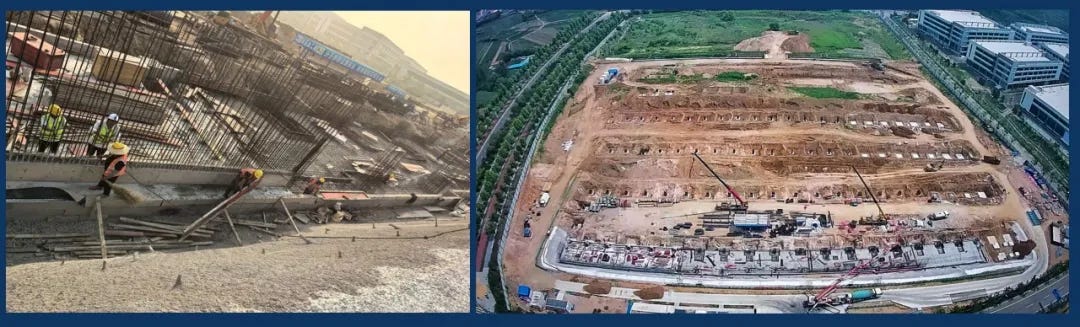
Capital raised this year so far is stated to be in support of proving and producing all components of Weiguang-1, including its full-flow staged-combustion cycle Huaguang-1 (华光一号) engines, ahead of a debut launch some time in 2028. Necessary for that will be a completed launch vehicle manufacturing base, currently under construction in Rizhao (日照市), Shandong (山东) province.
Once developed and placed onto a launch pad, the two-stage Weiguang-1 will stand 60 meters tall and 3.8 meters, loaded with liquid methane and liquid oxygen to weigh 350,000 kilograms at liftoff. When reusing the first-stage, the launch vehicle will carry 9,000 kilograms to low Earth orbit, or 11,000 kilograms if expending it.