

Welight Raises Capital for Reusable Carbon Fiber Launch Vehicle
Funding will be used to expand the company's national footprint and refine technical expertise.

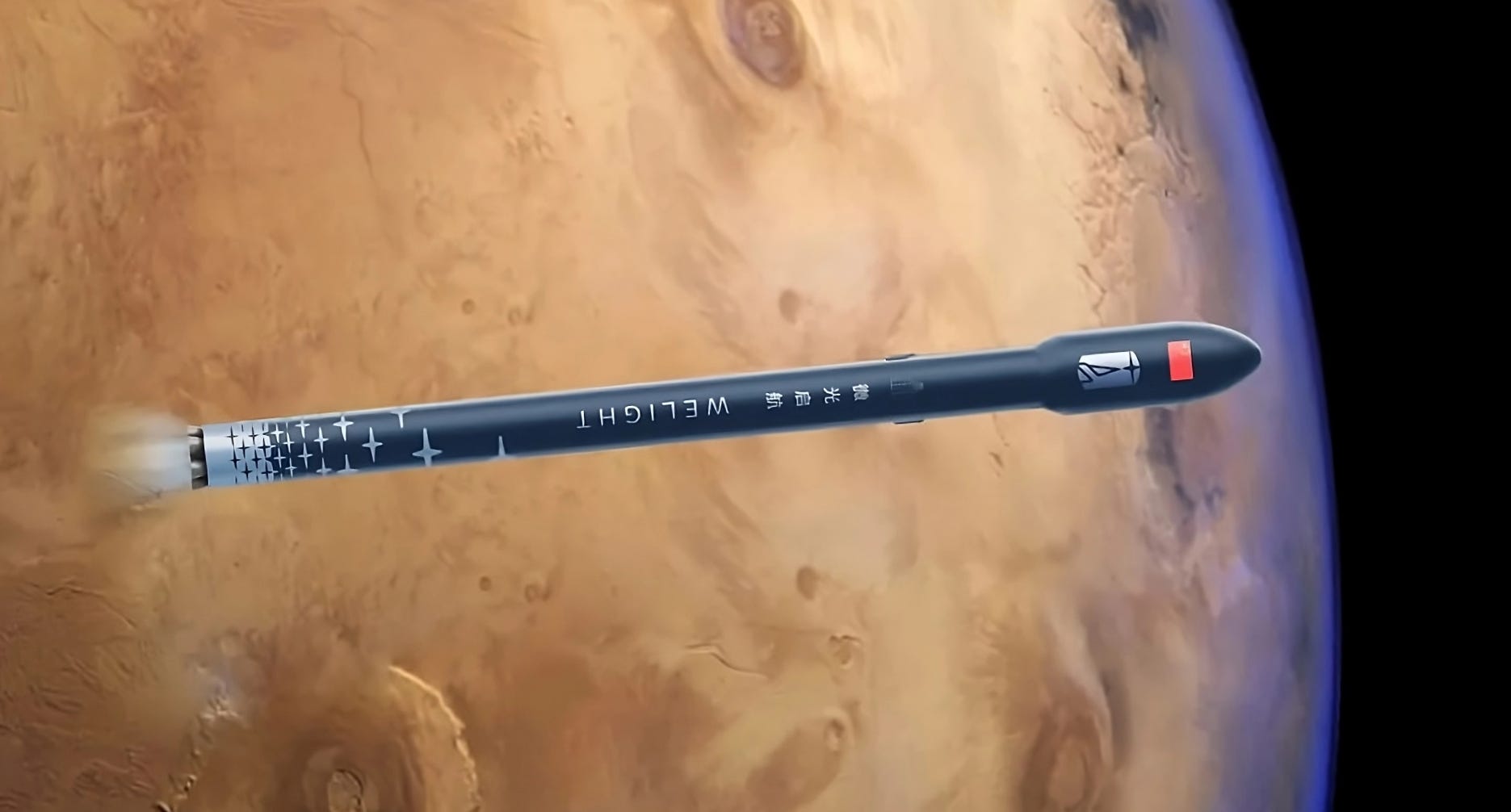
New reusable rocket developed Welight (微光启航) announced on March 30th that it has completed its ‘Angel+’ funding round recently, raising around 100 million Yuan (14.47 million United States Dollars, as of March 31st 2026).
Capital raised will mainly be used to expand Welight’s footprint across China. Details shared state that Changsha (长沙市) will be home to engine production, and the nearby Changde (常德市) will allow for engine testing, both in Hunan (湖南) province, while Rizhao (日照市), Shandong (山东) province, is the production base for launch vehicle structures and tanks. Meanwhile, Beijing (北京) will remain as the corporate headquarters and as a joint lead research and development center with Changsha.
The new funding raised is also said to be planned to be used for allowing the company’s teams to consolidate their technical expertise in its choices of carbon fiber for major launch vehicle structures and propellant tanks, as well as a full-flow staged-combustion cycle for their engines. Through those choices, Welight optimistically believes they can target per-kilogram payload costs of 20,000 Yuan (2,900 United States Dollars) during expendable flights1 and 5,000 Yuan (725 United States Dollars) with reusable launches2 after several flights.
In recent weeks, Welight has made progress on producing its carbon fiber propellant tanks, which are 3.8 meters in diameter, as shared in an undated photo alongside the funding round. At the very end of 2025, the company shared that its teams have successfully started 3D-printing engine injector plates3, flowing water through them in early February.
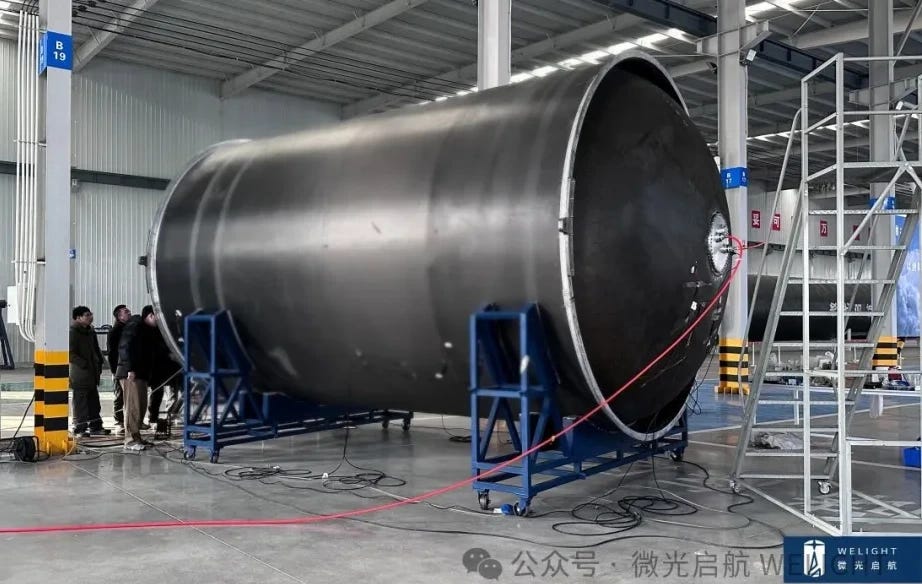
Propellant tanks being produced currently will be key for allowing Welight to understand how to manufacture its partially reusable Weiguang-1 (微光一号) two-stage 60-meter-tall launch vehicle with 3.8-meter-diameter stages. That vehicle, powered by a total of twelve4 full-flow staged-combustion cycle Huaguang-1 (华光一号) engines, is planned to carry 9,000 kilograms to low Earth orbit with first-stage reuse or 11,000 kilograms when expended. At present, Weiguang-1 is aiming to fly for the first time in 2028, perform first-stage booster landings in 2029, and refly boosters in 2030.
For a launch cost of 220 million Yuan (31.87 million United States Dollars).
For a launch cost of 55 million Yuan (7.97 million United States Dollars).
Which may have been assisted by the United Arab Emirates’ Leap71, according to a cooperation agreement from August 2025.
Eleven on the first-stage and a single vacuum optimized variant on the second-stage.