


Last night, an Antonov An-124 flew from Beijing (北京) to Haikou (海口市)1, Hainan (海南) province, carrying hardware for the Chang’e 7 robotic lunar mission, which will search for water ice in the Moon’s South Pole. Not long after the aircraft’s arrival, China’s space agencies and enterprises announced that the spacecraft had arrived in the province, being promptly taken to the Wenchang Space Launch Site.
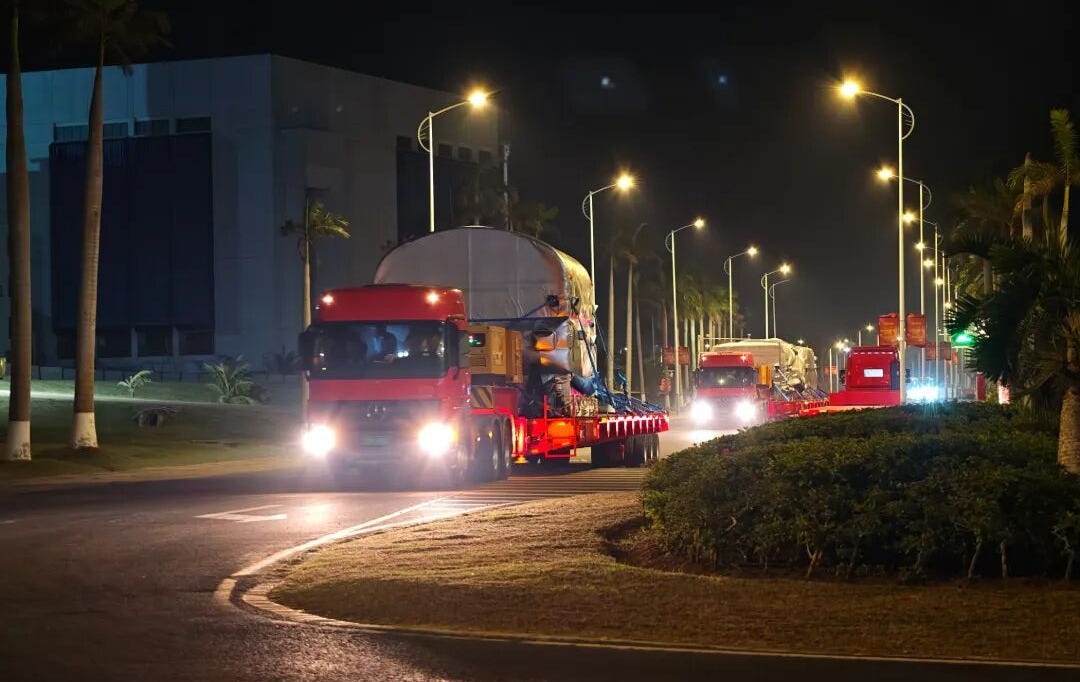
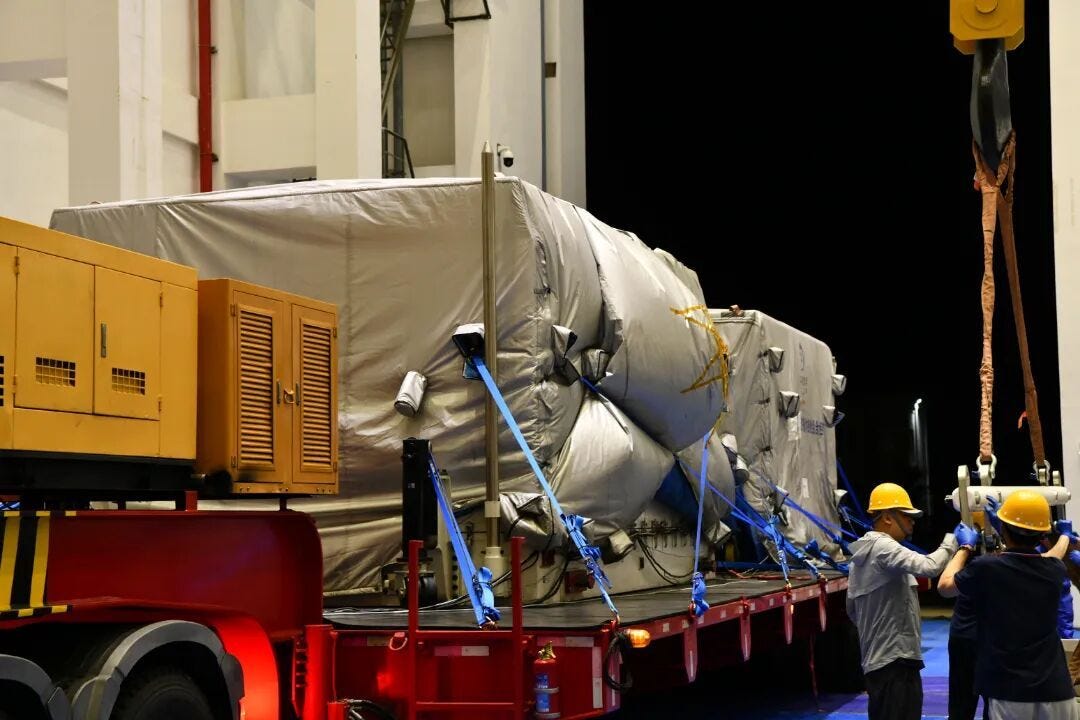
Arrival at the launch site, around twenty miles from the airport the spacecraft landed at2, occurred late at night to avoid traffic and disrupting others with a convoy of slow-moving, wide-load trucks. Once Chang’e 7 hardware was unloaded, the involved agencies and enterprises released their announcements and stated:
“Currently, the launch site facilities and equipment are in good condition, and all preparatory work is proceeding smoothly according to schedule. The Chang’e-7 mission is scheduled to launch at an appropriate time in the second half of this year.”
If there are any problems with this translation please reach out and correct me.
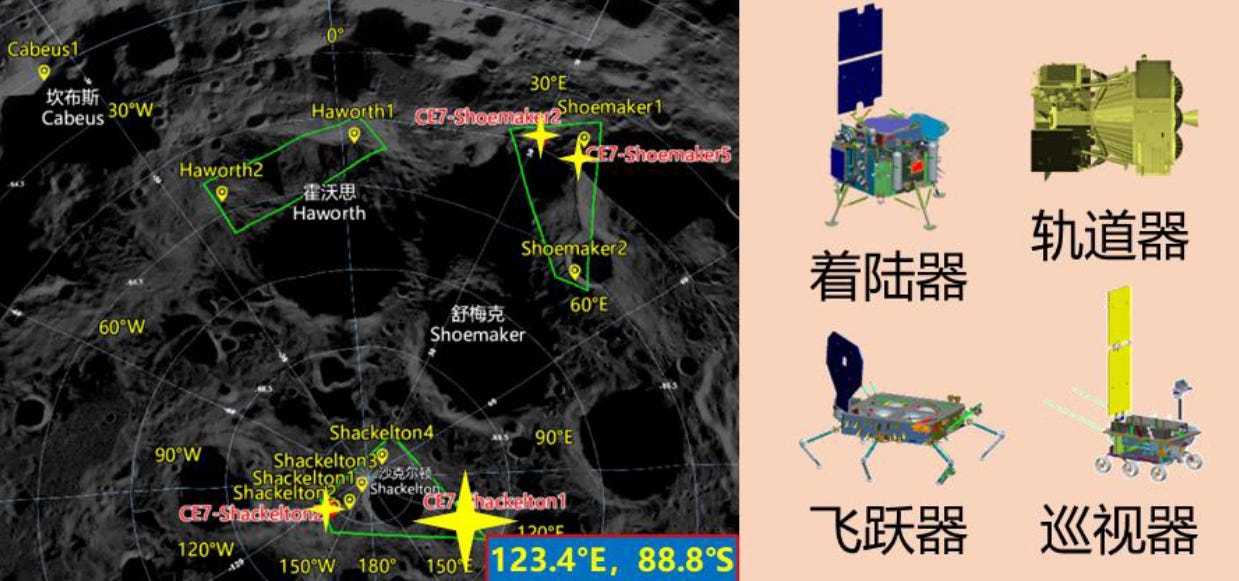
Over the coming weeks, Chang’e 7’s orbiter, lander, rover, and hopper will be integrated as a complete spacecraft for final pre-mission checks. That will be followed by encapsulating the complete spacecraft within a Long March 5’s fairing and eventually stacking it atop of the launch vehicle. Assuming those steps occur smoothly, Chang’e 7 could be ready to depart from Launch Complex 101 as early as August.
A few weeks after launch and loitering in a polar orbit of the Moon, Chang’e 7 will aim to land on a permanently illuminated peak next to Shackleton crater, at 123.4 degrees East and 88.8 degrees South, with backup sites near craters Shoemaker and Haworth.
On the lunar surface, Chang’e 7’s lander, rover, and hopper will search for water ice in permanently shadowed craters, via short excursions and study of the surface environment, for at least eight years. In a paper published earlier this year, scientists believe lots of water ice is likely present alongside many other chemicals, writing:
“Most of the surface of lunar regolith inside Shackleton crater is favorable for the stable preservation of water ice. … identified cold traps could preserve a rich history of volatile accumulation and serve as targets for in situ exploration of water ice during the [Chang’e]-7 mission.”
Many instruments are installed across Chang’e 7’s orbiter, lander, rover, and hopper, including cameras, spectrometers, and sampling drills. Unlike China’s last two lunar missions, samples gathered will remain on the Moon for in-situ study. A handful of the missions' instruments are coming from international partners, and are:
Egypt and Bahrain: a hyperspectral camera to study lunar geology and surface resource composition (on the orbiter).
Thailand: a hodoscope to detect high-energy particles and how they’re influenced by the Sun, Earth, and Moon (on the orbiter).
Switzerland: a spectrometer facing Earth to measure radiation going to and from our planet (on the orbiter).
United States (Hawai’i): a wide-field optical telescope from the International Lunar Observatory Association, to image the Milky Way and Galactic Center; included via a partnership with the University of Hong Kong’s Laboratory for Space Research (on the lander).
Russia: a lunar dust and electric field probe to measure plasma in the lunar surface environment (on the lander).
Italy: a laser retroreflector array for precisely measuring the distance to the Moon from Earth (on the lander).


Haikou Meilan International Airport (海口美兰国际机场).