

Chang'e 7's Long Route From Wenchang to the Moon's South Pole
To ensure a successful search for lunar water ice, China's next moon mission will wait in lunar orbit for several weeks before touching down near Shackleton crater.

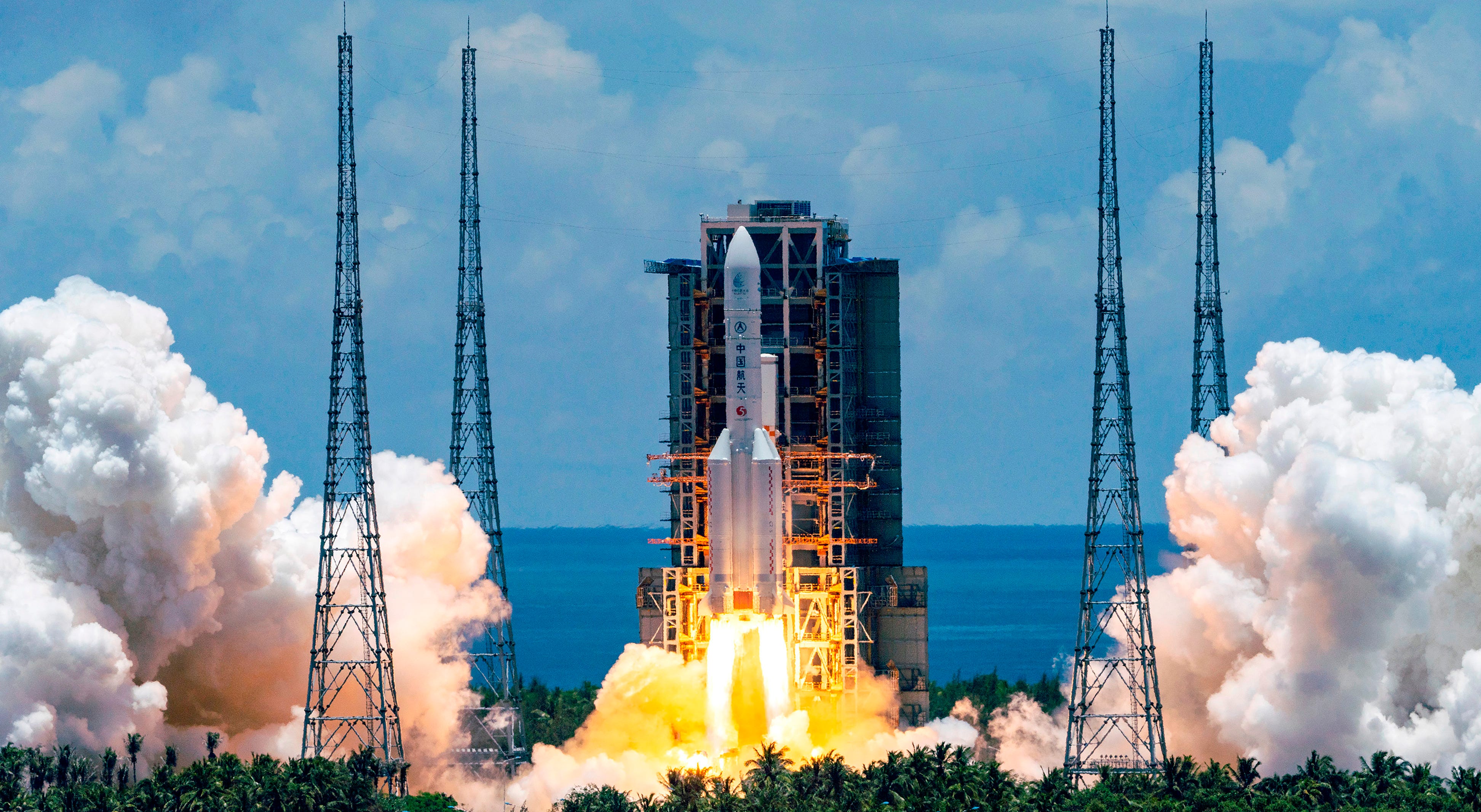
Having been delivered to the Wenchang Space Launch Site almost a month ago, the Chang’e 7 robotic Moon mission to search for water ice is set to launch from Launch Complex 101 as soon as August via a Long March 5 launch vehicle. But unlike previous Chang’e lunar landing missions, this year’s mission will spend an extended period in orbit ahead of venturing to its south pole landing site.
Detailed in a paper regarding the calibration of the International Lunar Observatory Camera payload onboard the mission’s lander, Chang’e 7’s lunar transfer trajectory will see the spacecraft head towards the Moon on a five to six-day flight path, depending on the launch period, to target its near-polar orbit. The path to that orbit will be refined by trajectory correction burns, as done previously by Chang’e 5 and Chang’e 6.
That same paper also states that Chang’e 7 will wait in that orbit, with the orbiter and lander remaining attached, for about ninety days. By waiting that long, the lander may wait to reach its preferred landing site, a permanently illuminated peak next to Shackleton crater at 123.4 degrees East and 88.8 degrees South, until very late October at the earliest.
As for why Chang’e 7 will be waiting that long, it comes down to ensuring mission success. A paper from 2024 shares that to perform the search for water ice, a significant landing accuracy with minimal deviation is required while verifying that the preferred site, as well as back-ups nearby, are sufficiently lit for guidance systems to function properly. For that, the orbiter is equipped with a High-Resolution Stereo Mapping Camera and a Miniature Synthetic Aperture Radar that will begin imaging the south pole landing sites shortly after entering orbit, doing so every pass following to build a repository of high-quality imagery to thoroughly understand patterns of lighting conditions and potential hazards present.
Other instruments like the Medium-Energy Proton Detector, Lunar Seismograph Payload, Lunar Penetrating Radar, Wide-band InfraRed Imaging Spectrometer, Electric Field Probe, and those from international partners will be calibrated during the flight out and the period in lunar orbit.
After the preferred and backup landing sites are properly understood and conditions are deemed acceptable to mission controllers back on Earth, Chang’e 7’s lander will be commanded to separate from the orbiter and head into a pre-landing orbit. From that orbit, the lander will descend towards Shackleton, maintaining communication through the Queqiao-2 (鹊桥二号卫星) relay satellite, and should successfully touchdown around twelve hours after being commanded to commit to descent.
Following a landing at Shackleton, Chang’e 7’s orbiter will continue to image the region where the lander is operating, as well as its rover and hopper, assisting in exploration planning, with its Wide-Band Infrared Spectrum Mineral Imaging Analyzer and Lunar Neutron Gamma Spectrometer instruments, and monitoring their conditions. While flying over other parts of the Moon, instruments onboard can be used to map other parts of the lunar surface and look into potential resources ahead of crewed missions later this decade.
Really appreciate these posts Jack. Western media ignores anything positive that China is doing in space.