

Chang'e Missions Are Now Managed by China Manned Space Agency
And is Chang'e 8 still planned to occur this decade with rumours of cancellation?

Beginning with the Chang’e 7 robotic mission to the lunar south pole, the China Manned Space Agency has become the government entity responsible for implementing and managing the Chinese Lunar Exploration Program (中国探月工程).
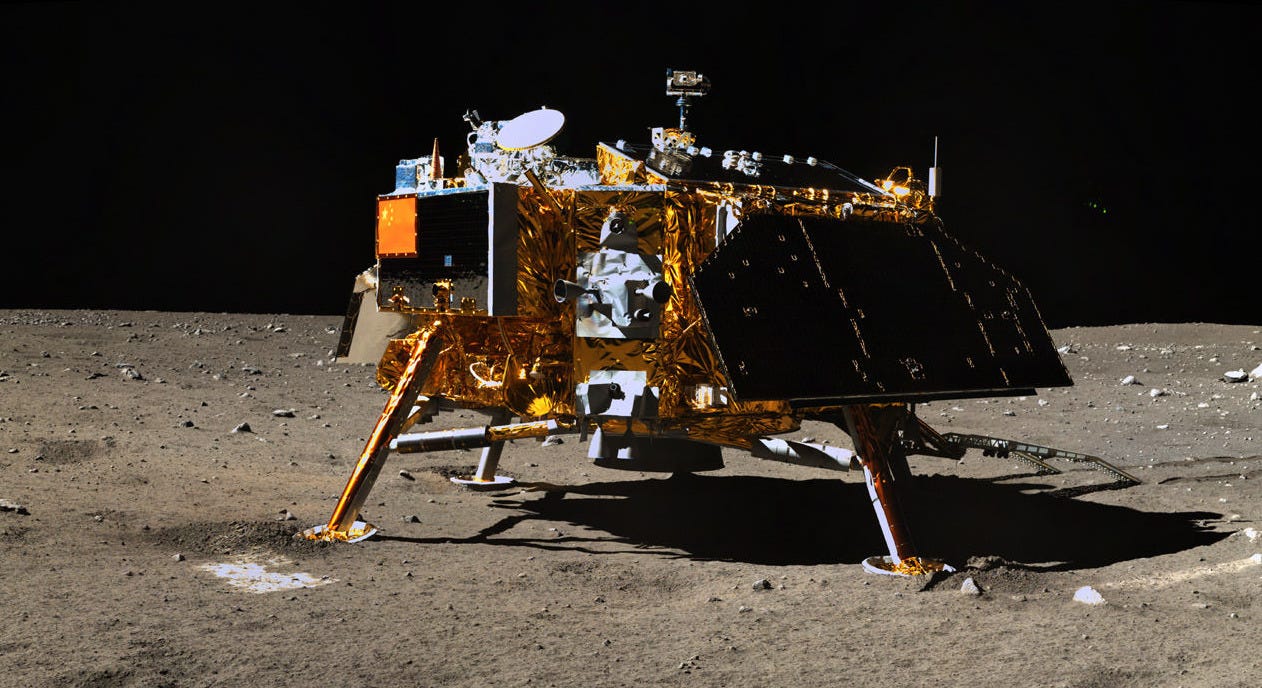
That has had missions currently underway, including Chang’e 31, Chang’e 42, Queqiao-1 (鹊桥号中继卫星)3 and Queqiao-2 (鹊桥二号中继卫星)4, transferred, along with their respective teams, out from under the China National Space Administration as it shifts focus towards robotic planetary and asteroid exploration5. Freeing up administrative room to look further afield into space is only part of the reason why management changed.
At the Shenzhou-23 pre-launch press conferences on May 23rd, representatives of the China Manned Space Agency told the media present that:
“To fully leverage the technical expertise and hands-on experience we have gained over the decades from the manned spaceflight missions and the Chang’e program, we have integrated the crewed Moon missions with the [robotic] ones by pooling together the tasks, resources, and teams.”
Those being pooled together are engineers who have worked on Chang’e systems and those working on the crewed lunar spacecraft, experts on lunar geology, teams working on mapping the Moon, and personnel who support taikonauts before and during their missions.
Before the transfer between entities, knowledge about certain hardware items that have previously been onboard Chang’e landers and will be featured on Lanyue (揽月) has been shared via the relevant manufacturer through a series of managers, to use one example6. Now teams can share information with less bureaucratic overhead.
Other teams and resources being brought together are those to determine the scientific efforts of the robotic and crewed missions, as has been the focus of the Chang’e program and will continue to be a key part of taikonauts’ tasks on the surface. Unifying scientific personnel under one organization allows for a better return on state-funded investment as work is not being duplicated.
While yet to be mentioned publicly, robotic missions for the China-led International Lunar Research Stations should have been moved too7. As of 2021, five scientific cargo-carrying missions were planned to occur between 2031 and 2035. In late 2025, design work indicated that landers for those deliveries would be built upon expertise and hardware used for Chang’e missions.
Although the China Manned Space Agency is managing the government-backed lunar exploration effort, it does not prevent other Chinese entities from conducting missions to lunar space. The Chinese Academy of Sciences has a small footprint around the Moon with its technology-proving Distant Retrograde Orbits Exploration network, and the Shanghai Academy of Spaceflight Technology is looking into methane-fuelled lunar landers to serve a variety of potential customers.
Chang’e 8 still on the roadmap
Following the China Manned Space Agency becoming the managing entity for Chang’e missions, rumours have begun to swirl about a potential ‘cancellation’ of Chang’e 8. Those rumours suggest that the mission will be changed from its current plans in favor of a more human-spaceflight benefiting task. That is, frankly, unfounded nonsense.
A new academic paper about the mission’s instruments has recently been published, with the team behind it having confidence in detailing a favored landing site at 84 degrees south, 32 degrees east on Mons Mouton, the Moon’s tallest named mountain located in its south pole region.
Alongside that, several international partners are already onboard, with Türkiye, South Africa, Peru, Italy, Russia, Thailand, Bahrain, Egypt, Iran, and Pakistan. Several are some nations’ first lunar rovers. If Chang’e 8 were to be cancelled after China agreed to carry international payloads, it would be a major embarrassment internationally for Chinese scientists and a blow to geopolitical goodwill.
As for usefulness to human missions, Chang’e 8 already is! It is set to prove technologies able to modify lunar surface materials into useful structures, like landing pads so visiting vehicles don’t kick up dust or additional walls around inhabited structures to reduce exposure to radiation. Those technologies will need to be understood if the International Lunar Research Station is to support human scientists for up to months at a time.
Along with all of the above, China Central Television (中国中央电视台) wrote at the start of the month that the mission is planned to launch no earlier than 2028.
Its lander is still active on the lunar surface.
Its lander is still active on the lunar far side along with its rover, Yutu-2 (玉兔二号).
Actively providing communications relay services to spacecraft on or near the Moon’s far side.
Actively providing communications relay services to spacecraft on or near the Moon’s south pole as well as the far side.
Starting with Tianwen-2 (天问二号), presently underway to asteroid Kamoʻoalewa, and Tianwen-3 (天问三号), as early as 2028 to return samples from Mars.
This example has been simplified for brevity.
At present its unclear whether the China National Space Administration will still act as the international face of the project. China Manned Space Agency does have experience in a similar role for enabling several nations’ experiments to be onboard the Tiangong Space Station.