

China Mobile Acquires Stake in Tianqi Constellation Operator, Report Claims
Space-based connectivity efforts at the commercial firm may change by aligning plans with the state-owned telecommunications giant.

Leading information and communications technology-focused outlet C114 reported on July 16th that China Mobile (中国移动), one of the nation’s three dominant state-owned telecommunications providers, has acquired a major stake in Guodian Gaoke (国电高科), of the Tianqi (天启) Internet-of-Things constellation.
According to the report, China Mobile has ‘strategically invested’ in the enterprise, spending a currently unknown amount of capital, to attain a 39.85 percent stake, making it the largest single shareholder. That is alongside new shareholders buying smaller stakes, resulting in the Chairman of Guodian Gaoke Lu Qiang’s (吕强) shares dropping down to 18.15 percent.
Citing industry insiders, C114 noted that Guodian Gaoke will maintain its operational independence and ownership of the Tianqi constellation, while enabling an efficient path for China Mobile services to be added to its satellites. To date, forty-one have been launched.
Services that the telecommunications giant would be looking to provide are space-based direct-to-device connectivity. Regulators approved relevant licenses for that in September 2025, with China Mobile being selected alongside the two other state-owned giants, China Unicom (中国联通) and China Telecom (中国电信).
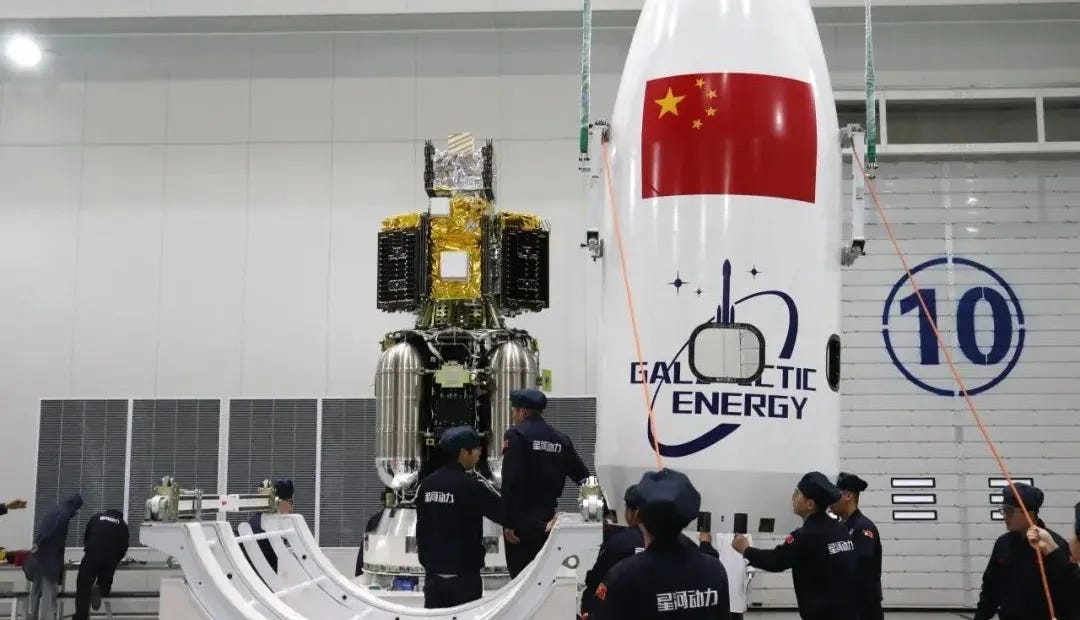
Seeking to understand challenges with those services, China Mobile had a sizeable demonstration satellite placed into low Earth orbit last month, built by commercial spacecraft maker GalaxySpace (银河航天). The satellite builds on earlier demonstrations contracted by the telecommunications provider.
Guodian Gaoke is known to be developing satellites capable of providing direct-to-device connectivity, having announced plans to do so in June. Known details are that those new satellites will see a mass increase of over sevenfold, requiring larger launch vehicles to deploy them, and an increase in connectivity throughput of around sixfold over their current capacity, compared to the forty-one deployed so far.
Meanwhile in May, Guodian Gaoke was approved by the Ministry of Industry and Information Technology (中华人民共和国工业和信息化部) to trial Tianqi connectivity services to consumers across China using its currently in-orbit satellites until May 2028.
Those plans and a regulator-approved trial may have been China Mobile’s rationale for obtaining the large stake.
Interestingly, both enterprises were part of a massive international filing of satellites, almost two hundred thousand, at the end of last year. In that, Guodian Gaoke filed for a 1,132-spacecraft expansion to the Tianqi constellation, while China Mobile outlined 2,664 satellites across two constellations. At present its unclear whether their plans could merge.
At the other telecommunications giants, China Unicom has partnered with Geespace for Geely Future Mobility Constellation to make use of its capabilities. China Telecom has opted to offer similar services from geostationary space through the three Tiantong (天通) satellites, launched between 2016 and 2021.
By 2030, the Ministry of Industry and Information Technology is aiming to have over ten million domestic users connected by China’s space-based services through supporting relevant enterprises and streamlining market access.