

Tianqi Satellites Planned to 7x in Size for Connectivity Expansion
The commercial Internet-of-Things constellation’s new satellites are set to be significantly heavier to support greater services and new capabilities.

With forty-one satellites deployed to date, Guodian Gaoke’s (国电高科)1 Tianqi (天启) Internet-of-Things constellation is one of China’s well-established space-based connectivity efforts, with its first satellite launched back in 2018 and the newest four added in January to complete the first phase.
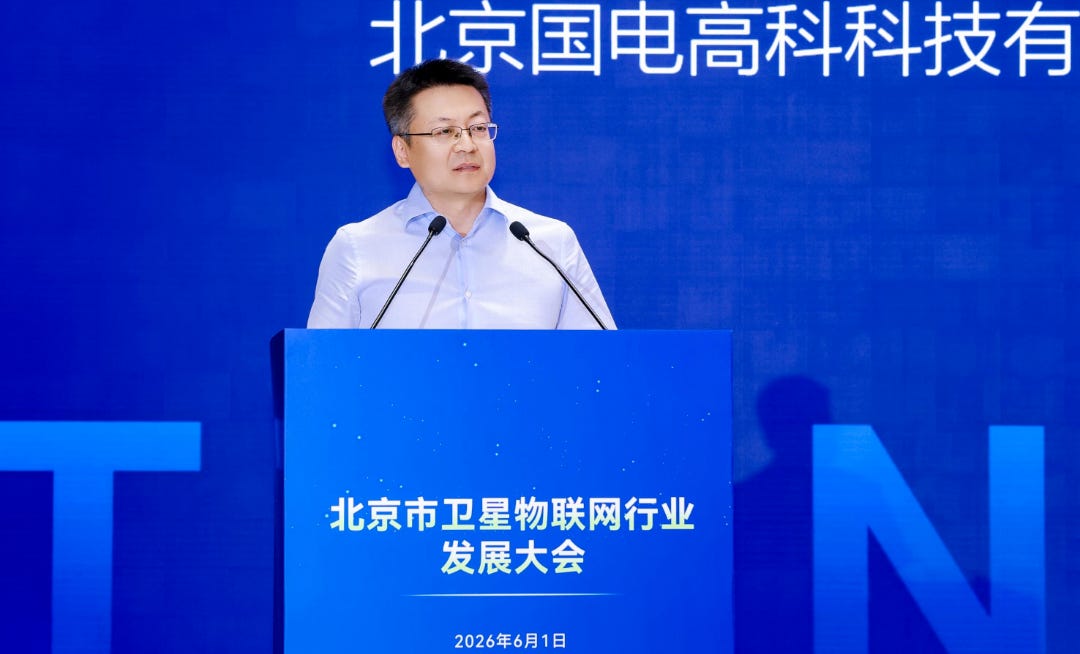
Thanks to that orbital seniority, Guodian Gaoke was a key part of the Beijing Satellite Internet of Things Industry Development Conference (北京市卫星物联网行业发展大会) on June 1st, along with ten government departments and other commercial space enterprises, to coordinate development of the sector while understanding the intended direction of the space industry and regulators. Malaysia’s MEASAT was also in attendance2.
At the conference, Lu Qiang (吕强), Chairman of Guodian Gaoke, announced that the second phase of Tianqi deployments will start this year, featuring a new satellite design. That design will have them grow from 50 kilograms to about 360 kilograms, a mass increase of over sevenfold, while increasing connectivity throughput by around sixfold over their current capacity. That second phase will begin with at least seven satellites launched by 20283.
It’s unknown if the larger second phase satellites will standardize components, as the company boasted about producing over ten different types of antennas with six modules able to be added to previously launched satellites during production.
Using larger satellites, Guodian Gaoke expects to expand its user base in and around cities while bringing in new ones within China from remote regions, vessels offshore, and aircraft, as well as mobile direct-to-device offerings and being a part of 6G infrastructures currently being formulated. Additionally, the company is aiming to offer its connectivity services to international customers. Only an enterprise agreement with MEASAT is known to have been signed to enable those.
The newly announced satellites may be related to a 1,132-satellite filing by Guodian Gaoke with the International Telecommunications Union in December 2025, with frequencies requested being within the VHF and L-bands used for marine, aviation, and mobile services. It could also be replacing a previous filing for 3,240 spacecraft that would likely have used smaller satellites.
Previously, Tianqi services have been used by a handful of enterprises for forestry, agriculture, aquaculture, petroleum, emergency response, ecological environment conservation, and smart city development in any weather at any time.
In May, Guodian Gaoke was approved by the Ministry of Industry and Information Technology (中华人民共和国工业和信息化部) to trial Tianqi connectivity services to general users across China. That approval is a step towards a national aim of having over ten million users of space-based connectivity services by 2030.
Full business name Beijing Guodian Gaoke Technology Co Ltd (北京国电高科科技有限公司).
In February 2025, they signed a Memorandum of Understanding for Qianfan’s connectivity services.
Wording from Lu Qiang was that ‘forty-eight plus’ Tianqi satellites will be in orbit by 2028, forty-one are already in orbit.