

China Seriously Backs Space-Based Compute With Over 57 Billion Yuan Financed
The 'rush' to develop orbiting data centers has found significant financial backing in China with major banking institutions.

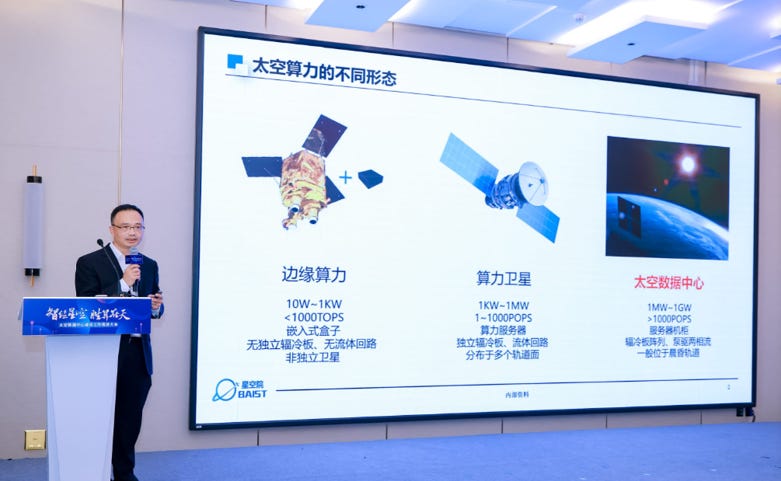
Recently on April 20th, Beijing Astro-Future Institute of Space Technology’s (北京星辰未来空间技术研究院) incubator Beijing Orbital Twilight Technology Co Ltd (北京轨道辰光科技有限公司), known in short as Orbital Chenguang (轨道辰光), completed its first round of capital financing, labelled as ‘A1’, to support its space-based AI compute plans.
That capital will be used to kick off the long-term development of space-based data centers previously outlined by the Astro-Future Institute, which will eventually establish a sixteen-spacecraft constellation of laser-linked gigawatt-scale data centers in sun-synchronous orbit to utilize effectively all-day solar power, by financing the development of critical technologies and supporting the establishment of relevant services. According to Zhang Shancong (张善从), head of both entities, putting compute in space will reduce emissions that warm the atmosphere and relieve demands on local grids. Sometime this year a first test satellite will be launched.
The capital round to do that was backed by Haisong Capital (海松资本), CITIC Securities Investment (中信建投投资), Cathay Capital (凯辉基金), Inno Angel Fund (英诺天使基金), Anhui Xinhua Group (安徽新华集团), Zhike Industrial Investment (智科产投), Kunlun Capital (昆仑资本), and Lizhe Fund (砺哲基金), while raising an undisclosed amount through the sale of company shares. Meanwhile, Orbital Chenguang has secured 57.7 billion Yuan (8.45 billion United States Dollars, as of April 21st) of strategic credit lines with multiple major fincial institutions, directly naming the Bank of China (中国银行), the Agricultural Bank of China (农业银行), the Bank of Communications (交通银行), Shanghai Pudong Development Bank (浦发银行), CITIC Bank (中信银行), China Merchants Bank (招商银行), China Minsheng Bank (民生银行), the Industrial Bank (兴业银行), Huaxia Bank (华夏银行), China Everbright Bank (光大银行), the Bank of Beijing (北京银行), and the Bank of Hangzhou (杭州银行).
With tens of billions of Yuan in strategic credit, Chinese institutions are serious in backing the further establishment and long-term use of space-based AI computing. In support of that, Orbital Chenguang quoted Chen Liguang (陈立光) of Haisong Capital as saying:
“With the rapid development of the space economy, space-based in-orbit computing power has become a core infrastructure in fields such as satellite internet, space remote sensing, satellite constellation deployment, and space exploration. The development potential of autonomous and controllable on-board computing power holds immense potential and is also a key national strategy. … In the future, we will leverage our industrial ecosystem, upstream and downstream resources, and capital platform to comprehensively empower the company’s technological iteration, in-orbit validation, and large-scale commercial deployment, working together to build the foundation for space-based data centers.”
If there are any problems with this translation please reach out and correct me.
Previously, the Astro-Future Institute has received backing from electronics giant Lenovo and the municipal government of Beijing (北京), with at least 140 million Yuan (20.5 million United States Dollars) in funding. More recently, Orbital Chenguang signed a cooperation agreement with the Harbin Institute of Technology, Shenzhen (哈尔滨工业大学, 深圳) to jointly research needed energy management systems for larger space-based data centers.
Elsewhere during this week, newer space enterprises have made first steps to prove their early plans for space-based computing. Xingyong Space Chengdu Technology Co Ltd (星用空间成都科技有限公司) increased its overall available capital to 218.6 million Yuan (32 million United States Dollars), while Comospace (中科天算), Hangsheng Satellite (航升卫星), and Yanhe Technology (炎和科技) have teamed up to perform a two-satellite high-powered in-space compute demonstration by March 2027, leveraging their expertise in small spacecraft, advanced solar cells, and powerful space-rated processors.
While the above-mentioned enterprises are still setting up plans to establish space-based compute, ADA Space (国星宇航) and Zhejiang Laboratory (之江实验室) have placed twelve satellites into orbit for the Three-Body Computing Constellation, which has run several different AI models and agents to date. 2026 should see the constellation triple in satellite count, and therefore compute too.
State-owned enterprises, namely the China Aerospace Science and Technology Corporation, have an interest in placing compute in space too, aiming to establish a gigawatt worth of space-based data centers during the 15th Five-Year Plan period (2026-2030). It’s unclear if the state-owned enterprise and its many subsidiaries would look to directly develop orbiting compute, possibly leveraging existing work for space-based solar power stations, or would be more managerial to align commercially operating companies.

If any readers would like to understand why China is pouring immense resources into AI, I can recommend Kai-Fu Lee’s (李開復) 2019 book ‘AI Superpowers: China, Silicon Valley, and the New World Order’ (ISBN: 9780358105589).