

China's Space Enterprises Quietly Lead in-Space AI Compute Capabilities
Hype in America has, so far, ignored operational efforts from Chinese enterprises.

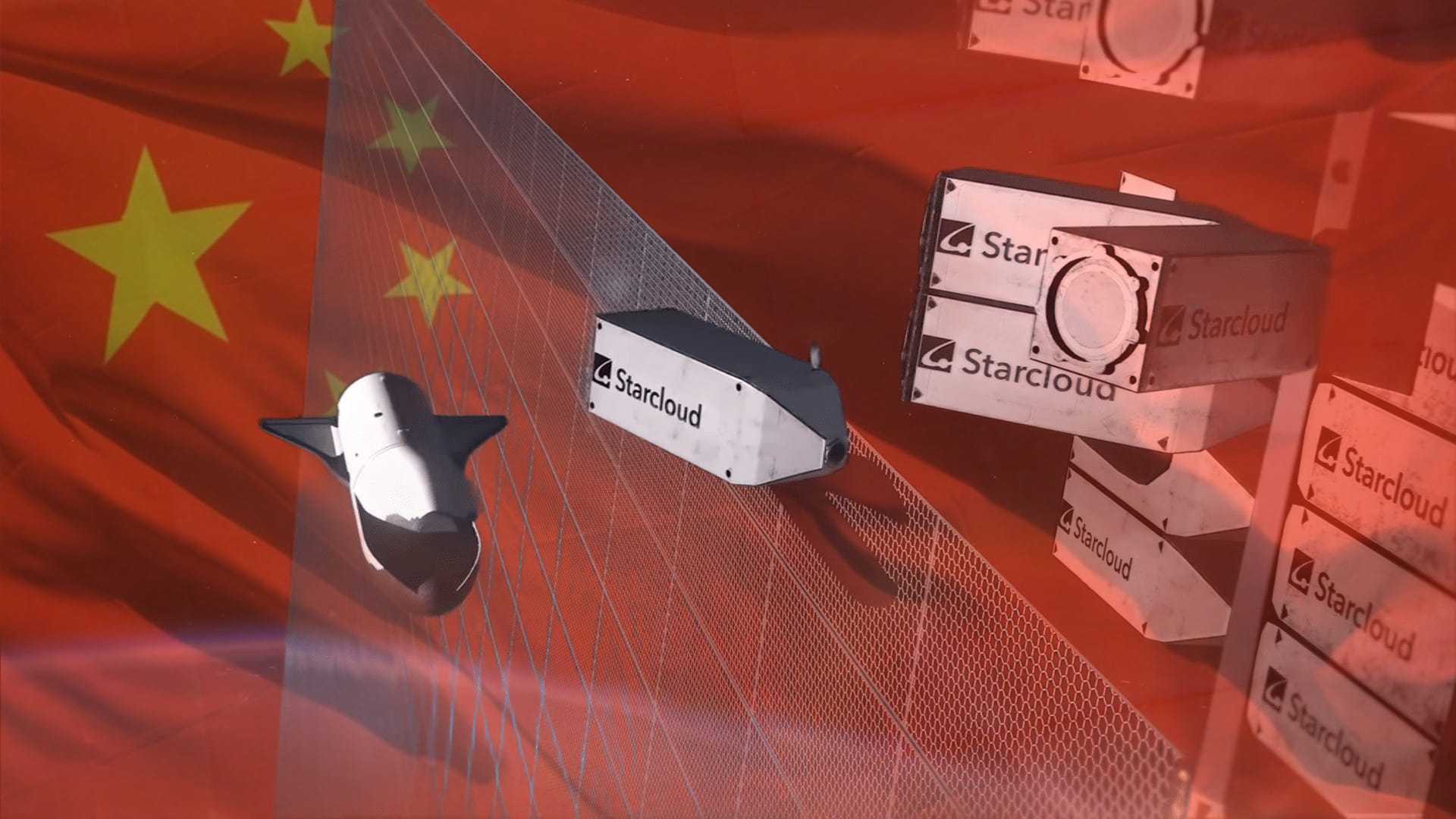
In the U.S., AI and space companies are rushing to develop and field orbiting data centers as part of a perceived international race that will supposedly reward the leading nation with increased productivity, greater economic output, and potential ‘artificial general intelligence’.
Advantages of moving data centers to space are claimed to be lower power and cooling costs while scaling ‘infinitely’, along with not needing to worry much about environmental impacts that Earth-based ones do.
While American companies are moving to start putting computing power in space, Chinese enterprises are already doing so, with significant backing to do it. As such, China has quietly1 gained a likely lead in space computing and orbiting AI.
Existing efforts
China’s most well-known space computing effort comes from ADA Space (国星宇航) and Zhejiang Laboratory’s (之江实验室) Three-Body Computing Constellation, which saw its first set of satellites launched in May 2025. Through the use of 100-gigabit intersatellite laser links, each satellite in the constellation is able to jointly work on a computing task thanks to their dedicated AI processors, adapting to the number of satellites needed depending on the amount of compute required.
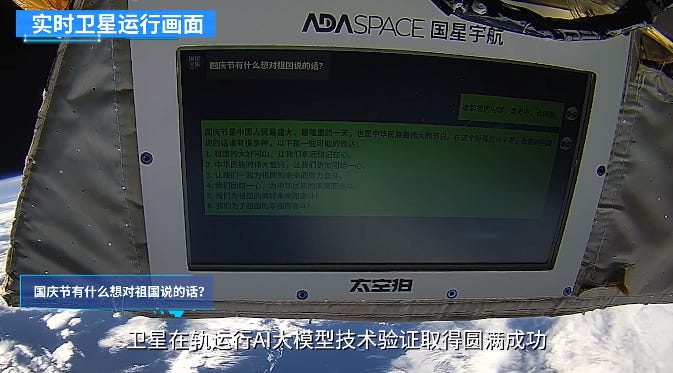
Ahead of the first operational satellite set launch, a demonstration satellite trained at least one AI large language model on-orbit in September 20242. By this January, Alibaba Cloud (阿里云) had its Qwen3 model performing real-world operations in space. As of mid-February, state-affiliated media in China started to report that ten AI models have been deployed and tasked onboard the constellation.
Later this year, the Three-Body Computing constellation is planned to be expanded with the launches of its second and third satellite groups, boosting combined processing power and the number of models that can be deployed concurrently. At the moment, just twelve spacecraft are in orbit for computing tasks out of an approved 2,800.
Of a similar purpose to the constellation but more regionally focused is the Chinese University of Hong Kong’s CUHK-1 (港中大一号卫星). The spacecraft, running a version of the DeepSeek model, is designed to connect with other Hong Kong-made satellites and process their data, then transmitting the finished data product to their operators in the Special Administrative Region.
Both the Three-Body Computing satellites and CUHK-1 have remote sensing capabilities onboard as well, as part of an additional value stream due to the unclear availability of high-capital spending users in the short term. Those capabilities have also been used to develop novel geographic-focused AI models.
Beyond dedicated computing applications, AI-assisted data processing is being added onto satellites too. To name a few satellites that are said to have assisted processing:
Remote sensing satellites Jilin Gaofen 07B01 (吉星高分07B01星), Jilin Gaofen 07C01 (吉星高分07C01星), and Jilin Gaofen 07D01 (吉星高分07D01星) have their images scanned by onboard AI processing to flag items of interest.
Twin X-band synthetic aperture radar spacecraft AIRSAT-03 (中科卫星03星) and AIRSAT-04 (中科卫星04星) have AI onboard to support gathering data on desired imaging locations.
Infrared imaging satellite Yixing-2 09 (驭星二号09星) has similar processing to the three Jilin Gaofen satellites for the same purpose.
AI models have also been installed on board the Tiangong Space Station. Since August 2025, taikonauts working inside the orbiting laboratory have used the assistive ‘Wukong AI (悟空AI)‘, developed jointly by Zhejiang Laboratory and the China Astronaut Research and Training Center (中国航天员科研训练中心), to ask where items are3 when preparing for tasks, finding digital versions of documentation for experiments onboard, and supporting general mission-supporting needs.

Getting AI models to work in-space can be a difficult task, however, as Professor Ma Peifeng (马培峰), Chief Designer of CUHK-1, explained regarding adapting DeepSeek:
“Addressing engineering challenges such as limited onboard computing power and the need for high stability during in-orbit operations, our team has . . . performed lightweight adaptation and workflow restructuring of the DeepSeek large model at the satellite level.”
Looking long-term
To enable ADA Space to deploy the Three-Body Computing constellation at scale, the enterprise has been granted a five billion Yuan (about 730.85 million United States Dollars, as of February 26th) line of financial support from the Sichuan (四川) branch of the Bank of China (中国银行) in October 2025, alongside other monetary support from the China Construction Bank (中国建设银行) and China Investment Corporation (中国投资有限责任公司). Additionally, the Ministry of Industry and Information Technology (中华人民共和国工业和信息化部) agreed to support the company at the start of the year by promoting the Three-Body Computing constellation’s capabilities and applications to small and medium-sized enterprises.
Other than financial and market support, ADA Space has signed agreements with Shanghai Jiao Tong University (上海交通大学) and Beijing University of Posts and Telecommunications (北京邮电大学) as well. Those agreements will establish mutually beneficial laboratories for space computing that should improve the constellations capabilites4 and train a workforce with real-world experience that can be hired shortly after graduation.
ADA Space is not the only space computing-focused enterprise in China with the announcement of the Beijing Astro-Future Institute of Space Technology’s (北京星辰未来空间技术研究院) plans in recent weeks. The Astro-Future Institute is looking to gradually prove the idea of putting data centers in space, with a demonstration satellite expected to launch during the year, and eventually establishing a sixteen-spacecraft constellation of laser-linked gigawatt-scale data centers. To do so, the enterprise has backing from electronics giant Lenovo and the municipal government of Beijing (北京), with at least 140 million Yuan (20.4 million United States Dollars) in funding.
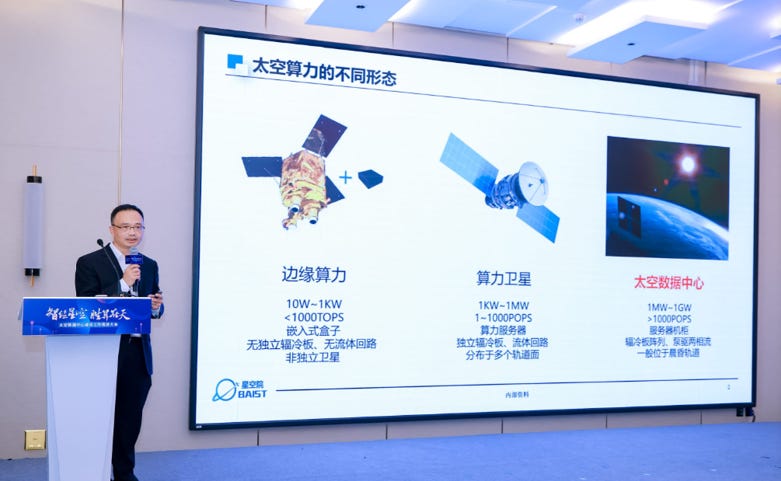
Placing data centers in orbit has also gained interest from the China Aerospace Science and Technology Corporation, a state-owned enterprise. Through a brief notice on focus areas during the 15th Five-Year Plan period, running from 2026 to 2030, space-based data centers were spoken of under space infrastructure:
“Build gigawatt-scale space-based digital and intelligent infrastructure, establish a new space architecture integrating cloud, edge, and endpoint computing, achieve deep integration of computing power, storage capacity, and transport capabilities, and empower ‘space-based computing with terrestrial data’, ‘terrestrial computing with space-based data’, and ‘simultaneous space-ground computing’.”
If there are any problems with this article’s translations please reach out and correct me.
State-backed concepts and plans for orbiting data centers will remain vague until at least the publication of related 15th Five-Year Plan documents. Efforts to establish a gigawatt-scale data center can likely be accelerated by existing work for space-based solar power station power-generating and thermal management hardware.
Where’s America?
To understand why China is likely leading space AI compute, it’s important to ask, where are the American efforts right now?
Since 2017, Hewlett Packard Enterprise has been sending high-powered computers, three to date, to the International Space Station in partnership with NASA. Those computers have been used to run computationally-intensive experiment tasks, using machine learning and AI.
NVIDIA and Y Combinator supported, to the tune of around twenty-one million United States Dollars, media darling Starcloud is the most well-recognised U.S. space computing enterprise, with plans to deploy massive orbiting data centers that are kilometers across. In October, the company plans to launch its first user-utilizable in-space computing platform that will enter operation in 2027.
Following a November 2025 launch, the Starcloud-1 demonstration NVIDIA H100-equipped satellite started training a version of Google’s Gemini model in December. That was used to make the claim that Starcloud was the ‘first’ entity to train an AI model in space, despite being fifteen months behind ADA Space5.
Internet giant Google has plans similar to those of Starcloud with its ‘Project Suncatcher’. Via a partnership with Earth imagery satellite maker Planet, two prototype satellites, equipped with Google-developed Tensor Processing Unit AI chips, are set to head to space in 2027 to trial joint computing tasks in orbit.
Meanwhile, Satellogic is preparing to fly its first AI-assisted Earth observation spacecraft sometime in 2027. The spacecraft will be like its already operational Chinese counterparts, using AI to find items of interest in imagery collected, then beaming back the possible item of interest to spacecraft operators.
More speculatively, SpaceX has submitted plans for one million satellites for space computing and AI development, after the rocket maker merged with xAI (both companies run by Elon Musk). Most of those satellites would be launched in a few years by the troubled in-development fully reusable Starship-Super Heavy launch system. A challenge with deploying that many spacecraft would be producing enough cells for solar panels, which may have to come from China. There is also the possibility that the massive satellite submission is to boost hype for SpaceX’s upcoming stock listing.

Worth a brief mention is the European ASCEND (Advanced Space Cloud for European Net zero emission and Data sovereignty) project from Thales Alenia Space. In 2024, a feasibility study was completed to confirm that orbiting data centers are possible and that a market may exist by 2030. By 2050, Europe’s space entities may deploy an 800-kilowatt data center into orbit.
Not all major AI or computing enterprises in the U.S. are convinced by the possibility of putting data centers in space. OpenAI’s Sam Altman believes the economics of doing so, launching significant amounts of compute and replacing what breaks6, aren’t ready. Amazon Web Services’ Chief Executive Officer Matt Garman agrees with Altman on the cost of launching massive data centers7.
Will the lead last?
So why is China quietly leading space AI computing? Simply, Chinese space enterprises are already deploying their capabilities for user use, whereas U.S. efforts are still being proven out or are yet to reach space.
Now, can that lead be maintained? Probably, but it depends. Starcloud, Google, and Satellogic are all moving slowly in comparison to their Chinese peers. That will allow ADA Space to triple the size of its Three-Body Computing constellation this year, and deploy more satellites in 2027, to bolster is capablites and compute capacity. Alongside them, the Beijing Astro-Future Institute of Space Technology and the China Aerospace Science and Technology Corporation should make good progress over the coming months and 15th Five-Year Plan period, thanks to lower-cost satellites and launch solutions.
But if SpaceX actually manages to start launching its imagined million satellites, that lead will shrink or disappear depending on the company’s openness to the rest of the industry. Additionally, U.S. efforts could be boosted by military contracts, as some in the AI sector try to label the ‘AI race’ a national security imperative.
Due to underreporting in English-language news media.
News regarding the September 2024 model training was:
China’s in-orbit satellite performs AI large-model tests (Xinhua / People’s Daily)
A Hong Kong University Launched the World’s First Large-Scale AI Model Earth Observation Satellite (The Diplomat)
China satellite completes AI large-model tests in orbit (Space Daily)
The Tiangong Space Station has a digital item organization system (via Bluetooth connectivity and QR code usage), allowing its computers to know where each item is onboard.
Through Shanghai Jiao Tong’s AI expertise and Beijing University of Posts and Telecommunications’ experience with emerging communication technologies.
When ADA Space was training models in space, Starcloud was getting around to publishing a corporate white paper. See Note 1 for September 2024 model training.
Either from traditional hardware failures or loss from a collision with a spacecraft or a piece of orbiting debris.
Placing one gigawatt of compute in space is estimated to cost 51 billion United States Dollars, while costing just 16 billion to build an equivalent system on Earth.