

CMSA Doubles Down on Safety Following First Human Spaceflight Emergency
"We must never assume our work has reached perfection."

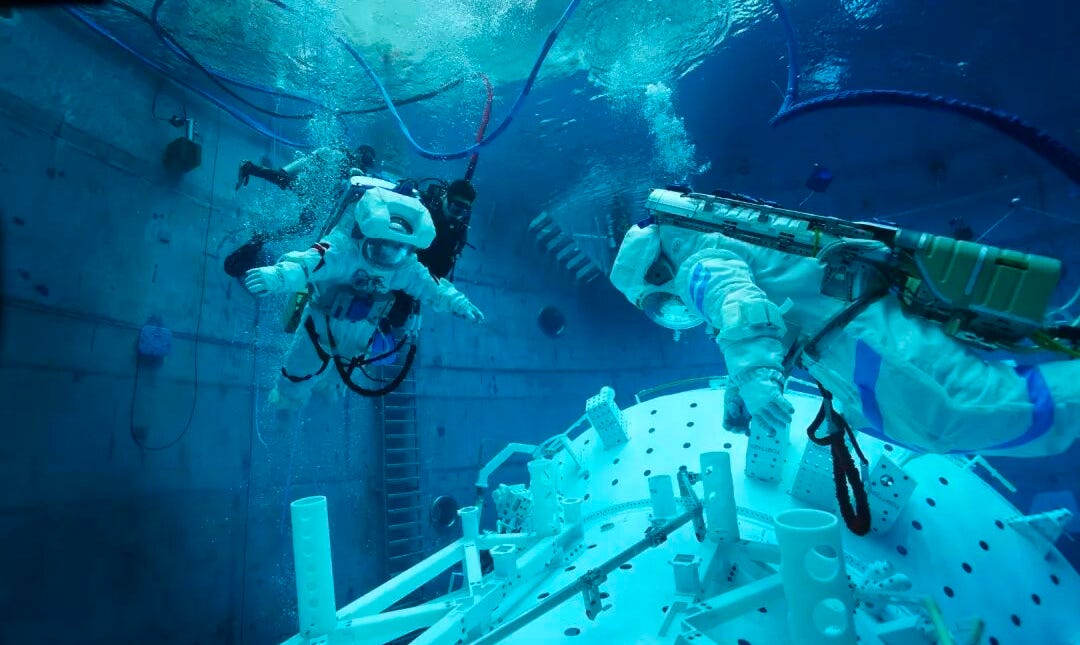
A few days ago, on December 5th, the China Manned Space Agency shared via its website and WeChat channel that it has appointed the first set of ‘quality supervision representatives’ for China’s human spaceflight program.
Those representatives, who are of an unknown number, were appointed at a conference convened in Beijing (北京) and held between multiple departments critical to human spaceflight missions. The representatives appointed are expected to remain with their original departments, continuing their original tasks alongside their new responsibilities. Relevant to that, the China Manned Space Agency wrote:
“The appointment of quality supervision representatives represents an innovative measure to enhance project quality management and serves as a robust safeguard for further tightening quality control over the development process of critical products. The representatives pledged to thoroughly study quality management requirements, immerse themselves in frontline development and production operations, closely monitor key processes, high-risk components, and new technology applications, diligently identify potential quality risks, and urge relevant units to strictly implement technical status management and fault resolution requirements. This ensures every stage and every product is controllable and reliable.”
Through having spacecraft, launch vehicles, and other systems with greater reliability, the China Manned Space Agency is looking to possess wider flexibility in the event of another emergency, which will have China’s taikonauts remain safe as they perform their missions. In that spirit, Jia Shijin (贾世锦), Chief Designer of the Manned Spacecraft System at the China Aerospace Science and Technology Corporation, told China Central Television the following on November 30th:
“This [(the events of November 2025)] serves as a reminder for the entire project: we must never assume our work has reached perfection. . . . I think this serves as a warning: after consecutive successes, we must remain clear-headed, vigilant, and maintain high standards. Not only should we not lower them, but I believe we must raise them even higher. Only by doing so can we achieve continued success in the future.”
If there are any problems with these translations please reach out and correct me.
At the moment, China’s human spaceflight efforts are in their most potentially hazardous period, as following the ‘emergency response‘ launch of Shenzhou-22, there is no backup Shenzhou spacecraft and Long March 2F/G launch vehicle ready at the Jiuquan Satellite Launch Center. If Shenzhou-22 were to become damaged, in a similar or worse way than Shenzhou-20, the crew on board the Tiangong Space Station would have to choose the less risky of the two for their return to Earth, coming home safe but with damaged items around them.
Thankfully, that period will be quite short, with efforts underway to deliver the Shenzhou-23 spacecraft and its launch vehicle to Jiuquan in January, rather than March as originally planned. The following mission, Shenzhou-24, will have its mission hardware prepared on an accelerated schedule too. Newly appointed quality supervision representatives’ efforts in maintaining hardware standards will be critical in having those missions flying unaffected in 2026.
Shenzhou inspections set for next spacewalk
The day before the announcement of the representatives, the human spaceflight agency announced that the Shenzhou-21 crew of Zhang Lu (张陆)1, Wu Fei (武飞)2, and Zhang Hongzhang (张洪章)3 would conduct their first spacewalk, realising a shortened episode of ‘Tiangong TV’ to show preparations for that. That spacewalk is yet to take place, at the time of publication, with the agency noting the three taikonauts have completed tasks relating to the arrival of the Shenzhou-22 spacecraft, checking on the damaged Shenzhou-20 vehicle, and building on tasks from the previous week.
When the spacewalk does occur, with two taikonauts exiting Tiangong in their Feitian (飞天航天服) spacesuits and another supporting them from inside the station, routine inspections of the Tianhe, Wentian, Mengtian, and Shenzhou-22 spacecraft will be conducted, alongside an extensive examination of Shenzhou-20. The damaged spacecraft has already been analysed by the crew from the inside as well as by the space station’s robotic arms, but after human eyes see it from the outside, a path forward with Shenzhou-20 will be decided.
According to Ji Qiming (季启明), Spokesperson and Assistant Director of China Manned Space Engineering Office, hardware for protecting Shenzhou-20’s damaged window was delivered via Shenzhou-22, alongside relevant tools to install it. That hardware can only be installed on the inside due to the heat of atmospheric reentry. It is expected that Shenzhou-20 will return to Earth after the protective hardware is installed, but the details regarding its landing location and cargo are yet to be decided.
Tiangong TV Episode December 4th 2025 originally from the China Manned Space Agency, cloned to YouTube for archival.
Zhang Lu is the Commander and Pilot of the mission for his second spaceflight, having flown for the Shenzhou-15 mission between November 2022 and June 2023. He is from Hanshou County (汉寿县), Hunan (湖南) province, and was selected as part of China’s second taikonaut group in 2010, also being considered a ‘post-70s’ taikonaut having been born in November 1976.
Before becoming a taikonaut, Zhang served in the People’s Liberation Army Air Force and achieved the rank of Senior Colonel. He also joined the Communist Party of China in April 1999. After the Shenzhou-15 mission, Zhang was awarded the Spaceflight Merit Medal (Third Class) along with the honorary title of hero taikonaut.
Wu Fei is the Flight Engineer for this mission, which will be his first trip into space. He is from Baotou (包头市 / ᠪᠤᠭᠤᠲᠤᠬᠣᠲᠠ), in the Inner Mongolia Autonomous Region (内蒙古自治区 / ᠥᠪᠥᠷ ᠮᠣᠩᠭᠣᠯ ᠤᠨ ᠤᠨᠥᠪᠡᠷᠲᠡᠭᠨ ᠵᠠᠰᠠᠬᠤ ᠣᠷᠣᠨ), and was selected as part of the third taikonaut group in October 2020, while being considered a ‘post-90s’ taikonaut having been born in 1993.
Before his selection as a taikonaut, Wu was an engineer at the China Aerospace Science and Technology Corporation. He also joined the Communist Party of China in 2015.
Zhang Hongzhang is the Payload Expert for this mission, with it being his first trip to space. He is from Binzhou (滨州市), Shandong (山东) province, and was also selected as part of the third taikonaut group in October 2020, while being considered a ‘post-80s’ taikonaut having been born in 1986.
Prior to being selected as a taikonaut, Zhang was a researcher at the Dalian Institute of Chemical Physics, Chinese Academy of Sciences (中国科学院大连化学物理研究所), where he explored new materials and technology for batteries. He also joined the Communist Party of China in 2004.
It is also high time that a new robust modular based assembly of the Shenzhou spacecraft be developed so that in case if any part of Shenzhou spacecraft damged then a smaller spacecraft could be launched to replace the defective part of the Shenzhou using a quickly assembled Small-Lift rocket. Smaller rockets like already available Kuaizhou are not hard to build and could be assembled and launched much quickly. Space debris is getting increased month by month , SpaceX is now launching almost 12 to 15 rockets per month , China is launching almost 7 rockets per month , then ISRO , ESA , JAXA and South korea too , so this means China needs to seriously tackle the space debris issue for the critical Shenzhou spacecraft as soon as possible. A small set of constellation sattelites should be built just to track and monitor the Shenzhou spacecraft vicinity so that debris collision could be avoided in advance and Shenzhou could be guided to deflect the space debris . Lastly , Shenzhou outer layers should be now made more robust in case of debris collision because debris is there all time waiting for a hit .