

Commercial Medium Orbit Relay Spacecraft Trio to Launch in 2027
In a move away from traditional ground station services, Shifang Satlink wants to connect customer satellites to Earth through a network of its own spacecraft.

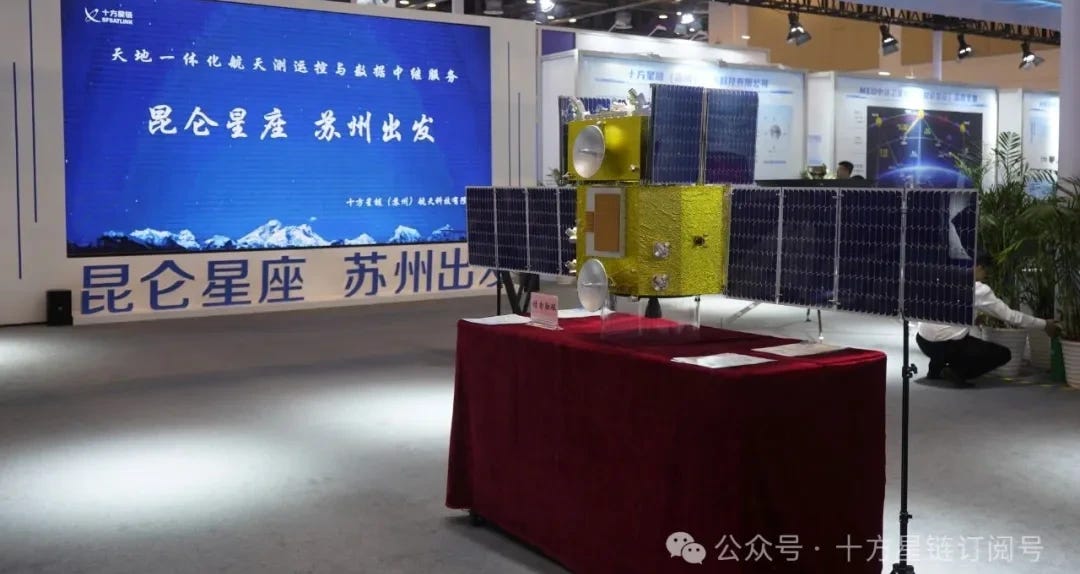
At the Shanghai Academy of Spaceflight Technology’s commercial spacecraft manufacturing firm in December 2025, the first three spacecraft for the Kunlun-1 relay constellation (昆仑一号卫星星座) passed their prototype design review meeting, a small step towards Shifang Satlink (十方星链)1 having their first communication assets in orbit.
Quietly in the first half of the year, progress on the trio has continued at the Shanghai Academy’s facilities. At the end of July, it was shared that a custom separation system had been verified, with inert models, to allow for the three satellites to be delivered atop of one launch vehicle. At the same time, orders for all necessary components from a variety of enterprises have reportedly been placed.
With the quiet development of the first satellites of the constellation, information about it has mostly come from industry events. In a May 2025 Xinhua piece, the constellation is introduced as a ‘space information infrastructure’ that will provide communications, tracking, and control services to satellites in low Earth orbit, in a similar manner to the Tianlian (天链) or NASA Tracking and Data Relay Satellites networks, by having constellation spacecraft above them in higher orbits.
The first three spacecraft, to be launched together, will weigh 1,000 kilograms to establish basic services via traditional communications hardware alongside the use of optical laser communications terminals, at speeds of up to 10 gigabits per second. Catching up with Xinhua in November 2025, company Director of Operations Wang Xingang (王鑫刚) explained the choice of three fairly sizeable spacecraft as:
“Although there are only three satellites, once launched, they will cover most of the globe, excluding the North and South Poles. Moreover, there will always be at least one satellite over China at any given moment, ensuring constant communication with the ground. This means we’ll never experience situations where a satellite ‘flies out of the service area and becomes unreachable.”
If there are any problems with this translation please reach out and correct me.
A brief entry on the to-be-relay-spacecraft owners’ website adds that those spacecraft will be on an equatorial orbit separated by 120 degrees in an 11,000-kilometer medium Earth orbit to keep each other in line of sight, ensuring at least one is in line of sight of China-based ground stations.
For the only news regarding launch, Shifang Satlink announced in April that it had signed a contract with the state-owned China Great Wall Industry Corporation2 to procure the three satellites a suitable launch vehicle. Xinhua was able to learn that they will fly from the Xichang Satellite Launch Center some time in early 2027.
Sometime after the first launch, the Kunlun-1 relay constellation is planned to be expanded with a pair of two-spacecraft carrying polar deployments to expand coverable orbits. The long-term future could see up to thirty-six total spacecraft launched depending on customer demand for the constellation communications throughput. Services may expand to unmanned aircraft and ocean-going vessels too.
Who’s behind this constellation?
Founded in November 2022, Shifang Satlink says that its core team has prior experience with relay satellites operating in geostationary space, likely meaning they were employed at the China Academy of Space Technology or the Shanghai Academy of Spaceflight Technology. The company’s establishment was supported by the Suzhou (苏州市) government-linked entities, the Institute for the Commercialization of Advanced Technology Suzhou Co Ltd (先进技术成果转化研究院(苏州)有限责任公司) and Zeshi Suzhou Advanced Technology Commercialization Fund (泽适(苏州)先进技术成果转化基金), alongside Guoke Hualu Aerospace Technology Co Ltd (国科华路航天科技有限公司).
Two funding rounds are claimed to have been completed, a ‘Pre-A’ in April 2023 and an ‘A’ in December 2024, but the amount raised has not been disclosed. Publicly available information states that the company has 703.55 million Yuan (104.16 million United States Dollars, as of August 3rd) in registered capital.
Other capital to deploy the Kunlun constellation has come from Shifang Satlink’s current business, providing spacecraft tracking, telemetry, and control services from its ground stations across China. That has seen it provide first communication links to over two hundred satellites, mostly for returning customers, shortly after they reach orbit. Emposat (航天驭星) is another firm that does the same and with which the company competes3.
For ground station services and future use of the Kunlun constellation, agreements with satellite hardware manufacturers and launch enterprise Galactic Energy have been signed, while discussions are ongoing with Space Pioneer. Technical seminars have been held as well during the constellation’s development.
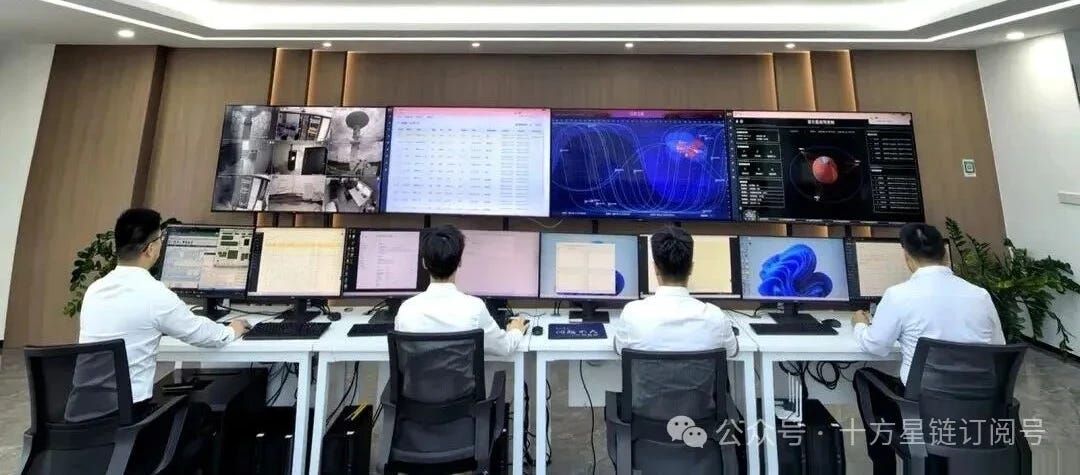
Full business name Shifang Satlink Suzhou Space Technology Co Ltd (十方星链(苏州)航天科技有限公司).
Under the China Aerospace Science and Technology Corporation, with responsibility to market China’s launch solutions to international and domestic clients. Those solutions are primarily from the China Academy of Launch Vehicle Technology and the Shanghai Academy of Spaceflight Technology, owned by the same entity.
For comparison, Emposat has connected just over seven hundred satellites not long after they made it to space.