

First Next Generation Tiangong Relay Deployed Toward Geostationary Orbit [Long March 7A Y29]
The first Tianlian-3 relay satellite has been placed into orbit by a launch mission from Wenchang, days after the last Tianlian-2.

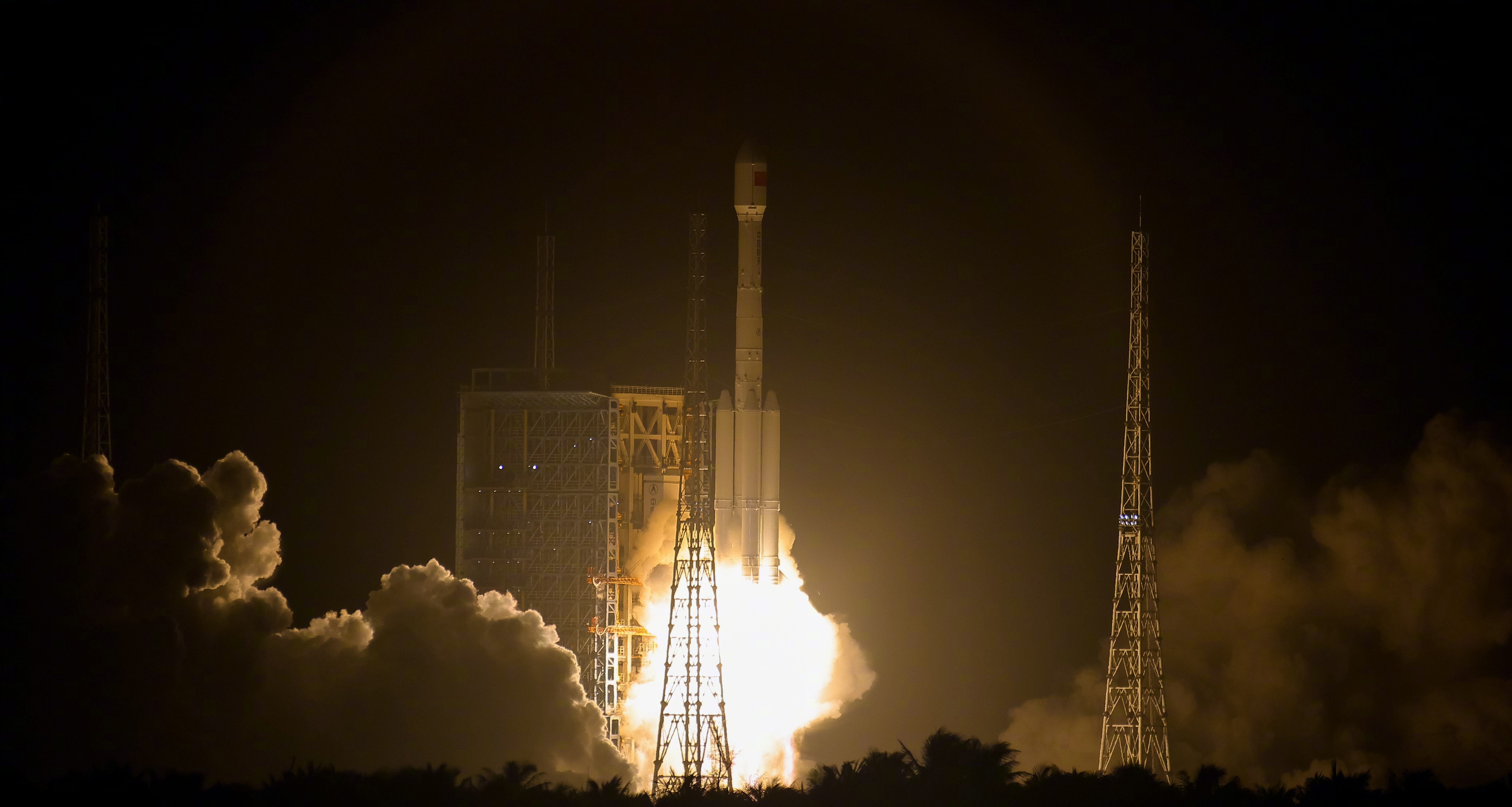
A Long March 7A lifted off from Launch Complex 201 at the Wenchang Space Launch Site at 19:50 pm China Standard Time (11:50 am Universal Coordinated Time) on July 29th, bringing a single satellite towards geostationary space.
That satellite was the Tianlian-3-01 (天链三号01星) communications and data relay, which will serve the Tiangong Space Station and its visiting vehicles. The new relay is the first of the third-generation, set to boost throughput between the orbiting laboratory and ground stations on Earth while further reducing communications dead zones.
In charge of developing the new generation and its first satellite is the China Academy of Space Technology, which stated to have completed their work on a ‘tight’ timeline. Tianlian-3-01 needed a lift by a Long March 7A, as it makes use of the Dongfanghong-4E (东方红四号增强型平台) satellite bus that can weigh about 6,000 kilograms. Advantages of using that bus are up to 10 kilowatts of usable power, from 13.5 kilowatts generated, for communication systems, improved multi-user1 parallel transmission capabilities, and a fifteen-year usable lifespan.
Tianlian-3-01 is the twelfth relay satellite launched in support of the orbiting laboratory. Between April 2008 and July 2021 five first-generation satellites were deployed2, followed by a six-spacecraft second-generation from March 2019 to July 23rd 20263.
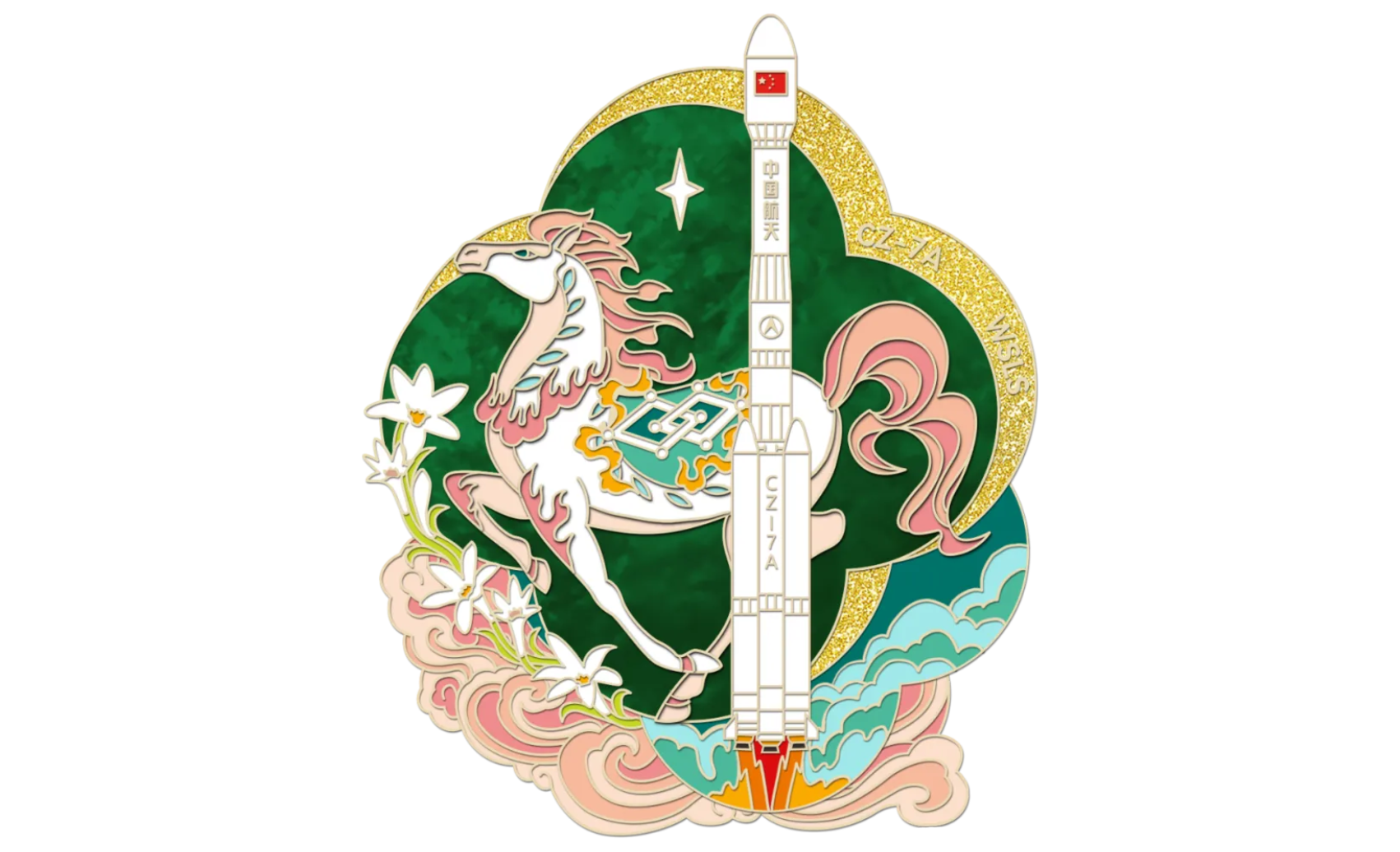
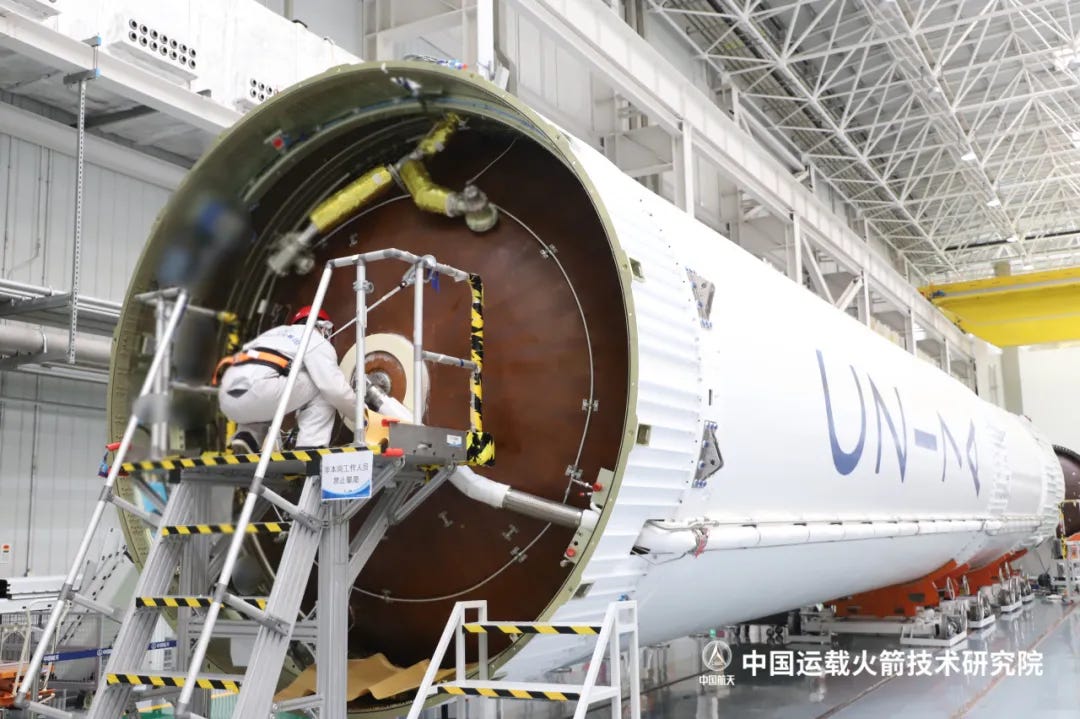
Following satellite delivery, the China Academy of Launch Vehicle Technology shared that launch teams have optimized their hardware anomaly methods, which may have been why the launch vehicle was rolled back to its assembly building earlier in the month4. Upgrades were also said to have been made to standardized measurement and control systems.
So far this year, four missions of the Long March 7 series have taken place, with a fifth under preparation to fly next month. Those missions and an increasing cadence have been enabled by a second vehicle assembly building and another mobile launch platform dedicated to the launch vehicle. 2026 is expected to see last year’s six total missions being surpassed by a comfortable margin.
Today’s mission was the 17th launch of a Long March 7A vehicle, the 28th launch of the Long March 7 series, and the 659th launch of the Long March launch vehicle series. This was also the 52nd launch from China in 2026.
Liftoff video via 央视新闻 on Weibo, 中国的航天 on WeChat, and ThatSpaceDogeGuy media team.
Launch livestream via ThatSpaceDogeGuy on YouTube.
Check out the previous Long March 7A launch
TJSW-26A Sent Towards Geostationary Space From Wenchang [Long March 7A Y20]
![TJSW-26A Sent Towards Geostationary Space From Wenchang [Long March 7A Y20]](https://substackcdn.com/image/fetch/$s_!WCPS!,w_1300,h_650,c_fill,f_webp,q_auto:good,fl_progressive:steep,g_auto/https%3A%2F%2Fsubstack-post-media.s3.amazonaws.com%2Fpublic%2Fimages%2F59cf38d9-970c-4104-a6f2-2b1210cf9b5d_8256x4340.jpeg)
The Wenchang Space Launch Site’s Launch Complex 201 had a Long March 7A liftoff at 10:10 am China Standard Time (02:10 am Universal Coordinated Time) on June 23rd, heading for geostationary space wit…
What is the Long March 7A?
This section is for those less familiar with China’s Long March series of launch vehicles.
The Long March 7A is the new-generation workhorse for beyond low Earth orbit missions, and was developed by the China Academy of Launch Vehicle Technology. This vehicle utilizes a three-and-a-half-stage design and is fuelled by rocket-grade kerosene and liquid oxygen in its boosters, first, and second stages long with liquid hydrogen and liquid oxygen in the third-stage.
The payload capacity of the launch vehicle is currently as follows:
8,000+ kilograms to a medium Earth transfer orbit
7,000 kilograms to geostationary transfer orbit
5,500 kilograms to a 700-kilometer sun-synchronous orbit
5,000 kilograms to a trans-lunar trajectory
The Long March 7A’s first stage is equipped with two YF-100 engines that produce 245 tons of thrust using rocket-grade kerosene and liquid oxygen, complemented by four boosters, each with a YF-100 engine generating 122 tons of thrust, resulting in a combined thrust of approximately 733 tons. The second stage is powered by four YF-115 engines, which together generate 72 tons of thrust using the same fuel combination. The third stage of the Long March 7A features two YF-75 engines, providing 17 tons of thrust by burning liquid hydrogen and liquid oxygen.
On the launchpad, the Long March 7A stands at 60.13 meters tall and weighs 573,000 kilograms when fully fuelled. The first and second-stage have a diameter of 3.35 meters, the four boosters are 2.25 meters in diameter, and the third-stage has a diameter of 3 meters, while the fairing has a diameter of 4.2 meters.
So far the Long March 7A has only flown from the Wenchang Space Launch Site, on the east coast of Hainan province.
Users in this case would be Tiangong, Shenzhou, Tianzhou, and ground stations.
All via the Long March 3C, which can send up to 3,900 kilograms to geostationary space.
All via the Long March 3B, which can send up to 5,500 kilograms to geostationary space.
Today’s Long March 7A was first transported to Launch Complex 201 around July 15th before being moved back. It was spotted again on July 27th.