

Commercial Reusable Launch Vehicle Prepares to Fly From Wenchang in 2026
Hyperbola-3's first launch has slipped to next year, but tests at the launch site and beyond have taken place this month.

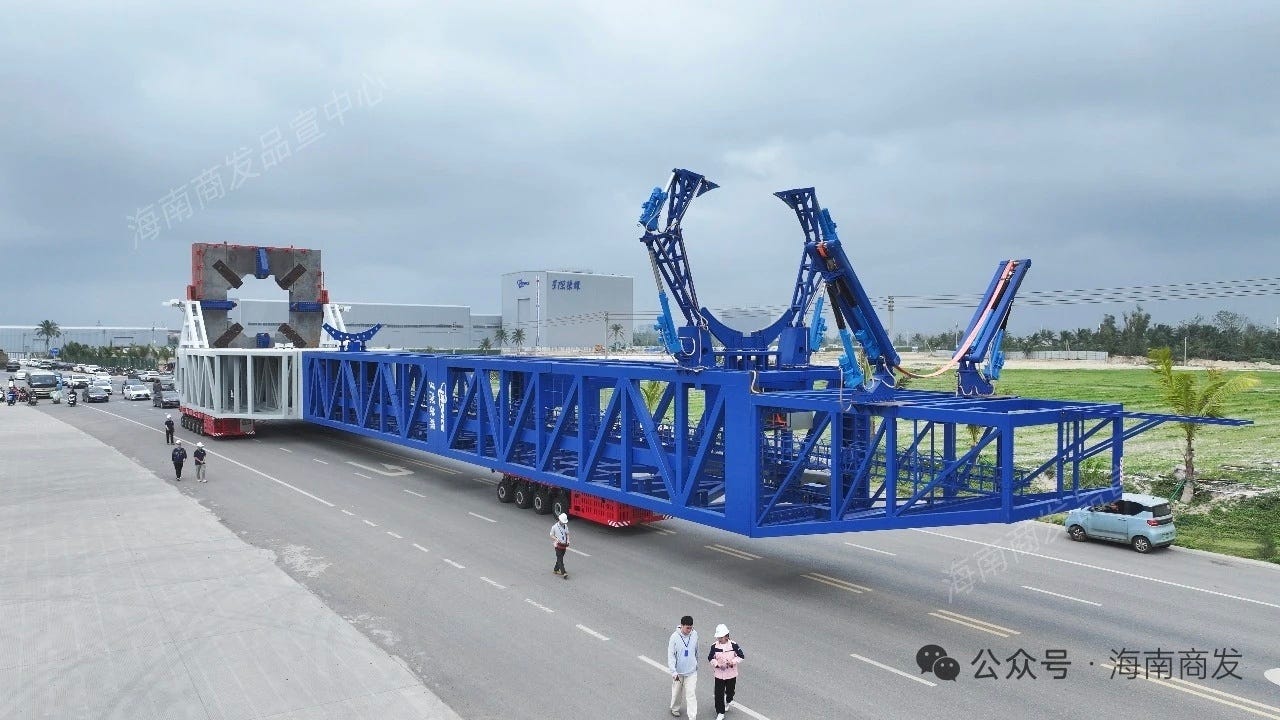
With a debut flight slipping into next year, iSpace has continued testing hardware for its partially reusable launch vehicle in December.
Between December 18th and 19th, launch startup iSpace and Hainan International Commercial Aerospace Launch Co Ltd (海南国际商业航天发射有限公司), operator of the Wenchang Commercial Space Launch Site, jointly rehearsed operations with the transporter-erector for the partially reusable Hyperbola-3 launch vehicle. For the rehearsal, teams from both enterprises drove the 70-meter-long, 300-ton transporter-erector, without a vehicle or a to-scale pathfinder atop, from iSpace’s Wenchang launch processing and support facility, neighboring the site, to Commercial Launch Pad 2, where it was taken just short of being moved by vertical-to-horizontal mechanisms. That process was said to have taken about ninety minutes.
According to iSpace, the rehearsal simulated ‘real working conditions’ for launch day operations, using three self-propelled vehicles to carry it in humid conditions, and the process to send the transporter-erector between facilities, including slowing and halting traffic from the general public. At Commercial Launch Pad 2, it was verified that Hyperbola-3’s transporter-erector can ‘dock’ with the launch pad’s base.
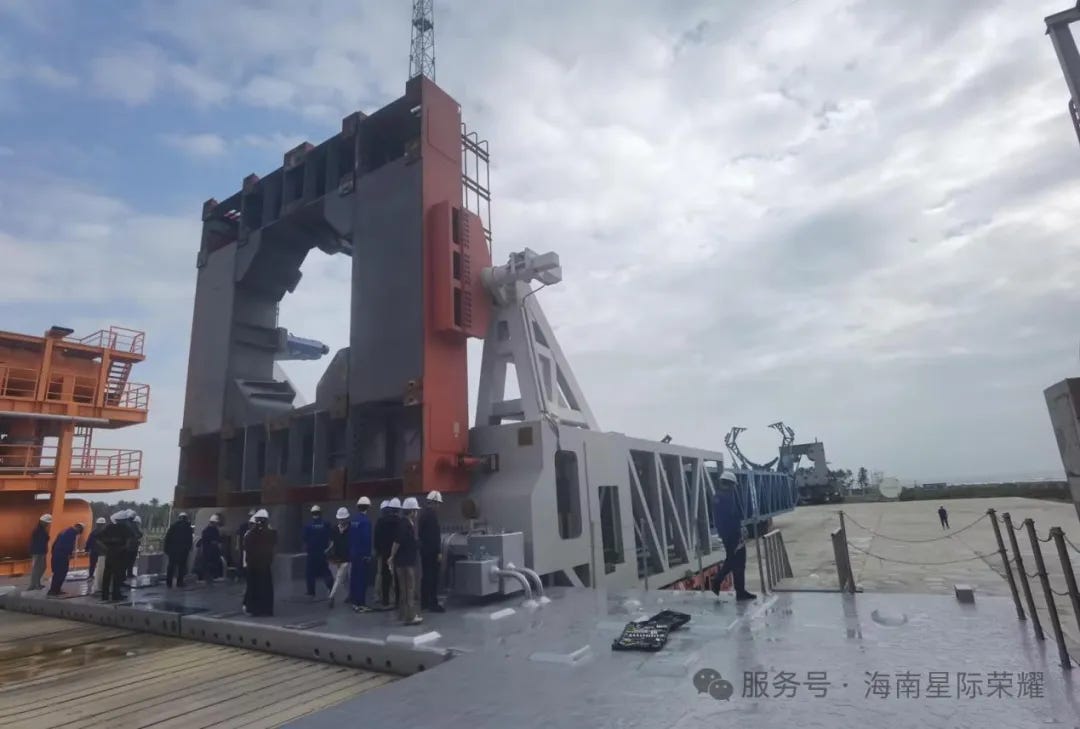
iSpace has previously tested Hyperbola-3’s transporter-erector elsewhere for technical verifications with a pathfinder of their partially reusable launch vehicle. During its two publicised tests, no plumbing for loading the vehicle with propellant was installed. The launch startup plans to add the necessary plumbing in the coming weeks for extensive testing, possibly with a Hyperbola-3 launch vehicle, in late January or early February 2026.
After the conclusion of the joint rehearsal, Hainan International Commercial Aerospace Launch Co Ltd noted that it was the first time that the commercial launch site had provided direct access to a privately-backed space enterprise. Previous users of site resources are the China Academy of Launch Vehicle Technology and the Shanghai Academy of Spaceflight Technology, both state-owned enterprises.
Away from Wenchang, iSpace has been making steady progress on other parts of Hyperbola-3. On December 4th, it was shared that the aft end of the second-stage had been produced and equipped with in-space attitude control thrusters and two storable propellant tanks. Those thrusters and tanks took part in a 2,600-second test with firings to simulate various expected uses, such as adjusting the stage’s orientation, settling the propellant in the main tanks, and fine-tuning orbits.
A day later, on December 5th, tests of a single 3D-printed metal first-stage grid fin were revealed. For the first test, the grid fin was unlatched from its inactive position and into a mechanical lock for use during descent. The second test had its operational use verified in a weightless and vacuum state, as well as with some atmosphere, to demonstrate that a flight computer and control mechanisms can accurately move it into position at speed and adjust it when needed.


Despite the three recent hardware updates, iSpace has not made any mention of a possible launch date for Hyperbola-3 since it became obvious it was going to miss its planned debut target of December 2025. With further testing planned at Wenchang in the first months of 2026, the earliest the partially reusable could fly is March 2026.
Earlier in 2025, iSpace launched its drone ship for recovering Hyperbola-3 first-stage boosters, with sea trials believed to be underway. Cryogenic proof testing of propellant tanks has been underway as well, with several hundred million Yuan secured in investment.