


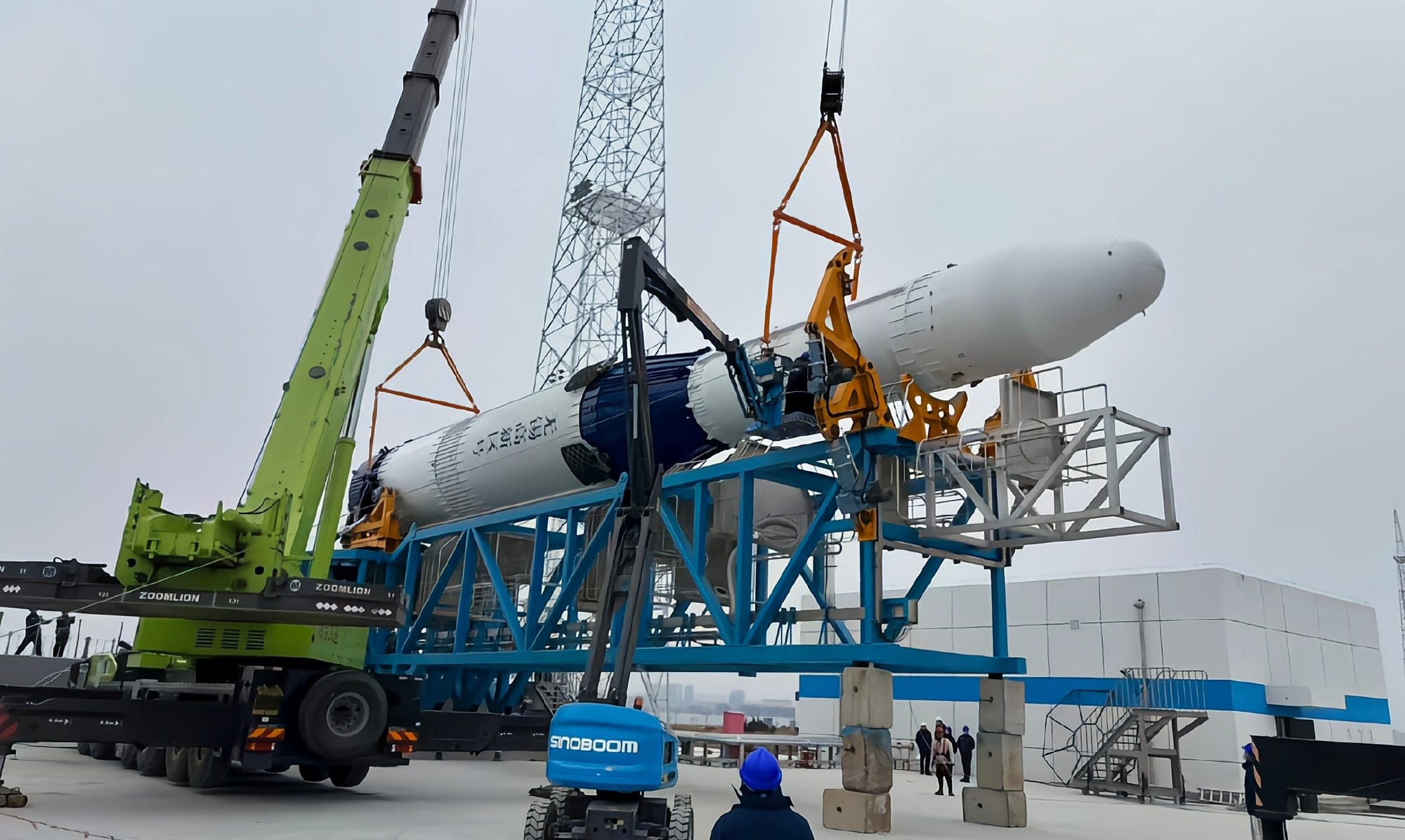
Having conducted static fires of Nebula-1A’s1 second and first stages in September and November 2025, Deep Blue Aerospace may be nearing its first orbital flight with a complete vehicle spotted in Haiyang (海阳市), Shandong (山东) province. Nebula-1A was first spotted in the coastal city, which usually supports vehicle testing, back in mid-March.
While the launch vehicle has been in Haiyang, Deep Blue’s communications team has been tight-lipped, with supporting enterprises also being vague. Once such enterprise was the Beijing Academy of Space Launch Technology (北京航天发射技术研究所)2, who specialize in vehicle and site testing, having recently completed liquid rocket propellant hardware tests on one of the city’s artificial islands. In a recent blog post, the enterprise shared that they have commissioned the recently built ‘Lianli Island Sea Flight Recovery Test Platform No.-1 (连理岛海上飞行回收试验1号平台)’3 with a vehicle on that pad, writing:
“From March 30 to March 31, 2026, the platform successfully supported the integrated test mission for a certain type of rocket. This marks the platform’s full operational capability to support rocket launches … During the rocket joint training, it successfully carried out the full-process drill for the refueling and venting of liquid oxygen, liquid nitrogen, and kerosene, and stably provided high-pressure gas sources.”
If there are any problems with this translation please reach out and correct me.
While not saying what the launch vehicle was used, only one has been spotted on the artificial island, being Nebula-1A. Nebula-1A is also a very suitable choice for the test due to its small size and propellant usage compared to other liquid-fuelled rockets in China.
As for what Nebula-1A is doing in Haiyang (more on the spaceport later), Deep Blue has not provided a reason. In a China Central Television (中国中央电视台) report from the end of 2025, it was said that the launch vehicle will perform its debut launch from Haiyang and fly into orbit while attempting a first-stage splashdown. People’s Daily (人民日报) repeated that in mid-March, with Nebula-1A appearing around the same time with four grid fins but no landing legs4. Alternatively, rumours circulating say that the second-stage will not reach orbital speeds but will still ignite.
For that flight, Nebula-1A will stand 30.2 meters tall with a reusable first-stage diameter of 3.35 meters as well as a second-stage and fairing diameter of 2.25 meters. The first-stage is equipped with nine Thunder-R engines that generate 22 tons of thrust each, for a total of 198 tons, while the second-stage has a single vacuum-optimized version. If heading into orbit, Deep Blue says that the launch vehicle can carry up to 2,000 kilograms into low Earth orbit.
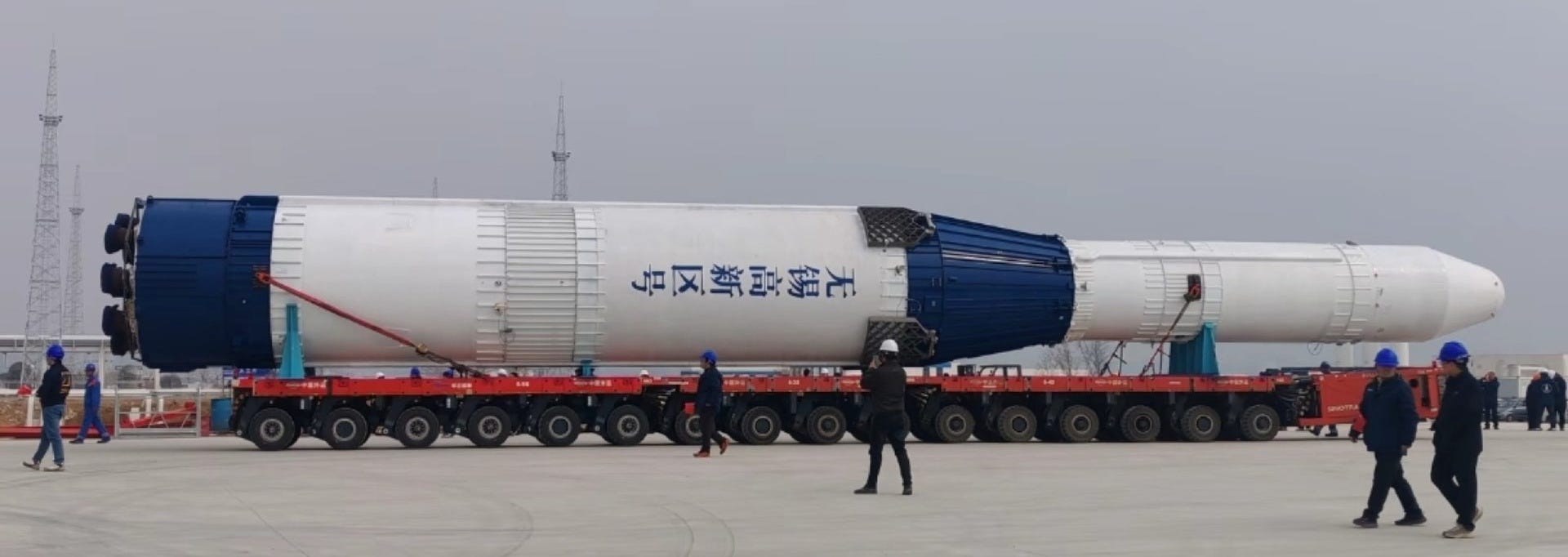
Ahead of the upcoming flight, Deep Blue has conducted two hop tests with Nebula-1A first-stages, equipped with three engines instead of nine. The first took place in September 2024, flying almost completely successfully before software errors left the vehicle hovering several meters above the ground. Then, between July 28th and August 2nd 2025, a second hop was attempted and never spoken of directly due to loss of control and explosive crash.
After a handful of flights in the launch vehicle’s current design, Deep Blue plans to upgrade to Nebula-1B, which will stretch the reusable first-stage, equip it with eleven Thunder-R engines, and widen the second-stage to 3.35 meters, allowing the rocket to carry at least an extra 1,000 kilograms.
Building a liquid propellant ‘sea launch’ pad
Since June 2019, the Haiyang Oriental Spaceport (海阳东方航天港) has been supporting the assembly of and performing sea-based launches for over two dozen solid propellant launch vehicles via dedicated floating platforms or vessels5, with the most powerful being OrienSpace’s Gravity-1, able to lift up to 6,500 kilograms. In recent years, the spaceport has also opened up to suborbital experimental reusable rocket tests and test firings of liquid propellant boosters.
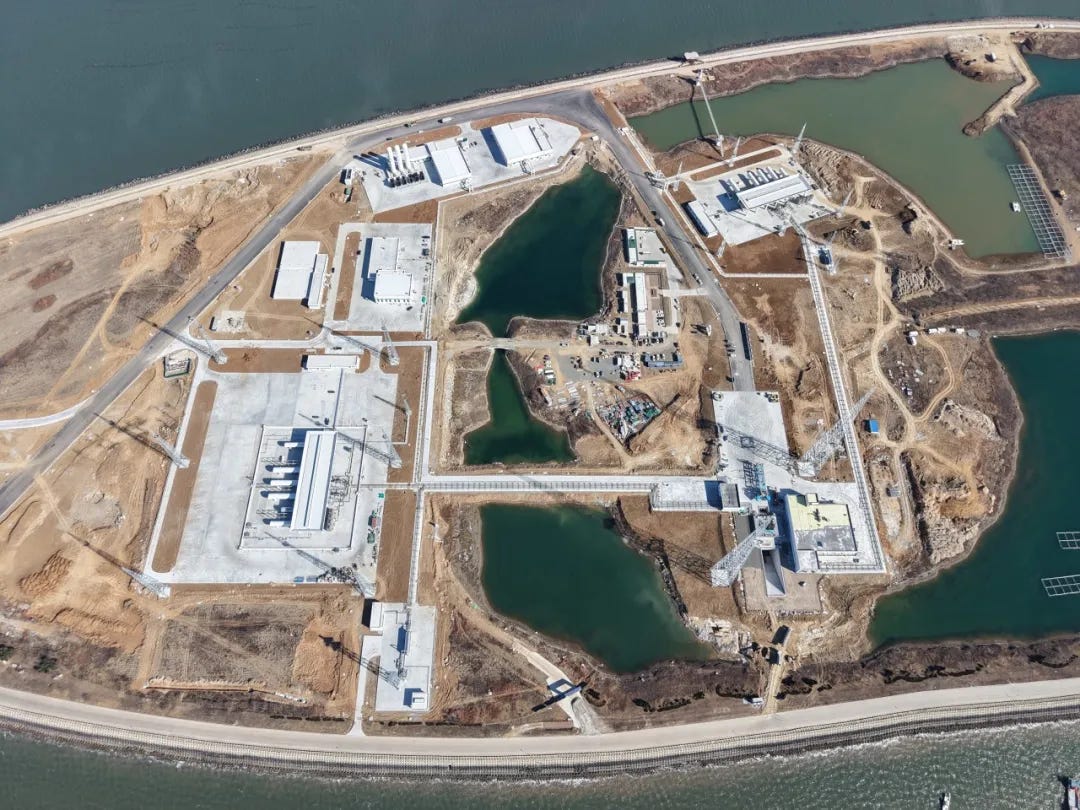
In opening to liquid propellant vehicles, the Haiyang Oriental Spaceport realized that conventional launch vehicles, currently utilizing in-land launch sites and those in Hainan (海南) province, can be flown safely too. As part of plans to expand spaceport operations with a 500 million Yuan (72.59 million United States Dollars, as of April 4th) investment in May 2025, the ‘Lianli Island Sea Flight Recovery Test Platform No.-1’6 was established and took over an island formerly part of a failed real estate project. Work on the launch pad appears to have begun in June 2025, with liquid oxygen, liquid methane, and rocket-grade kerosene propellant systems installed by November 2025.
And now, as of the end of March, the new liquid propellant launch pad is basically completed with its first launch vehicle standing atop of it. With the ability to handle liquid methane and rocket-grade kerosene, ‘Lianli Island Sea Flight Recovery Test Platform No.-1’ is likely a multi-user launch pad, similar to Commercial Launch Pad 2 at the Wenchang Commercial Space Launch Site and the Long March 12 Series Launch Pad at the Jiuquan Satellite Launch Center. It’s unknown what other launch vehicles may fly from Haiyang given the opportunity.
What Deep Blue Aerospace is calling the variant of the Nebula-1 launch vehicle that will perform the vehicle’s first handful of flights. It features a smaller diameter and a shorter second-stage.
Under the China Aerospace Science and Technology Corporation.
Possibly also known as Lianli Island Workstation No.-1 (连理岛一号工位).
Landing legs are not needed for a splashdown, as there’s nothing to land on.
For why China is performing sea-based launches, see the insightful video embedded below from Dongfang Hour:
At its closest point between the artificial island and the mainland, the distance is 1,300 meters. From the launch pad to an inhabited structure, it is 2,400 meters.