

European, Chinese Space Agency Heads Meet for First Time Since 2017
Delegations from the two space agencies discussed achievements since their last meeting, alongside their collaborations.

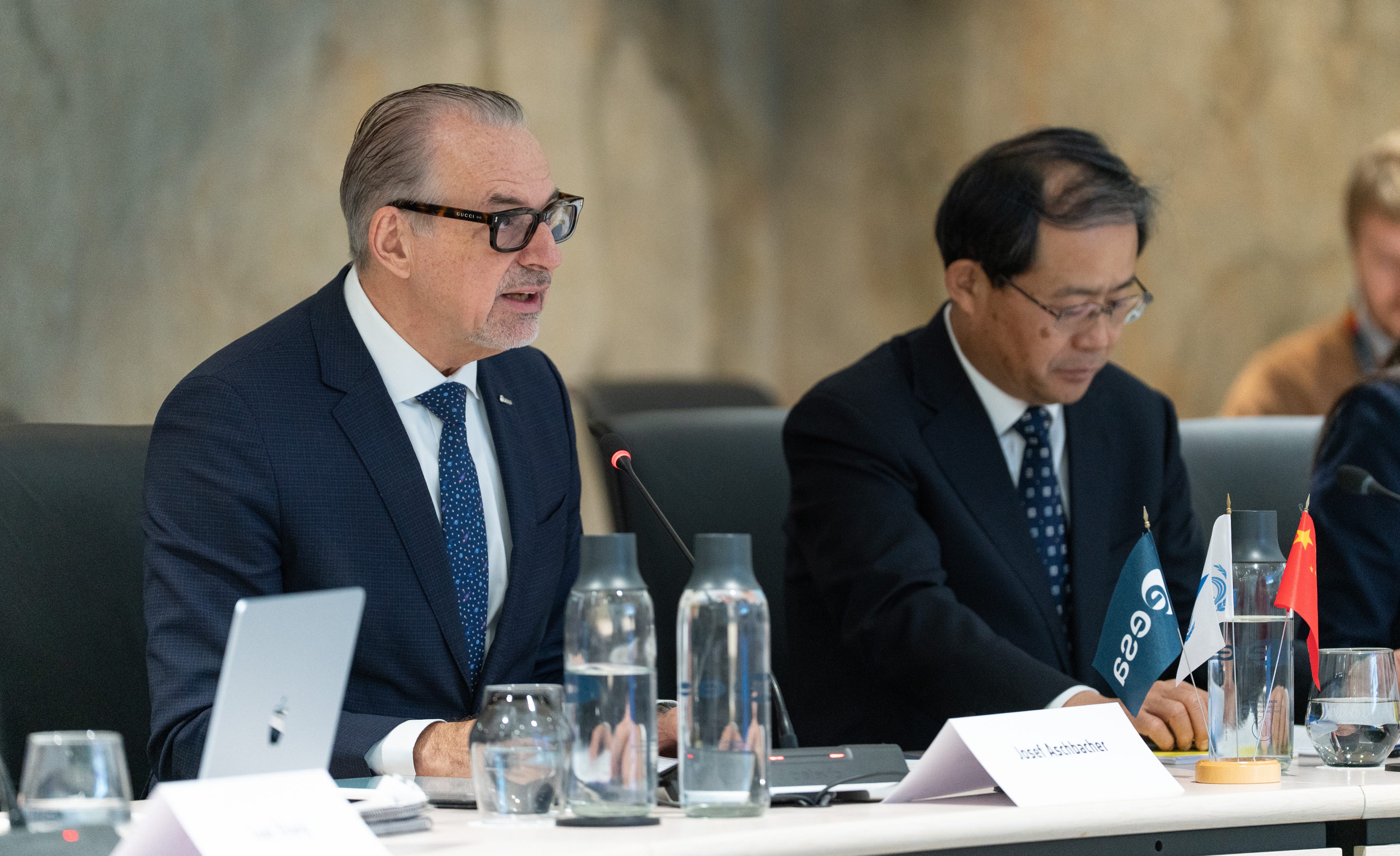
On January 13th 2026, at the European Space Agency’s headquarters in Paris, France, Director General Josef Aschbacher met with Shan Zhongde (单忠德), Administrator of China National Space Administration, for the first meeting between the two space agency heads since 2017, both under their space cooperation agreement.
At the meeting, which was Shan Zhongde’s first foreign trip as Administrator after entering the job in January 2025, both agencies’ delegations spoke on their achievements over the past nine years, efforts to support each other’s missions via Earth-based telemetry and tracking stations, efforts to ensure space safety, and observation programs to monitor human-caused climate change. Joint missions between the two agencies were also spoken of, including those ongoing, one soon-to-launch, and potential new ones still in the planning stages.
Notably, at the time of publication, the China National Space Administration, or other Chinese space agencies working with it, have not spoken of or mentioned the meeting, possibly indicating that nothing new was agreed in Paris.
Today’s Sino-European missions
At the moment, the two agencies are currently operating and analyzing data from the Einstein Probe astrophysics-focused mission, launched in January 2024 and two years into an at least three year time in orbit. For the probe, Europe provided calibration and testing expertise for various instruments and support systems that remain on Earth. Meanwhile, China contributed the spacecraft systems, instrument design and manufacturing, and a Long March 2C launch.
During 2024, the European Space Agency had an instrument, Negative Ions at the Lunar Surface, carried to the Moon via the Chang’e 6 mission in 2024, touching down on May 8th and departing with samples on June 4th. That instrument resided on the spacecraft’s descent module and had data returned to Earth via China’s lunar relay satellites, collected by ground stations in China and Europe.
Later this year, no earlier than April, a European Vega-C rocket will carry the SMILE mission out 121,000 kilometers away from Earth to study solar weather. For the spacecraft, Europe made the payload module, while China has developed the service module. Regarding instruments, both sides have worked on the Soft X-ray Imager, UV Imager, Light Ion Analyser, and Magnetometer.
Back in the early and mid-2000s, China and Europe’s first joint mission, Double Star, was conducted over four years to study Earth’s magnetosphere. For that collaboration, China provided two launch solutions, two spacecraft, and several instruments, while Europe supplied the remainder of the instruments and its expertise.
Outside of the European Space Agency, its member states have worked with China on:
The Franco-Chinese SVOM gamma-ray burst studying spacecraft.
The Netherlands-China Low-Frequency Explorer onboard Chang’e 4.
Two Italo-Chinese Seismo-Electromagnetic satellites.
The Sino-French CFOSat oceanography mission.
Sweden’s Neutral Atom Detector on Chang’e 4.
Chang’e 6 carried France’s DORN instrument to the Moon.
Germany’s Lunar Lander Neutron Dosimetry onboard Chang’e 4.
Future collaborations?
While no new collaborations between the China National Space Administration and the European Space Agency were announced, one of China’s achievements since the 2017 meeting is the full construction of the permanently crewed Tiangong Space Station in low Earth orbit. In 2016 and 2017, the two sides’ spacefarers trained together for potential visits to the space station, before being canceled in 2023.
Since then, China’s human spaceflight programs have greatly matured, to the point of agreeing to a Pakistani visitor later this year. In the current geopolitical environment, that may be something Europe wants to explore again, maybe for the Moon too.
An area that China and Europe are pursuing separately, but are aligned on, is the exploration of Mars. The European Space Agency is currently building its Mars surface sample Earth Return Orbiter as part of the U.S.’ formerly-in-limbo Mars Sample Return mission. As of January 2026, the American segment of the mission, which involved launching samples from Mars, was canceled by U.S. lawmakers.
Meanwhile, China is building two spacecraft, a Mars orbiter-Earth return spacecraft and a lander-ascent vehicle, for its Tianwen-3 Mars sample retrieval mission, set to begin in 2028. Europe’s spacecraft for a now-canceled sample collection mission is proposed to fly a year earlier, and China is open to collaboration, for at least scientific instruments, with Tianwen-3. At present, the European Space Agency is looking toward modifying the Earth Return Orbiter into a communications relay for Mars due to American unreliability with its plans.