


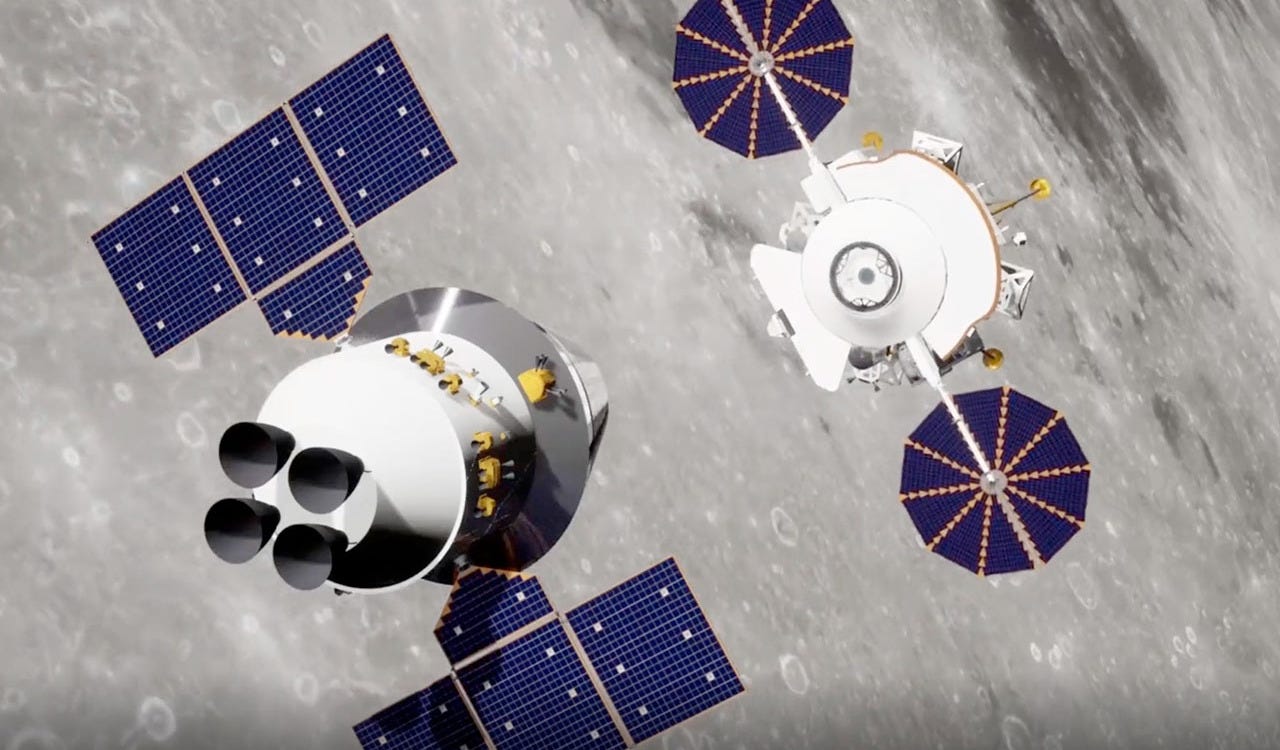
Recently, around January 6th 2026, Yang Liwei (杨利伟), the first Chinese person to be sent into space and Deputy Chief Designer at the China Manned Space Agency, provided a short update on hardware development for China’s crew lunar exploration program, set to land a first duo around 2028 or 20291, at an event organised by China Science and Technology Museum (中国科学技术馆) and People’s Daily Online (人民网).
Most items needed for those missions were touched on, with the Lanyue (揽月) lunar landing having a small update. Yang spoke of the lander’s basic design characteristics, a crew module and propulsion unit, and its ability to send people, cargo, and rovers to and from the lunar surface. When on the surface, Lanyue will be used as a mission hub for crews and robots being brought along, with Yang adding that future plans will have the spacecraft used for extended surface stays. Takeoff and landing tests that took place in August 2025 were mentioned to have happened alongside integrated tests in the preliminary development phase.
The Wangyu (望宇) lunar spacesuit, unveiled in September 2024, had the most significant update provided by Yang. According to him, during 2026 the spacesuit will undergo comprehensive testing of its structural integrity, thermal control systems to keep taikoanuts cool inside, control of its electrical systems to run various parts of the suit, and testing in simulated environment conditions, like the Moon’s extreme temperatures as well as the stickiness and abrasiveness of lunar regolith. By the year’s end, Wangyu is expected to be in its final prototype phase of development.
The Tansuo (探索) lunar rover will interface with the Wangyu spacesuit during exploration of the Moon’s surface, but Yang did not mention it during his update. About ten months ago, the development of the rover was said to be progressing smoothly.
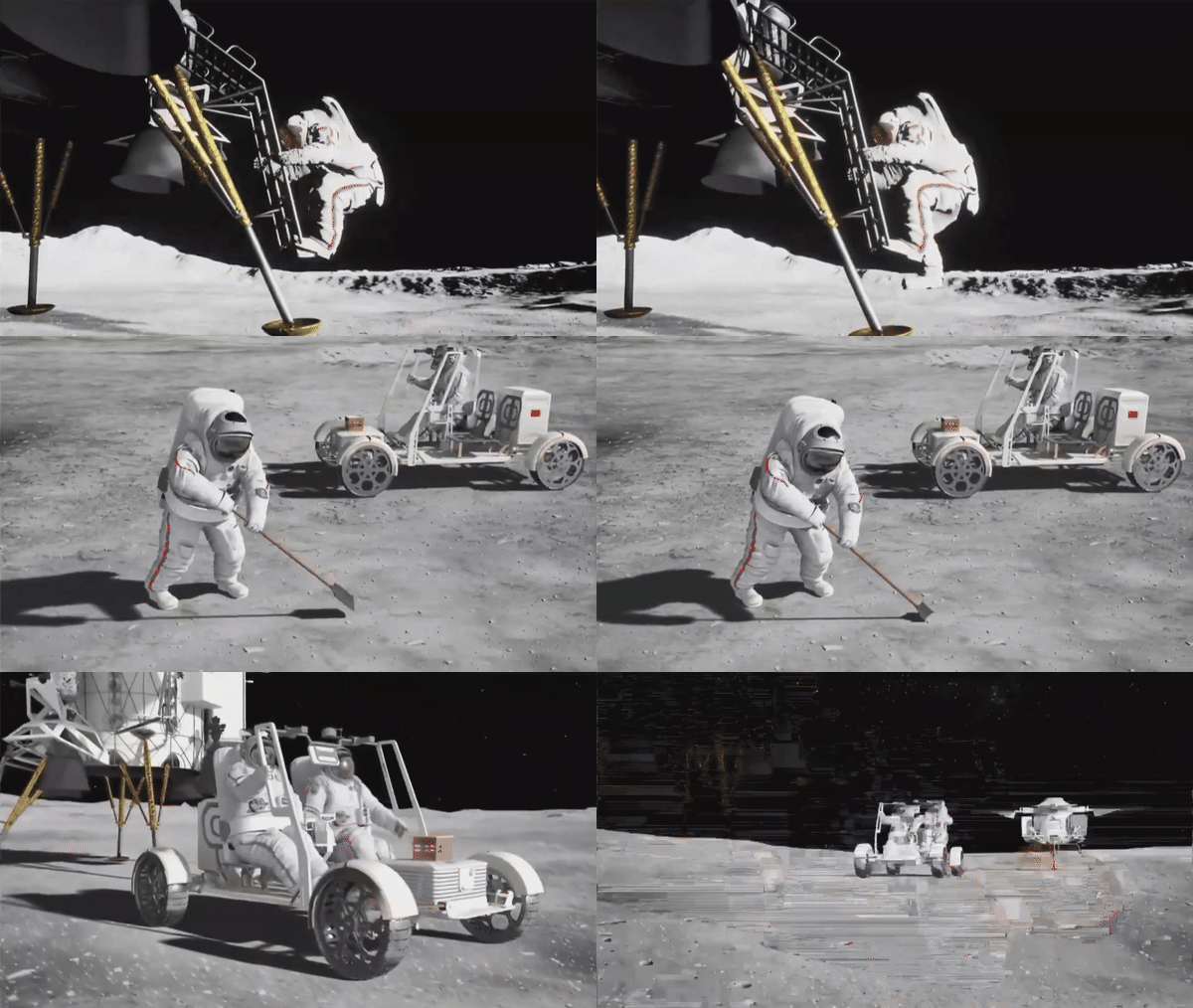
Similarly, the Mengzhou (梦舟) crew capsule had no mention. During the year, the next-generation crew capsule will perform an in-flight abort test for its final milestone ahead of an uncrewed demonstration mission to the Tiangong Space Station after the next crew rotation. In mid-2025, a launch pad escape test was successfully conducted.
Yang did, however, mention the Long March 10 series of launch vehicles, specifically the Long March 102 Moon rocket and Long March 10A3. In his update, the two rockets were stated to have completed verification of their required technologies alongside static fires of the second-stage at a test facility and two firings of the Long March 10 series static fire article on the rockets’ launch pad. Flight data for the launch vehicles’ engines has been gathered too through the use of the YF-100K on the Long March 12 and the YF-75DA on the Long March 8A.
The last thing spoken of by Yang was launch vehicle support facilities at the Wenchang Space Launch Site. Other than Launch Complex 301, two mobile launch platforms, and two vertical vehicle assembly buildings (which had external work completed in December 2025), which have been under construction since around January 2025, expanded launch vehicle tracking, telemetry, and communications facilities have had designs finalized and will be built in the near future.
Clips of Yang’s update were shared by the Weibo accounts for the Chinese Lunar Exploration Program (中国探月工程) and the Deep Space Exploration Laboratory (深空探测实验室).
In the days before Yang shared details on hardware progress, it was reported that most of China’s taikonauts participated in extreme environment psychological training via a six-day exercise in a cave to mentally prepare them for missions to the lunar surface. That is a small but key part of training for various crews, one of which will have a duo become the first to set foot on the Moon via Chinese hardware. Through the training, the taikonauts are also providing feedback on ways to improve Mengzhou, Lanyue, Wangyu, and Tansuo operationally from a user’s perspective.
Officially ‘before 2030’.
Dedicated to the crewed lunar landing program and able to send up to 27,000 kilograms on a trans-lunar trajectory.
Dedicated to low Earth orbit tests of lunar mission hardware, the Tiangong Space Station, and government missions. The rocket is able to lift up to 18,000 kilograms into low Earth orbit.