

Groundbreaking Begins for Long March 9's Wenchang Base
The giant launch vehicle looks to be on its way to being real in a couple of years, after an extensive period of design iteration.

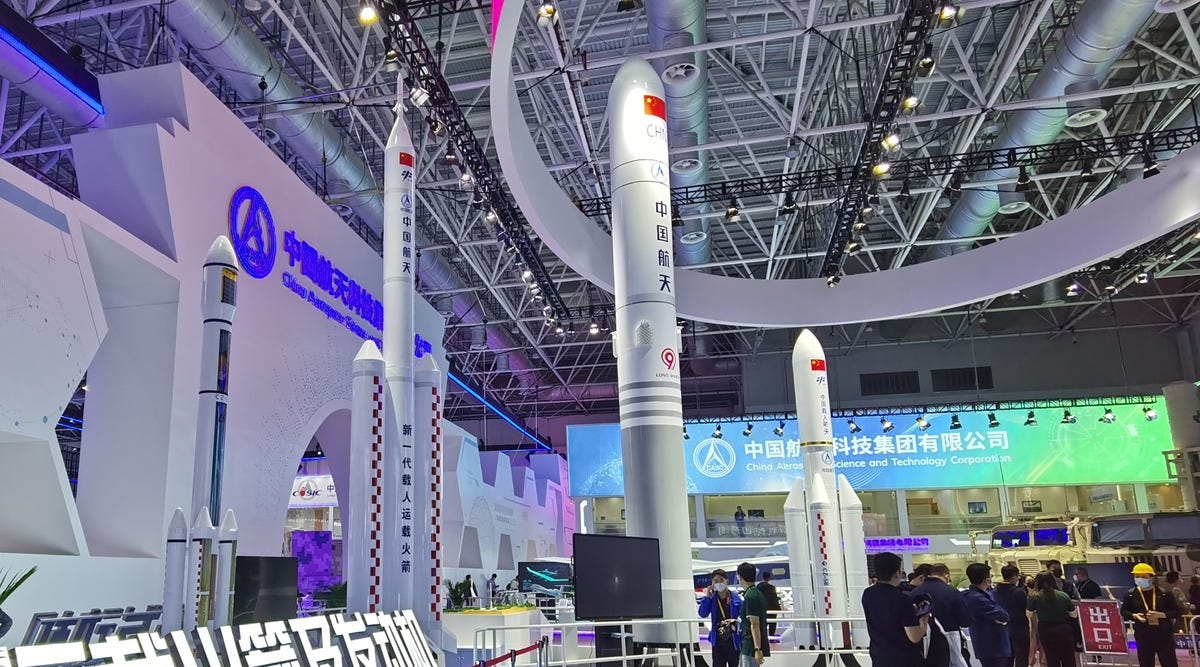
Having been thought up in the late 2000s for establishing a moon base and building space-based solar power, and going through many design changes, the massive Long March 9 launch vehicle appears to be taking its first firm steps toward becoming a real launch vehicle.
At the end of March, the China Academy of Launch Vehicle Technology put out a tender for construction, which was won by the Aviation Industry Corporation of China’s Planning and Design Institute (中国航空规划设计研究总院有限公司), for a massive facility in Wenchang (文昌市), labelled as a ‘Joint Workshop Rocket Base Project’, that will occupy 101.5 square kilometers. That facility was outlined to be ‘single story’, with select areas having up to four floors, and having two major buildings. The larger building was dubbed the ‘general assembly building’ with dimensions of 380.5 meters in length, 182.4 meters in width, and heights of 119.5 and 80.8 meters dictated by usage inside. The smaller building, called the ‘sub-assembly building’, was stated to be 64.3 meters long, 28 meters wide, and 35.8 meters tall.
Within the first week of April, as seen by European satellites, ground was broken at a location previously of interest for the Long March 9. That site sits a short drive north of the Wenchang Commercial Space Launch Sites technical area, where launch vehicles are prepared to fly. Construction at the location is set to take place over twenty-five months, wrapping up by May 2028.
Due to the sheer scale of the site, recent groundbreaking ahead of construction is quite likely to be for the mammoth partially reusable Long March 9 launch vehicle, 10.6 meters in diameter and about 114 meters tall, which will also have a full reusable variant1. Direct updates about the site will probably be few, as development work on the vehicle so far has been kept largely behind closed doors.
As for why the ‘Joint Workshop Rocket Base Project’ site is so large, it is going to be due to limitations of rocket transportation systems. Currently, China’s launch vehicles are delivered to Wenchang via ships sailing between Hainan (海南) province and production facilities in Tianjin (天津) and Shanghai (上海市). With space limitations in those cities and the high cost of building new larger, dedicated vessels2, locating a manufacturing site (‘sub-assembly building’) and a stage integration facility (‘general assembly building’) near the launch site dramatically reduces costs. This approach has been previously taken by SpaceX for its Starship-Super Heavy system.
Just outside Wenchang, with plans to catch Long March 9 first-stages downrange on an autonomous ship, the Qinglang Port (清澜港) may need to be expanded further south and on its eastern shore to enable offloading of boosters3. It is expected that ‘Linghangzhe (领航者)’, the catching ship for the Long March 10 series, can use the port at present. Alternatively, a dedicated port for offloading boosters could be built closer to the Wenchang launch sites.
Building the Long March 9 so far
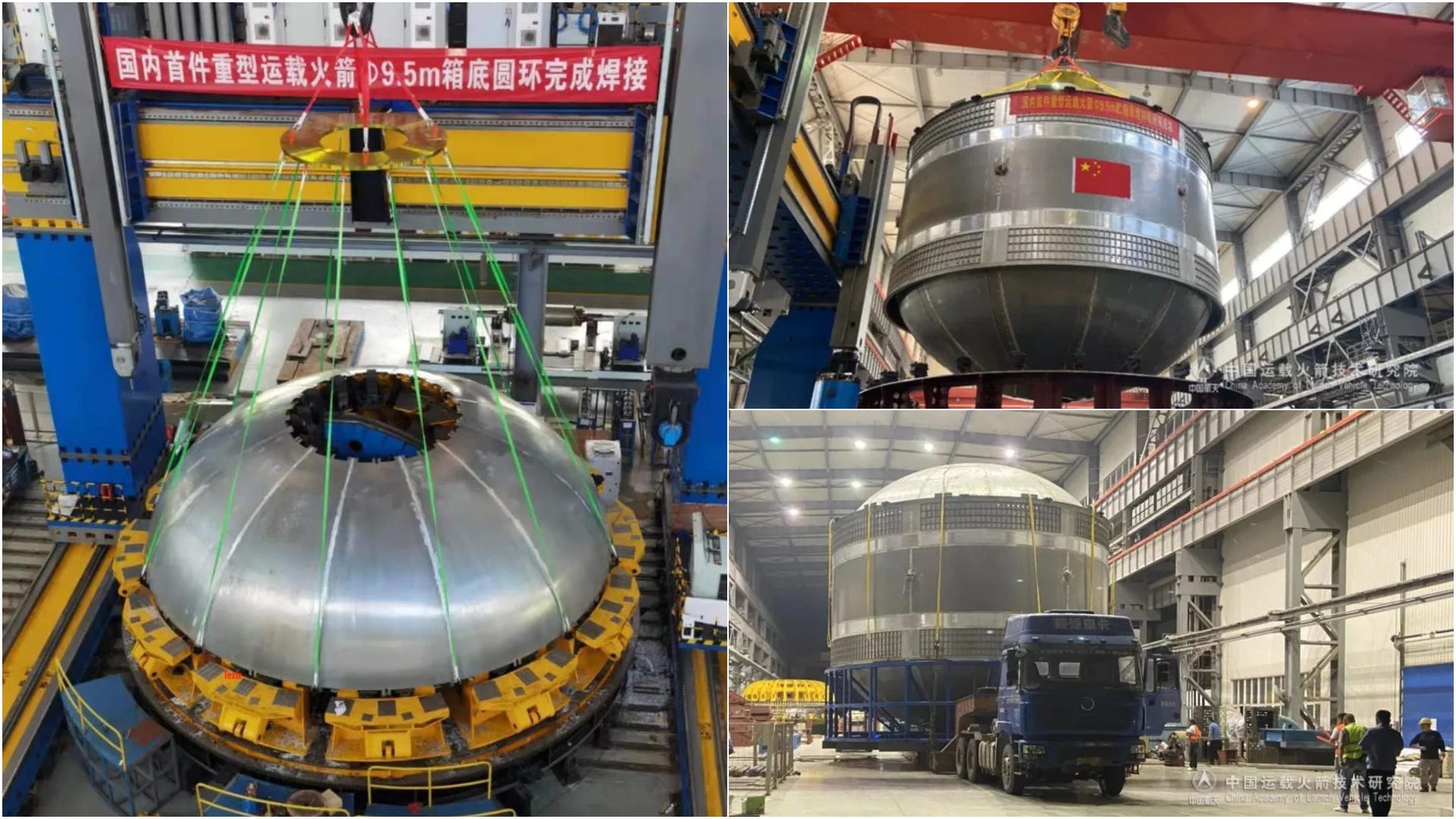
Regarding launch vehicle development4, the China Academy of Launch Vehicle Technology has put the majority of its efforts into developing the systems, techniques, and skills to produce large propellant tanks. In 2021, a first 9.5-meter-diameter tank dome was completed to prove welding methods. By March 2023, the first proving tank was completed, standing about 6 meters tall while retaining the dome’s diameter, and taken for testing. More test tanks of varying sizes and increasing diameters are believed to have been produced since.
A few dozen engines are set to consume the propellants stored in the Long March 9’s propellant tanks. Thirty YF-215 liquid methane and liquid oxygen burning full-flow staged-combustion engines will be used on the first-stage, with five more on a second-stage, generating about 200 tons of thrust. Designs of the engine were solidified in 2022, with subscale tests by mid-2024, partial tests in the second half of 2025. First full system tests are expected to take place imminently, if they have not already without publication.
Meanwhile, the engine to propel the Long March 9’s third-stage, sending payloads to the Moon and deep space, is far along in development. Designated the YF-79 with four set to be installed on the stage, each generating 25 tons of thrust from burning liquid hydrogen and liquid oxygen, the first thrust chamber tests occurred in December 2021, and by mid-November 2022 full system firings began. Since September 2025, there is discussion of replacing the four YF-79’s with a single YF-91, using the same propellants but generating 120 tons of thrust.
Currently understood plans will have the Long March 9 performing its debut flight around 2030, with the introduction of its three-stage version a few years later. In the 2040s a reusable second-stage will be introduced upon the completion of research into relevant thermal protection technologies5.
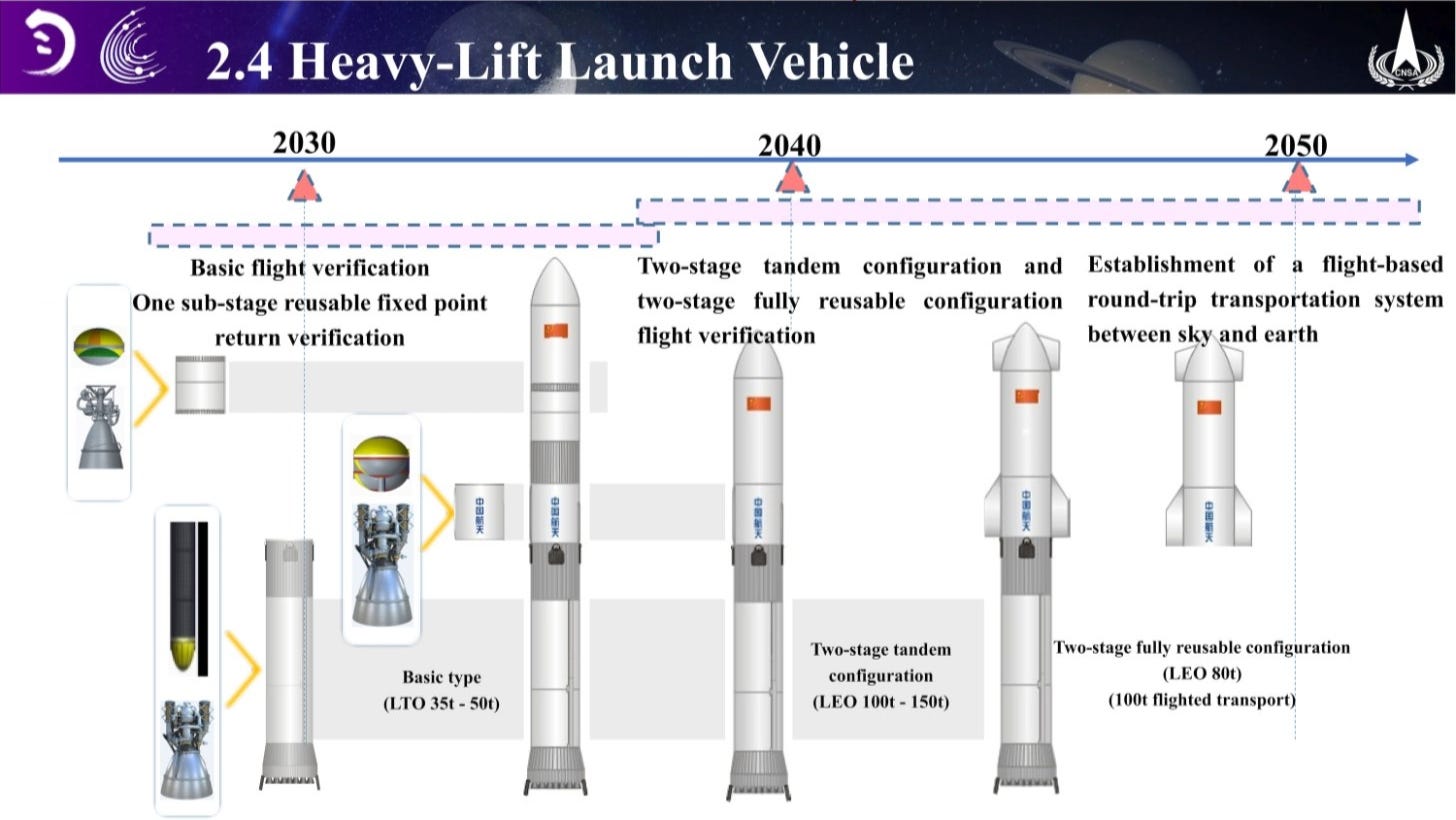
Three variants of the launch vehicle are under development:
A two-stage vehicle, with a reusable first-stage, dedicated to low Earth orbit missions to lift up to 150,000 kilograms.
A three-stage vehicle, with a reusable first-stage, to send payloads beyond low Earth orbit, to deliver up to 50,000 kilograms to a trans-lunar trajectory.
A two-stage vehicle, with reusable first and second stages, able to bring 80,000 kilograms to low Earth orbit.
Current ships frequently deliver the Long March 5 series’ 5-meter-diameter 33.1-meter-long first-stage.
A bridge near the port is used to haul launch vehicle stages when delivered, and the Long March 5 is as large as the bridge allows.
At this year’s space day, accelerating the development of large lift reusable launch vehicles was spoken of as needed.
Possibly actively being tested on the four times flown Reusable Experimental Spacecraft (可重复使用试验航天器).