

Long March 10 Series Booster Recovery Ship Delivered To Launch Vehicle Academy
'Linghangzhe' is set to support robotic and crewed missions from Earth to lunar orbit.

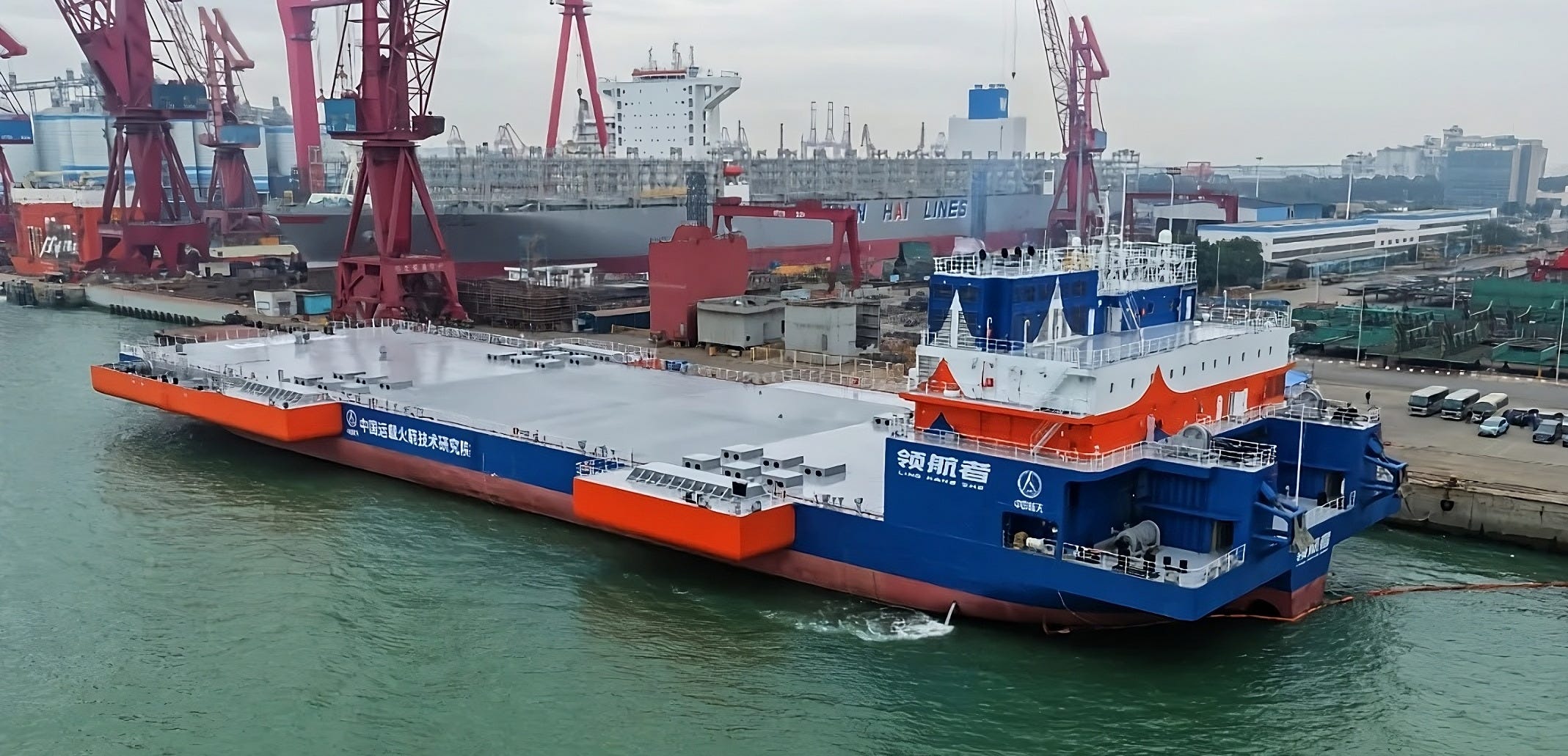
On November 30th, the China Academy of Launch Vehicle Technology announced that it had taken delivery of China’s first autonomous booster recovery ship, often called a drone ship in short. The launch vehicle academy has named the ship ‘Linghangzhe (领航者)’, meaning ‘Pathfinder’ in English.
According to the launch vehicle academy, delivery of the drone ship to them is a key part of plans for ‘upgrading’ spaceflight transportation systems, as ‘Linghangzhe’ will allow for more cost-effective launch solutions and more high-density launches thanks to reused hardware. It is also said to be part of a leap from technology verification to operations.
Details about ‘Linghangzhe’ give it a 144-meter length, a 50-meter width, and a total displacement of 25,000 tons. It has the ability to remain stationary through redundant propulsion systems in the aft and bow while keeping its deck steady.
Production and commissioning were contracted to China State Shipbuilding Corporation (中国船舶集团有限公司), with design work underway between September and December 2024, followed by construction starting in April 2025. Recently, ‘Linghangzhe’ obtained a relevant certificate from the China Classification Society (中国船级社).
At the delivery ceremony in Guangzhou (广州市), the China Academy of Launch Vehicle Technology’s Chief Designer of the Long March 10 series and Long March 9 series, Rong Yi (容易), was in attendance alongside Guangzhou Shipyard International’s (广州船舶国际有限公司) Deputy General Manager Kang Youping (康友平) and Director, General Manager, Deputy Party Secretary Zhou Xuhui (周旭辉). Delegations from the Chinese Academy of Sciences (中国科学院) and the Hainan Provincial Department of Science and Technology (海南省科学技术厅) were also present.
For the delivery, Zhou Xuhui gave a speech, alongside others, in which he stated:
“The successful delivery of this platform stands as another significant testament to our collective efforts in striving for excellence. Looking back on the construction journey of this project, with the strong support from multiple parties, we have achieved remarkable results in technological innovation, engineering application, and other aspects. On behalf of Guangzhou Shipyard International, I would like to express my respect to all the personnel involved in the research and construction. It is precisely through the team’s superb skills and unremitting efforts that this offshore recovery platform has transformed from a grand blueprint into reality, turning a steel structure into a ‘maritime pride’ shouldering space missions.”
If there are any problems with this translation please reach out and correct me.


‘Linghangzhe’ is planned to be used in support of the partially reusable Long March 10 series of launch vehicles, the triple-core Long March 10 Moon rocket1 and the single-stick Long March 10A2, as their first-stage boosters are planned to be caught on ‘tensioned wires’ via hooks deployed from the interstage to save weight and to simplify refurbishment.
Currently, hardware to catch boosters is very obviously not installed on top of the deck. In the coming months, teams will install the large structure onto it as well as the sets of steel wires for booster catches. Software allowing ‘Linghangzhe’s catch system and the boosters to communicate real-time positions will be verified after that.

Back in August, iSpace of the Hyperbola launch vehicles launched its drone ship ‘Qinglan’ (清澜), ‘Clear Waves’ in English, for their ‘Xingji Guihang’ (星际归航), ‘Interstellar Homecoming’, fleet. That ship is yet to obtain a relevant certification, making ‘Linghangzhe’ China’s first technically operational drone ship, albeit without some recovery hardware.
With the launch of both ships, Chinese space launch enterprises possess the sixth and seventh rocket reuse-related drone ships in the world, following Blue Origin’s ‘Jacklyn’, Rocket Lab’s ‘Return On Investment’, and SpaceX’s ‘Just Read the Instructions’, ‘Of Course I Still Love You’, and ‘A Shortfall Of Gravitas’.
Dedicated to the crewed lunar landing program and able to send up to 27,000 kilograms on a trans-lunar trajectory.
Dedicated to low Earth orbit tests of lunar mission hardware, the Tiangong Space Station, and commercial missions. The rocket is able to lift up to 18,000 kilograms into low Earth orbit.
That's a good step but now it's CALT turn to prove their abilities and show us that they have powerful reusable rockets and I am talking about not one , not two but many that can deliver atleast 20tons to the LEO as soon as possible. CALT was founded in 1957 and now has 30000+ employees whereas SpaceX was founded in 2002 and has 13000 employees so actually CALT is many times bigger than SpaceX and has more capability , experience and technology than SpaceX could imagine. I am 100% sure that if there is any organization in the world that can beat SpaceX in reusable rocket technology hands down then that company is CALT and they will succeed definitely.
So , guys at CALT , its time to take down SpaceX by developing a reusable rocket that could land anywhere , like on desert , on sea drone pad or even on some flying drone pad if technology could allow this .