

Guodian Goake's Tianqi Connectivity Constellation Approved for Commercial Trials
China's smallest connectivity mega-constellation player is going to explore offering general services from its satellites over the next two years.

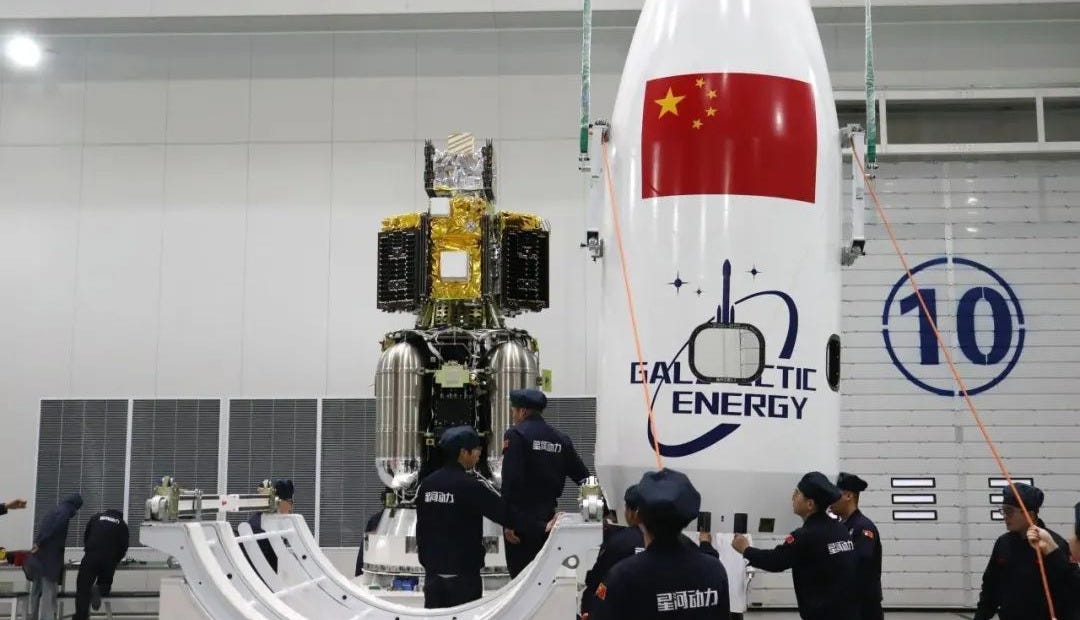
Currently the smallest player in the deployment of China’s connectivity mega-constellations, Guodian Gaoke’s (国电高科) Tianqi (天启) Internet-of-Things constellation has been approved to commence commercial trials over the next two years by China’s Ministry of Industry and Information Technology (中华人民共和国工业和信息化部) as of May 6th.
Through the trial, Guodian Gaoke will pilot Internet-of-Things connectivity services in a ‘wide-coverage’, ‘high-reliability’, and ‘low-power’ mode to prove all-weather data delivery and receiving systems to general users in whatever sector they operate. The pilot will likely see an uptick in the production and sales of Tianqi user terminals, which reportedly cost under 1000 Yuan (147 United States Dollars, as of May 6th), with global coverage capabilities thanks to existing satellites.
Previously, Tianqi services have been used by a handful of enterprises for forestry, agriculture, aquaculture, petroleum, emergency response, ecological environment conservation, and smart city development. Since 2021, the constellation has been assisting with agricultural monitoring in southern Hainan (海南) province, while Guodian Gaoke has been donating user terminals to emergency services to assist them, with a notable example being during the 2023 Beijing (北京) extreme rainfall event.
At present, Guodian Gaoke has deployed 41 Tianqi satellites into low Earth orbit, flying in groups no larger than four. With that number of satellites, the constellation has achieved its first phase of launch plans, having taken from 2018 to 2025 to complete.
Over the coming years, according to filings with the International Telecommunication Union, the Tianqi constellation will be greatly expanded through two additional phases. Phase two of deployment will have up to 640 satellites sent into orbit, while phase three may deploy up to 3,240 satellites, for an overall total of 3,918 satellites. Those upcoming phases will explore adding the capability for direct-to-device connectivity to smartphones and wearable devices.
In approving the commercial trial of Tianqi services, the Ministry of Industry and Information Technology is taking a meaningful step towards its aim of having over ten million users of space-based connectivity services by 2030. To hit that goal, routine services will need to be available from China’s other mega-constellations, including Qianfan (千帆) and the state-backed GuoWang (国网), which have been viewed as a new key enabler for further economic modernization. It’s unclear when other mega-constellations will have trials beginning, but Shanghai Spacesail Technologies Co Ltd (上海垣信卫星科技有限公司) expects Qianfan to be providing some form of service in China before the end of the year.