

GuoWang Mission Ends China's Month-Long Launch Hiatus [Long March 8A Y8]
A twentieth group for the low Earth orbit connectivity mega-constellation entered orbit, with nine satellites being deployed.


Out of the Wenchang Commercial Space Launch Site, off of Commercial Launch Pad 1 a Long March 8A lifted off at 03:48 am China Standard Time on March 13th (19:48 pm Universal Coordinated Time on March 12th), carrying a group of satellites into low Earth orbit.
Riding atop of the vehicle was the twentieth group of GuoWang satellites, with nine being placed into orbit1. The Innovation Academy for Microsatellites, Chinese Academy of Sciences (中国科学院微小卫星创新研究院) developed the spacecraft in this group.
After this launch, 163 GuoWang spacecraft are in space and flying up toehir operation orbits. This year, it is planned that 310 satellites2 will be deployed, followed by 900 in 2027, and 3,600 every year beginning in 2028 to sustain and grow the constellation. In the 2030s, up to 13,000 satellites could be in operational orbit.
GuoWang satellites launched atop of the Long March 8A and the Long March 12 use the mega-constellations’ small satellite platform, weighing about 695 kilograms each. A large satellite platform, around thirty percent bigger and weighing up to 1,000 kilograms, is launched via the Long March 5B and Long March 6A. Both platforms utilize electric propulsion systems to manuever on orbit, powered by two solar panels.
The GuoWang (国网) constellation is operated by China Satellite Network Group, a state-owned enterprise and wholly backed by the Chinese government. China Satellite Network Group plans to provide worldwide internet services; for now, China-focused services are the immediate priority.
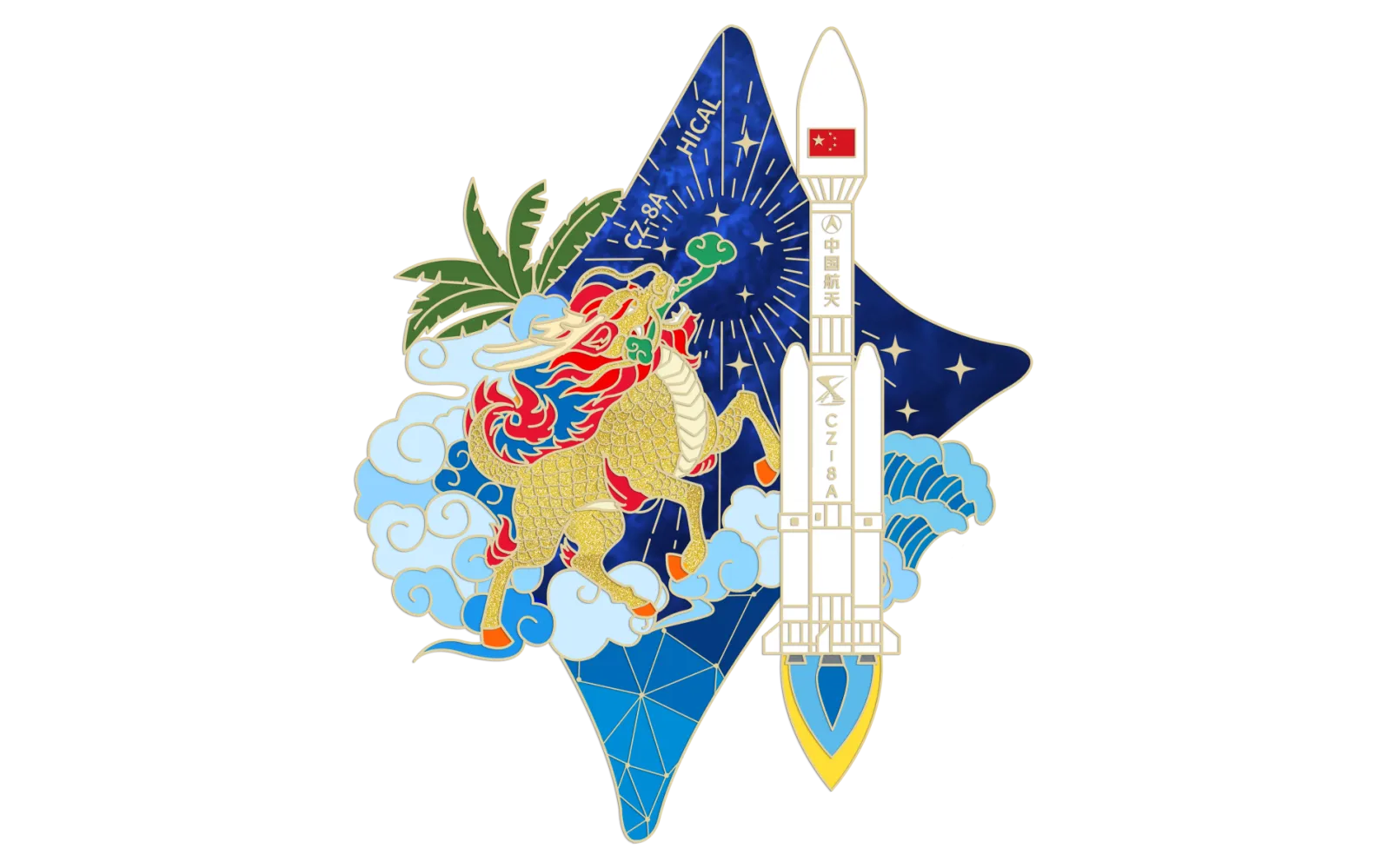
Today’s launch mission comes a month after China’s last, via a Jielong-3 in the South China Sea on February 12th. A lengthy pause in launches came as a result of the eight-day Spring Festival (春节), the Two Sessions (两会) in Beijing (北京), and two hardware failures earlier this year, neither of which directly affected the Long March 8A.
This flight also marked the start of the second year of the Long March 8A’s launch operations. One year and one day ago, in February 2025, the launch vehicle successfully performed its debut flight from the Wenchang Space Launch Site.
According to China Central Television (中国中央电视台), the Long March 8 series of launch vehicles, including the Long March 8 and 8A, is set to fly fifteen times in total this year, for thirteen more flights over the next nine and a half months. To fly often enough to reach that goal, the China Academy of Launch Vehicle Technology stated that it would continue to cultivate the talent of the vehicle’s launch teams, via optimizing rotating shifts and deepening relevant professional literacy.
This mission was the 8th launch of a Long March 8A vehicle, the 12th launch of the Long March 8 series, and the 631st launch of the Long March launch vehicle series. This was also the 11th launch from China in 2026.
Liftoff footage via 人民日报 and 央视新闻 on Weibo, as well as 海南商发 on WeChat.
Livestream replay via ThatSpaceDogeGuy on YouTube.
Check out the previous Long March 8A launch
Wenchang Launch Begins GuoWang Deployments in 2026 [Long March 8A Y7]
![Wenchang Launch Begins GuoWang Deployments in 2026 [Long March 8A Y7]](https://substackcdn.com/image/fetch/$s_!AMvy!,w_1300,h_650,c_fill,f_webp,q_auto:good,fl_progressive:steep,g_auto/https%3A%2F%2Fsubstack-post-media.s3.amazonaws.com%2Fpublic%2Fimages%2Fa553ea3d-6ca8-4bf5-9c8c-0041a0aea827_6149x3299.jpeg)
At 23:25 pm China Standard Time (15:25 pm Universal Coordinated Time) on January 13th, a Long March 8A lifted off from Commercial Launch Pad 1 at the Wenchang Commercial Space Launch Site, heading into low Earth orb…
What is the Long March 8A?
This section is for those less familiar with China’s Long March series of launch vehicles.
The Long March 8A is an improved and more cost-efficient upgrade of the Long March 8 and the future workhorse of its developer, the China Academy of Launch Vehicle Technology. The vehicle utilizes a two-and-a-half-stage design and is fuelled by rocket-grade kerosene and liquid oxygen in its first-stage and boosters along with liquid hydrogen and liquid oxygen in the second-stage.
The payload capacity of the launch vehicle is currently as follows:
9,800 kilograms to low Earth orbit
7,000 kilograms to a 700-kilometer sun-synchronous orbit
6,800 kilograms to a 900-kilometer sun-synchronous orbit
3,500 kilograms to geostationary transfer orbit
The Long March 8A’s boosters and first-stage are powered by YF-100 engines, with two engines on the first stage and one on each of the two boosters, generating a combined thrust of 490 tons at liftoff. The second-stage is equipped with two YF-75DA engines, which produce 20 tons of thrust.
On the launchpad, the core alone Long March 8A stands at 50.5 meters tall and weighs 371,000 kilograms when fully fuelled. The first and second-stage have a diameter of 3.35 meters, the two boosters have a diameter of 2.25 meters, while the fairing has a diameter of 4.2 or 5.2 meters.
Currently, the Long March 8A is flown from the Wenchang Space Launch Site and the Wenchang Commercial Space Launch Site, both on the east coast of Hainan province.


The manufacturer of the satellites said after launch that they had deployed 248 spacecraft in total; after their previous satellite deployments that number was 239.
So far, 27 out of 310.